
Automotive Software Trends in 2026:
How Automotive Companies are Becoming Software Companies

Automotive Software Trends in 2026: What Changes for Engineering Teams
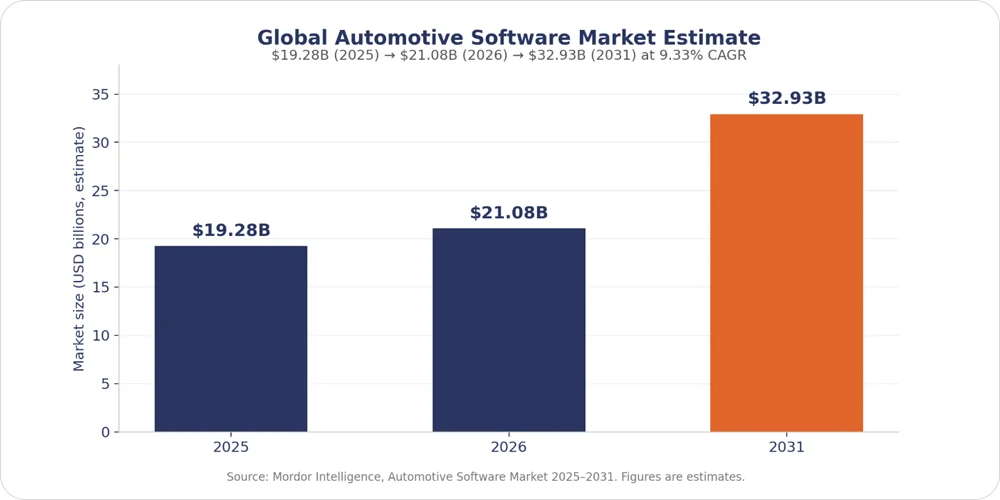
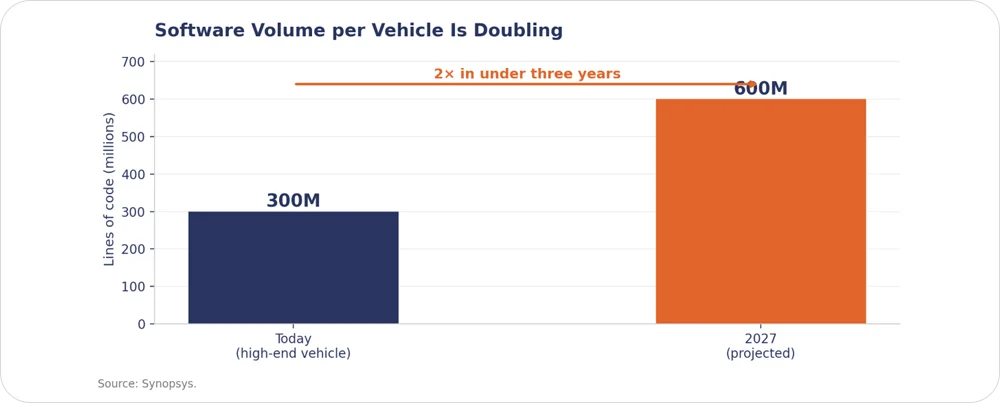
Mordor Intelligence estimates the global automotive software market at $19.28 billion in 2025, $21.08 billion in 2026, and $32.93 billion by 2031 — a 9.33% CAGR. Modern high-end vehicles contain upwards of 300 million lines of code, and Synopsys projects that figure to approach 600 million by 2027 as software-defined vehicle architectures mature.
The demand is structural. OEMs and Tier-1 suppliers are migrating from distributed ECU architectures to centralised, software-updatable platforms. Those platforms require CI/CD pipelines, OTA infrastructure, and functional-safety-compliant development practices that traditional automotive processes were never built to support at this scale. The pressure registers directly in developer behaviour. 58% of automotive software developers say recent software recalls significantly changed their development approach, and nearly 40% call those changes major (Design News / Keysight SDV Developer Survey, 2026).
$32.93B
Automotive software market by 2031, at a 9.33% CAGR (Mordor Intelligence estimate)
600M
Projected lines of code in a high-end vehicle by 2027 (Synopsys)
58%
Of developers changed their approach after recent software recalls (Design News / Keysight, 2026)
For CTOs steering automotive digital transformation programmes, the automotive software trends in 2026 concentrate around six engineering shifts.
TREND 01
The Software-Defined Vehicle Is Reshaping Automotive Software Trends in 2026
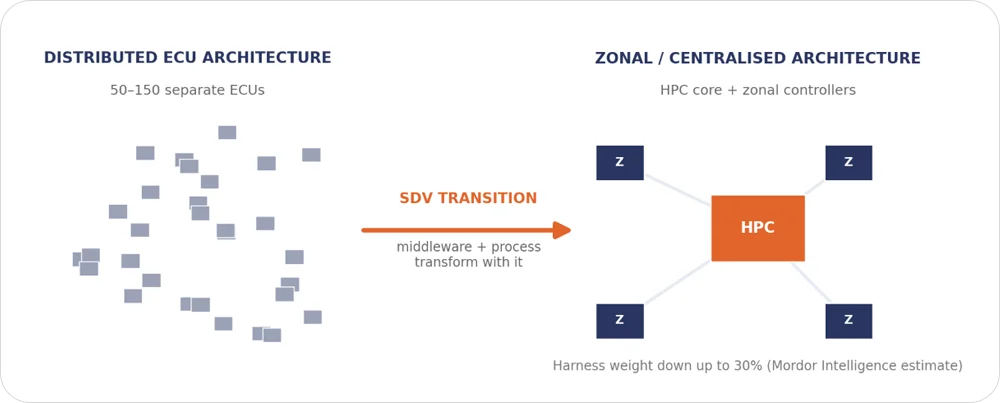
The SDV transition replaces distributed architectures of 50–150 separate ECUs per vehicle with centralised or zonal compute built around a High-Performance Computing (HPC) unit running core vehicle software. The change lands on three layers at once: hardware architecture, middleware, and development process. Teams that plan it as a hardware refresh underestimate the programme, because the middleware and process transformation carry most of the engineering cost and most of the schedule risk. Mordor Intelligence also flags a shortage of AUTOSAR-certified developers, which puts the staffing constraint on the same critical path as the architecture.
AUTOSAR Adaptive Platform has become the architecture-standard middleware for SDV software updateability. It runs on POSIX-compliant operating system interfaces and enables service-oriented communication through SOME/IP and DDS. That foundation lets vehicle functions ship, update, and scale as services instead of fixed firmware. The operational scale is already visible in production. OTA campaigns in production SDV programmes now deploy to millions of vehicles simultaneously. The update infrastructure behind them must be designed and tested at that scale from day one, because an OTA rollback across a deployed fleet is a recall event by another name.
An OTA rollback across a deployed fleet is a recall event by another name.
The commercial logic reinforces the engineering logic. Subscription-based functions-on-demand is opening post-sale software revenue streams for North American OEMs (Mordor Intelligence, 2025). Zonal architecture migration reduces wiring harness weight by up to 30% and frees compute capacity for new features (Mordor Intelligence estimate). Post-sale revenue depends entirely on software that updates safely in the field. That dependency makes OTA compliance an architectural requirement from the first design review. UN R156 governs the Software Update Management System at type-approval level. ISO 24089 defines the software update engineering processes beneath it. Neither can be added to a platform after the architecture is frozen.
ENGINEERING IMPLICATION
Post-sale software revenue and OTA compliance are the same architectural decision. A platform that cannot prove update integrity under UN R156 and ISO 24089 cannot monetise functions-on-demand, because the update channel is the product.
ENGINEERING CAPACITY THIS SHIFT DEMANDS
- AUTOSAR Adaptive implementation and domain-to-zonal architecture migration planning
- CI/CD pipeline design compatible with functional safety constraints
- OTA update management system development compliant with UN R156 and ISO 24089
- Cloud-vehicle integration layers on Azure Connected Vehicle Platform or AWS IoT FleetWise
TREND 02
ADAS Software Engineering Is the Fastest-Growing Capability Demand in the Automotive Stack
ADAS and safety systems lead the automotive software market by application revenue, according to Fortune Business Insights' market estimates. Regulation sets the floor under that demand. The EU General Safety Regulation (EU) 2019/2144 mandates intelligent speed assistance and event data recorders for all new road vehicles. For cars and vans, it additionally requires systems including emergency lane-keeping and advanced emergency braking. The compliance dates have passed, and the systems now ship as standard equipment in every European volume programme.
| EU General Safety Regulation (EU) 2019/2144 | Scope |
|
Intelligent speed assistance |
Mandatory — all new road vehicles |
|
Event data recorders |
Mandatory — all new road vehicles |
|
Emergency lane-keeping systems |
Additional requirement — cars and vans |
|
Advanced emergency braking |
Additional requirement — cars and vans |
The compute profile explains why ADAS reshapes vehicle architecture instead of bolting onto it. Sensor fusion algorithms for Level 2+ systems require 10–100 TOPS (tera-operations per second) of processing workload (AgamiSoft SDV Development Guide, 2026, practitioner reference). That workload exceeds traditional ECU microcontrollers by orders of magnitude, which makes centralised HPC architecture a precondition for advanced ADAS capability. Production programmes confirm the direction. CARIZON — the CARIAD and Horizon Robotics joint venture within Volkswagen Group — launched an AI-powered ADAS system at Auto Shanghai 2025, built on a high-performance system-on-chip. OEM-scale AI/ADAS integration now runs in production in the world's most competitive ADAS market.
WHY IT CHANGES THE ARCHITECTURE
10–100 TOPS of sensor fusion workload cannot run on a traditional ECU microcontroller. ADAS capability and centralised HPC architecture are one decision, not two — which is why ADAS demand pulls the whole SDV programme forward.
The engineering organisation carries a matching load. Sensor fusion, perception model training, and validation across camera, radar, and lidar stacks demand skill sets that most automotive software teams have had to build from scratch inside four years.
For automotive software product companies building ADAS-adjacent platforms, the engineering challenge extends beyond perception algorithms.
Cloud platforms, data pipelines, validation tooling, APIs, and operational analytics all require software teams that can work within safety-sensitive development environments.
Two engineering standards shape every ADAS architecture decision from the first requirements review. ISO 26262 defines functional safety for road-vehicle E/E systems, including the ASIL classification that determines development rigour per component. ISO/SAE 21434 defines cybersecurity engineering requirements across the development lifecycle. OEM procurement treats both as supplier qualification requirements. Evidence of compliant process is part of winning the contract, and retrofitting either standard into an existing codebase costs multiples of building with them from the start.
Evidence of a compliant process is part of winning the contract.
ISO 26262 and ISO/SAE 21434 as supplier qualification requirements
ENGINEERING CAPACITY THIS SHIFT DEMANDS
- ADAS software architecture and sensor fusion algorithm development
- ASIL classification and decomposition
- HIL/SIL test automation and ISO 26262 ASIL-B/C/D-compliant development processes
- Camera/radar/lidar stack integration
TREND 03
Connected Vehicle Platforms Require Cloud Engineering at Automotive Scale
Named investment marks where connected vehicle platforms are heading. Hyundai Motor Group unveiled Pleos, its end-to-end mobility software platform, in March 2025 — designed to support autonomous movement and smart device management across transportation modes. The major cloud providers have built dedicated automotive offerings around the same demand: Azure Connected Vehicle Platform (Microsoft), AWS IoT FleetWise (Amazon), and Google Cloud Automotive. Platform choice at this layer sets the integration surface for a decade of vehicle programmes, which raises the cost of a wrong first decision.
The engineering problems underneath a connected vehicle platform are concrete:



This work rewards platform-specific cloud engineering depth. Azure-native cloud architecture for connected systems covers the ingestion, streaming, and integration patterns that fleet-scale telemetry depends on. The same architectural discipline transfers directly to mobility SaaS platforms integrating vehicle data from heterogeneous fleets. Fleet management vendors, EV charging platform operators, and mobility-as-a-service companies face the identical ingestion and governance problem, one vehicle brand removed.
ENGINEERING CAPACITY THIS SHIFT DEMANDS
- Real-time vehicle telemetry data pipelines and fleet data lake architecture
- V2X middleware development and edge-cloud hybrid architecture
- Azure or AWS IoT integration
- Digital twin implementation for vehicle state
Automotive software product companies partnering with Softwarium gain access to distributed engineers with experience in regulated software delivery, cloud-native architecture, mobile platform engineering, systems integration, and SDET-led quality assurance for regulated software in complex software environments.
Scaling Your Automotive or Mobility Software Platform?
TREND 04
EV Growth Is Creating a Distinct Software Engineering Category
Electric vehicles form the fastest-growing segment of the automotive software market, driven by EV adoption, battery management software demand, and government incentive programmes across major markets (Mordor Intelligence, 2025). China's trajectory shows the scale. Jabil cites an industry estimate of the Chinese SDV market growing from $18.2 billion in 2025 to $69.5 billion by 2031 (Jabil/industry estimate). EV-led programmes account for much of that software demand.
Several of these categories sit outside embedded automotive engineering entirely. EV fleet platforms, charging network software, telemetry pipelines, battery analytics, and driver-facing mobility applications are cloud, data, and mobile engineering problems attached to vehicle hardware. Platform architecture and data governance are the constraints in that case.
EV software has hardened into an engineering category with its own stack:
- Battery management systems (BMS) — cell balancing, charge control, and safety limits.
- Energy and range models — optimisation and prediction that turn battery state into information a driver can act on.
- Charging integration — OCPP 1.6/2.0 protocols connecting vehicles, charge points, and network operators.
- Over-the-air BMS calibration — tuning battery behaviour across a deployed fleet without a service visit.
- Thermal and regen control — software sitting directly in the safety-relevant path.
- Vehicle-to-Grid (V2G) — bidirectional energy flow, turning the vehicle into a grid asset with its own protocol, billing, and scheduling logic.
Incentive conditions shift underneath this stack faster than the engineering does. Confirm the status of any national EV incentive programme before it enters a business case, because provisions change between budget cycles while software roadmaps run for years.
Fleet electrification multiplies each requirement. Depot operators need telematics integration across mixed fleets, charging schedule optimisation across depot and public infrastructure, and battery state-of-health monitoring feeding lifecycle and residual-value decisions. A fleet EV platform is simultaneously an energy management system, a logistics optimiser, and a battery analytics product — three engineering disciplines carried by one roadmap.
ENGINEERING CAPACITY THIS SHIFT DEMANDS
- BMS software engineering and EV energy management platform development
- OCPP integration, V2G, and smart charging software
- Real-time range and charging optimisation
- Fleet EV telemetry data pipelines
TREND 05
Automotive Cybersecurity Has Become a Type-Approval Engineering Requirement
UN Regulation No. 155 makes cybersecurity a market-entry requirement in regulated markets. OEMs must implement a Cybersecurity Management System (CSMS) and demonstrate it at type approval — vehicles without that approval cannot be sold in those markets (UNECE). UN Regulation No. 156 applies the same type-approval mechanism to software updates, mandating a Software Update Management System (SUMS) for OTA compliance. Two engineering standards operationalise the regulations. ISO/SAE 21434 defines cybersecurity engineering requirements for road-vehicle E/E systems throughout the development lifecycle. ISO 24089 defines the software update engineering processes that complement UN R156 at the engineering level.
| Instrument | What it governs |
|
UN R155 |
Cybersecurity Management System (CSMS) — type-approval regulation. No approval, no sale in regulated markets. |
|
UN R156 |
Software Update Management System (SUMS) — type-approval regulation for OTA compliance. |
|
ISO/SAE 21434 |
Cybersecurity engineering requirements for road-vehicle E/E systems across the lifecycle. |
|
ISO 24089 |
Software update engineering for road vehicles — the engineering standard beneath UN R156. |
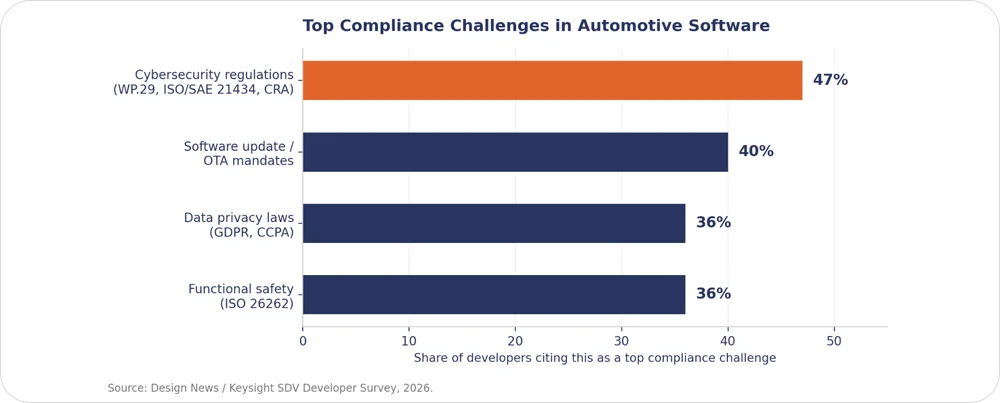
Developers rank this pressure above every other compliance category. 47% of automotive software developers cite cybersecurity regulations as their top compliance challenge, naming WP.29, ISO/SAE 21434, and the Cyber Resilience Act. OTA mandates follow at 40% and functional safety standards at 36% (Design News / Keysight SDV Developer Survey, 2026).
The threat data justifies the ranking. VicOne's Shifting Gears 2025 automotive cybersecurity report counts 530 automotive-related CVEs published in 2024, nearly double the 2019 total. The same report identifies onboard systems, cloud infrastructure, and supply-chain/third-party integrations as the most exposed threat domains in the SDV ecosystem.
530 automotive CVEs published in 2024 — nearly double the 2019 total.
The engineering consequence reaches every layer of the vehicle software stack. A CSMS requires threat analysis and risk assessment (TARA) embedded in the development process, with evidence trails an approval authority can audit. Secure OTA architecture must prove update integrity end to end. In-vehicle networks need segmentation so a compromised infotainment domain cannot reach braking or steering. Hardware security module integration anchors key management in silicon rather than software. Penetration testing has to run against vehicle interfaces, beyond the backend that serves them.
ENGINEERING CAPACITY THIS SHIFT DEMANDS
- CSMS implementation per ISO/SAE 21434 and TARA tooling
- Secure OTA update architecture per UN R156 and ISO 24089
- In-vehicle network segmentation and HSM integration
- Penetration testing for automotive systems
TREND 06
ISO 26262 Compliance Requires Traceable Engineering Process
Recalls changed how automotive software gets built. 58% of developers report that recent software recalls significantly altered their development approach — and for nearly 40%, the changes were major (Design News / Keysight SDV Developer Survey, 2026). The SDV transition raises the stakes on that shift. With upwards of 300 million lines of code in a high-end vehicle (Synopsys), delivering to ISO 26262 ASIL requirements through traditional waterfall processes collides with competitive development timelines. A four-year release cycle cannot absorb continuous software change, and the market no longer grants one. Feature parity now gets judged against OEMs shipping software updates quarterly.
The industry response is automotive-adapted CI/CD. Continuous integration pipelines run automated MISRA C/C++ static analysis on every commit. HIL test automation moves hardware-dependent validation into the pipeline instead of a late test phase. Safety case management tooling keeps the argument for safety synchronised with the code it describes. AUTOSAR-compliant build systems keep platform conformance continuously verifiable. The unifying property is traceability: every requirement, every ASIL classification, and every test result linked in an evidence chain that survives an audit.
An OEM procurement team scores a supplier's engineering process against ASPICE capability levels before awarding work. Clean code alone earns no score.
Automotive SPICE (ASPICE) defines the process capability maturity OEMs assess in their software suppliers. It operates as a supplier qualification requirement rather than a regulatory type-approval mandate. Teams already practising regulated software delivery carry a structural advantage into ASPICE assessment. Process evidence, traceability, and independent verification are standing requirements in aerospace and other safety-critical domains, and the habits transfer.
ENGINEERING CAPACITY THIS SHIFT DEMANDS
- ISO 26262-aware CI/CD pipeline design
- MISRA C/C++ static analysis integration (Polyspace, PC-lint, LDRA)
- HIL/SIL test automation and AUTOSAR-compliant build systems
- Safety case management and ASPICE process documentation
THE TAKEAWAY
The Engineering Constraint Behind All Six Trends
The six trends express one structural demand. Automotive software product companies and mobility technology vendors need engineering capacity that combines delivery velocity with compliance discipline. The automotive market enforces that discipline through type approval and through procurement, and neither route accepts speed without evidence. SDV architecture, ADAS compute, connected platforms, EV software, UN R155/R156 compliance, and ASPICE-assessed process draw on one scarce capability: engineers who ship fast inside a traceable, auditable process. Hiring that capability at pace is the constraint most automotive software roadmaps hit in 2026. The talent exists in adjacent regulated domains — aerospace, industrial control, clinical systems — where traceable process and safety-critical delivery are the daily standard. The gap between organisations delivering at that intersection and those still running traditional automotive development processes widens with every product cycle. Automotive digital transformation budgets in 2026 are moving toward the teams that close it. Otherwise, the compliance backlog sets the release schedule.
Delivery velocity inside a traceable, auditable process = the capability every one of the six shifts depends on. Softwarium's engineers bring it from aerospace, industrial, and other regulated software environments.
Discuss engineering capacity for regulated automotive and mobility software
Source List
-
Mordor Intelligence — Automotive Software Market 2025–2031 (market estimate; zonal harness weight; functions-on-demand; AUTOSAR developer shortage)
https://www.mordorintelligence.com/industry-reports/global-automotive-software-market -
Fortune Business Insights — Automotive Software Market (ADAS leading application segment by revenue)
https://www.fortunebusinessinsights.com/automotive-software-market-110028 -
Synopsys — vehicle lines of code (~300M today, ~600M by 2027)
https://www.synopsys.com/automotive.html -
Design News / Keysight — SDV Developer Survey 2026 (recall impact; compliance challenges)
https://www.designnews.com/automotive-engineering/why-software-defined-vehicles-are-the-ultimate-test-for-automakers -
Jabil — The Software-Defined Vehicle (China SDV estimate)
https://www.jabil.com/blog/software-defined-vehicle.html -
AgamiSoft — SDV Development Guide 2026 (ADAS Level 2+ 10–100 TOPS; practitioner reference)
https://agamisoft.com/software-defined-vehicles-development-guide-2026 -
VicOne — Shifting Gears: 2025 Automotive Cybersecurity Report (530 CVEs in 2024; threat domains)
https://vicone.com/reports/2025-automotive-cybersecurity-report -
ISO 26262 — Road vehicles: functional safety
https://www.iso.org/standard/68383.html -
ISO/SAE 21434 — Road vehicles: cybersecurity engineering
https://www.iso.org/standard/70918.html -
ISO 24089 — Road vehicles: software update engineering
https://www.iso.org/standard/77796.html -
UNECE — UN R155 (CSMS) and UN R156 (SUMS)
https://unece.org/transport/road-transport/vehicle-regulations-wp29/regulatory-framework/cyberSecurity -
AUTOSAR — Adaptive and Classic Platform
https://www.autosar.org -
MISRA — MISRA C:2012 / MISRA C++:2023
https://misra.org.uk -
Automotive SPICE — Process Assessment Model (intacs / VDA QMC)
https://www.automotivespice.com -
European Commission — General Safety Regulation (EU) 2019/2144
https://eur-lex.europa.eu