
Digital Transformation
in Real Estate:
6 PropTech Trends Every CTO Should Act On in 2026

Real Estate Proptech Digitalisation Trends
The global PropTech market reached $53.24 billion in 2026. By 2031, Mordor Intelligence projects it crossing $120 billion — a 17.79% compound annual growth rate built not on optimism, but on structural necessity. Investor pressure for data-led risk models, mandatory ESG reporting frameworks, and tenant expectations for digital-first experiences have made technology adoption a core operational requirement across every real estate category.
PwC and the Urban Land Institute documented this shift: AI has moved from experimentation to active adoption across the built environment. Real estate is now being pulled forward by forces well outside its own decision-making cycle.
Below is a breakdown of the six PropTech trends defining engineering roadmaps in 2026, and what each one actually requires to ship.
Global PropTech Market Growth 2026–2031
| Year | Market Size | CAGR | Key Milestone | Source |
|
2026 |
$53.24B |
17.79% |
IoT: 40.88% share |
Mordor Intelligence |
|
2027 |
~$62.7B |
17.79% |
AI leasing: +85% conversion |
Mordor Intelligence |
|
2028 |
~$73.9B |
17.79% |
Digital twins: 23.05% CAGR |
Mordor Intelligence |
|
2029 |
~$87.0B |
17.79% |
58% transactions digital |
Global Growth Insights |
|
2030 |
~$102.5B |
17.79% |
72%+ portfolios smart-enabled |
Global Growth Insights |
|
2031 |
$120.74B |
17.79% |
ESG compliance: regulatory mandate |
Mordor Intelligence |
Source: Mordor Intelligence, Global Growth Insights, Fortune Business Insights
6 PropTech Trends at a Glance
| # | Trend | Key Stat / Driver | Engineering Focus |
|
01 |
AI-Powered Property Intelligence |
85% leasing conversion uplift |
Azure ML · MLflow · BERT / spaCyAzure ML · MLflow · BERT / spaCy |
|
02 |
Smart Buildings & IoT at Portfolio Scale |
30% opex reduction |
IoT pipelines · Edge compute · Digital twin arch |
|
03 |
Legacy Platform Modernisation |
Yardi / MRI / AppFolio integration |
Event-driven · API-first · Microservices wrappers |
|
04 |
Real Estate Data & Transaction Intelligence |
Real-time risk + demand analytics |
Data lake · Doc intelligence · API-first data products |
|
05 |
ESG Compliance Engineering |
Local Law 97 · EU Taxonomy · SFDR |
Carbon accounting · IoT monitoring · Audit pipelines |
|
06 |
Digital Transactions & PropTech-FinTech |
58% transactions now digital |
Smart contracts · Fraud ML · Escrow API integrations |
Trend 1:
AI-Powered Property Intelligence Is the New Competitive Baseline
According to Mordor Intelligence, AI-driven leasing engines now improve lead-to-lease conversions by 85% — a figure that repositions AI from competitive advantage to table stake for any platform operating in residential or commercial leasing.
The more significant shift is from static automated valuation models to real-time risk analysis. Coherent Market Insights' 2026 research documents AI operating as a continuous analytics layer: processing demand forecasting, tenant behavior, and market movement simultaneously. For portfolio managers, that means pricing decisions running on live data, not last quarter's comps.
Building AI through the property lifecycle, instead of bolting it onto an existing platform as a module, requires:
-
ML pipelines for property valuation models;
-
NLP tooling for lease document analysis;
-
recommendation engines;
-
and predictive churn modeling for tenant retention programs.
The distinction means a lot architecturally: a feature can be removed; an infrastructure layer cannot.
Engineering Stack Reference: AI-Powered Property Intelligence
| Tool / Framework | Function | Production Use Case |
|
Azure ML |
Model training and deployment at scale |
Property valuation models, occupancy forecasting |
|
MLflow |
Experiment tracking and model versioning |
Model lifecycle management across environments |
|
BERT / spaCy |
Natural language processing |
Lease clause analysis, maintenance request triage |
|
Predictive churn models |
Tenant retention analytics |
Early warning systems for vacancy risk |
CTOs are asking how deep AI runs through the data model and whether their team has the ML engineering capacity to build, version, and maintain what the product roadmap demands over the next 12 months. Teams that answered that question honestly in 2024 are now shipping faster than those that deferred it.
Trend 2:
Smart Building Technology Is No Longer a Premium Feature — It's a Portfolio Management Tool
IoT-connected building infrastructure accounted for 40.88% of the total PropTech market in 2025, per Mordor Intelligence. Global Growth Insights reports that over 72% of US commercial portfolios now operate with smart building technology in place — which means the question for most CTOs is no longer whether to build for it, but how deep the integration needs to go.
Commercial real estate owners deploying integrated building management and analytics platforms cut operating costs by up to 30%, according to Mordor Intelligence. Automated HVAC optimization, predictive maintenance alerts, occupancy-based energy management, and real-time facilities dashboards drive that reduction by replacing manual inspection cycles with sensor-driven decision-making.
Digital twins are the fastest-growing segment of this market at a 23.05% CAGR (Mordor Intelligence). A digital twin gives building operators a live virtual model of a physical asset: sensor readings, maintenance events, and energy consumption mapped continuously. For portfolio managers overseeing multiple properties, the operational shift is from reactive to genuinely preventive.
How Digital Twins Work
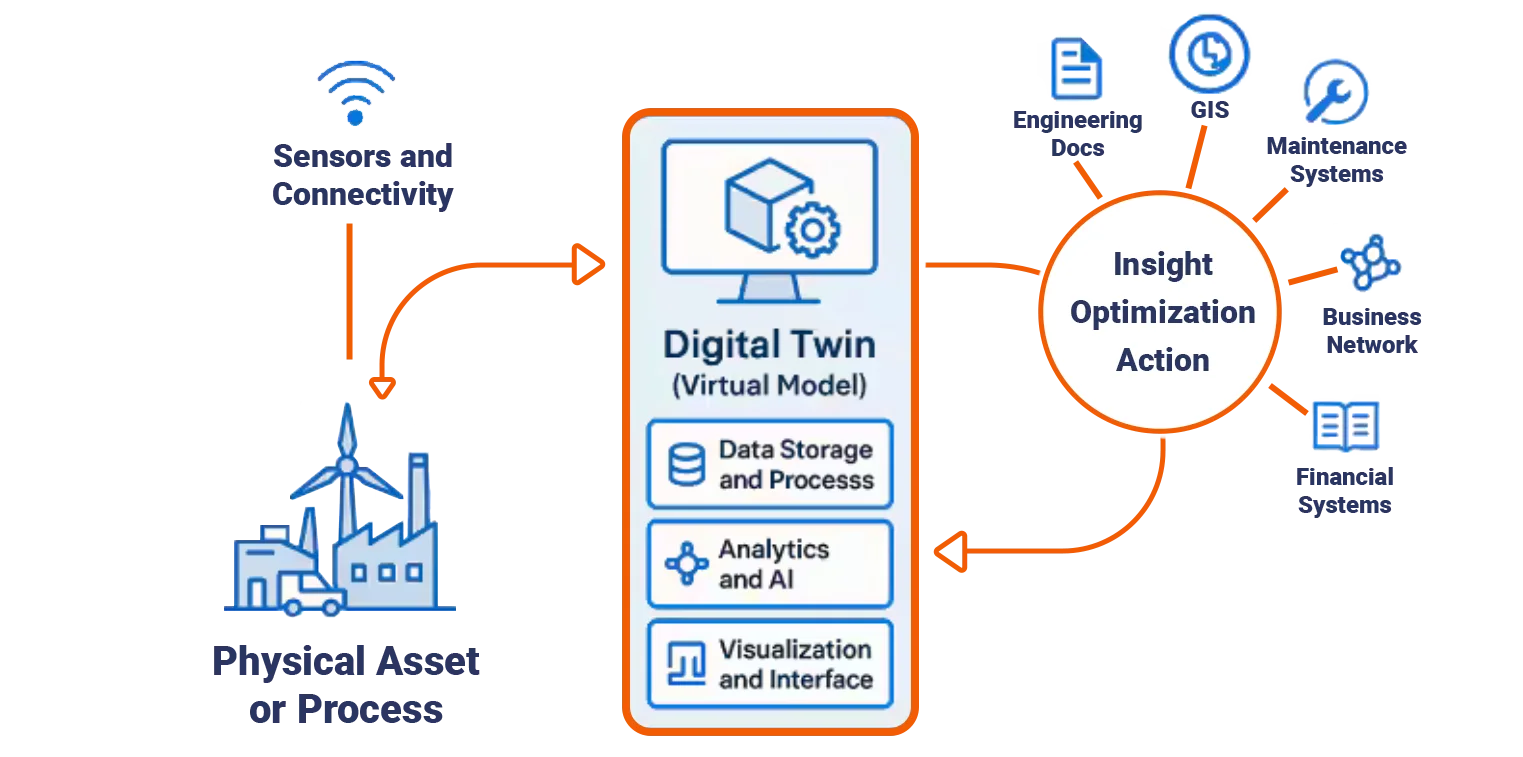
The engineering requirements at this layer include IoT sensor data pipelines handling high-frequency telemetry without data loss, edge computing nodes processing locally before transmitting upstream, and digital twin architecture that integrates with existing BMS infrastructure. That integration point is where most projects get complicated. Legacy building management systems were not designed with API-first data sharing in mind, and bridging them to a modern analytics layer is a specific engineering work.
Trend 3:
Legacy Platform Problem Is a Product Architecture Problem
Most established real estate operations run on Yardi, MRI Software, or AppFolio. These platforms were designed before cloud-native architecture was the default, before ML pipelines were a product requirement, and before IoT data volumes were a consideration. That is the starting point for most PropTech integration work in 2026.
Treating this as a software selection problem is wrong. Replacing Yardi or MRI Software at portfolio scale is a multi-year program that most organizations cannot absorb without operational disruption. The productive architecture pattern is a modern capability layer built alongside the existing system: event-driven integrations, API-first middleware, and microservices wrappers that expose clean interfaces to new AI or IoT capabilities without rewriting the core platform.
Data architecture is the other half of the problem. Legacy property management platforms store data in schemas designed for their own reporting requirements. Building a unified data warehouse or lake — pulling from Yardi, MRI Software, AppFolio, and modern sources like IoT feeds or market data APIs — requires deliberate design decisions made early. Getting the data model wrong at this stage carries compounding costs: every AI feature, every analytics dashboard, and every ESG reporting pipeline built on top of it inherits the same architectural debt.
PropTech companies partnering with Softwarium gain access to distributed engineers specialising in Azure-native cloud architecture, ML engineering for property analytics, IoT platform development, and SDET-led quality assurance for data-intensive real estate systems.
Scaling Your PropTech Platform?
Trend 4:
Real Estate Data Is the Asset. The Platform That Owns It, Wins.
Data-driven PropTech platforms are outshining intuition-led competitors on transaction speed, risk accuracy, and market positioning.
Coherent Market Insights documents the practical output: AI-driven analytics now deliver real-time risk analysis, demand forecasting, and market intelligence at portfolio scale. For portfolio managers, that translates to pricing decisions built on live data, and risk models that update as market conditions change.
Softwarium's work with ProTitleUSA, a Pennsylvania-based title search company, shows what real estate data engineering delivers in practice: a digitised pipeline that processes title and deed data faster and with higher accuracy than the manual workflows it replaced.
The engineering requirements diverge from general product development. Property data platforms need document intelligence — ML-based extraction from deeds, leases, and title records — automated ingestion pipelines that handle data quality issues at the source, and a real estate data analytics platform architecture that makes the asset usable across analytics, compliance, and product functions. API-first data products mean the platform's intelligence reaches every part of the business, beyond the reporting team.
Trend 5:
ESG Reporting Is Now an Engineering Requirement
Four regulatory frameworks are actively shaping engineering roadmaps across PropTech right now. Portfolios that cannot produce audit-grade emissions data carry regulatory and reputational risk that institutional capital is pricing in at the due diligence stage — not after.
| Framework | Region | Active since | Engineering implication |
|
Local Law 97 |
New York City |
2024 (penalties phase-in) |
Real-time energy monitoring per building + automated penalty risk calculation |
|
EU Taxonomy |
European Union |
2022 (full reporting 2024+) |
Sustainable activity classification engine; portfolio-level data aggregation |
|
SFDR |
European Union |
2021 (Level 2 from 2023) |
Automated ESG disclosure pipeline; fund-level carbon footprint reporting |
|
EnEfG |
Germany |
2023 |
Waste-heat reuse tracking for data centres; IoT thermal sensor integration |
Compliance Module vs. Product Layer
PropTech platforms that embed ESG at the product layer win institutional clients and REITs that need auditable, continuous ESG data. Platforms that treat it as a bolt-on compliance module lose those clients to the ones that didn’t.

Compliance module approach
- Added at contract renewal
- Separate dashboard, not integrated
- Annual report output only
- Loses institutional clients to competitors who built it natively

Product layer approach
- Audit-grade data provenance from day one
- Real-time monitoring integrated with IoT and smart meter feeds
- Automated pipeline per regulatory framework (LL97, EU Taxonomy, SFDR)
- Wins and retains institutional clients and REITs
What the Engineering Actually Requires
Building this as a product feature rather than a professional services engagement is where the long-term institutional client relationship is won. The infrastructure it demands:




Trend 6:
The Transaction Stack Is Being Rebuilt From the Ground Up
Nearly 58% of real estate transactions now use some form of digital processing.
Title, escrow, mortgage origination, and compliance workflows are migrating off paper and legacy systems.
What’s Actually Changing Layer by Layer
The convergence of PropTech and FinTech is moving through the core transaction workflow. Each layer of the stack is being rebuilt, and the platforms that own the workflow own the client relationship.
| Stack layer | Legacy state | Digital-native state | Engineering requirement |
|
Title & deed processing |
Manual search, paper records, 5–10 day turnaround |
ML-based extraction, automated title reports, same-day output |
Document intelligence pipeline, deed/title ML models, API to escrow |
|
Mortgage origination |
Broker-led, document-heavy, 30–60 day close |
Digital origination, automated underwriting, real-time decisioning |
Underwriting ML models, secure document ingestion, credit API integrations |
|
Lease lifecycle management |
PDF contracts, manual renewal tracking, missed escalations |
Smart contracts handling renewals, rent escalation, compliance checkpoints |
Smart contract development, event-driven lease lifecycle architecture |
|
Cross-border compliance |
Manual legal review per jurisdiction, slow and error-prone |
Automated compliance checks, jurisdiction-aware transaction routing |
Compliance rules engine, regulatory API integrations, audit logging |
|
Fraud detection |
Rule-based flags, high false-positive rate, late review |
ML models trained on transaction patterns, real-time scoring |
Fraud detection ML at regulatory sensitivity thresholds, real-time inference |
Sources: Global Growth Insights PropTech Market 2026–2035; Mordor Intelligence PropTech Market 2026–2031
On blockchain in PropTech
The practical near-term application is contractual compliance and audit trails: renewal triggers, rent escalation clauses, cross-border KYC. It is a workflow automation problem that smart contracts solve today. The tokenisation narrative (fractional ownership, on-chain REITs) is real but at an earlier commercial stage. CTOs serving institutional real estate clients know the difference, and the engineering brief should reflect it.
What the Engineering Actually Needs
The engineering bar at this layer is higher than property analytics. Data integrity, audit logging, and fraud detection all need to meet regulatory thresholds. Teams building this infrastructure now are setting the operational baseline for how the transaction stack functions over the next decade.





The Gap Is Widening. Engineering Capacity Is the Variable.
Six trends share one underlying demand: PropTech product teams need engineering capacity that ships AI features, IoT infrastructure, and data platforms at the speed the market now moves. The distance between digital-native PropTech and everyone else is now growing quarterly.
The teams closing this gap are the ones with the engineering capacity to execute on them.
|
Softwarium builds and scales engineering teams for PropTech companies.
|
Explore our engagement models → |