
contact us

Five Teams Building the Data Layer Modern Real Estate Needs

PropTech Startups to Watch in 2026
Ready to get started?

PropTech Startups to Watch in 2026: 5 Companies Rebuilding How Real Estate Runs on Software

Softwarium

Real estate runs on a mountain of paperwork, and a fair amount of it still lives on spreadsheets, PDFs, and phone calls. One commercial building produces decades of records, utility bills, lease documents, inspection reports, tax assessments, maintenance logs, and a lot of that sits in formats software struggles to read. For years, the industry treated that as normal. The companies in this roundup treat it as the opening.

Investors are paying attention now . Proptech investment topped $1 billion in a single month in early 2026, and funding for AI-native real estate technology grew sharply over the prior year (industry reporting). The PropTech startups 2026 below work on different corners of the problem: fund administration, resident and tenant communication, building autonomy, property tax appeals, and commercial real estate operations. They sell to different buyers, from institutional fund managers to individual homeowners. The thread running through all of them is the same engineering challenge: taking the unstructured, deeply regulated information real estate runs on, and turning it into software people can act on with confidence.
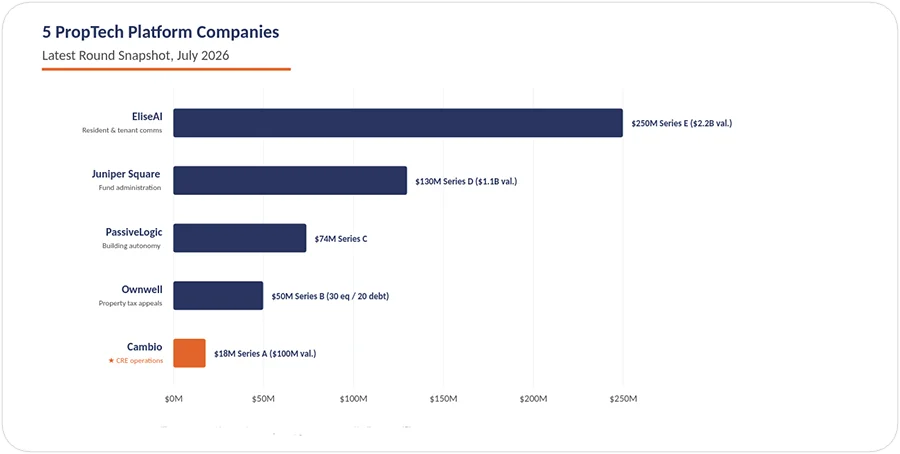
5 PropTech Platform Companies

The Roster

JUNIPER SQUARE

FUND ADMINISTRATION

$130M Series D, June 2025, at a $1.1B valuation.


Juniper Square is a system of record for private-markets fund managers, handling investor reporting, fund administration, and the operations behind roughly 2,000 fund entities. Its newest push is JunieAI, an AI layer built on top of that structured fund data to help general partners move faster on investor communications, document work, and reporting. The engineering advantage here is quiet but real: years of clean, structured private-markets data give an AI something reliable to reason over, which is harder than it sounds in a field full of bespoke fund structures.

ALISEAI

RESIDENT & TENANT COMMS

$250M Series E, August 2025, at a $2.2B valuation.


Founded in 2017 by Minna Song and Tony Stoyanov, EliseAI automates the constant back-and-forth of property management: leasing inquiries, tour scheduling, application processing, maintenance requests, and resident messaging, handled around the clock across chat, email, and voice. It reports powering close to 10% of the US apartment market and serving most of the largest residential operators.

One detail worth noting for engineers: EliseAI sits on top of the property management systems operators already run, reading availability and writing back appointments, which makes integration depth a core part of the product.

PASSIVELOGIC

BUILDING AUTONOMY

$74M Series C, September 2025; total funding above $125M.


PassiveLogic builds autonomous control software for buildings, backed by Prologis Ventures, Johnson Controls, and NVIDIA's venture arm. Its Hive platform pairs physics-informed AI with real-time digital twins to run heating, cooling, lighting, and logistics as one coordinated system rather than a set of isolated controllers. Having Johnson Controls, a building-systems incumbent, and Prologis, a major logistics landlord, on the cap table signals that the buyers who operate buildings at scale take this approach seriously.

OWNWELL

PROPERTY TAX APPEALS

$50M Series B, February 2026: $30M equity plus $20M debt.


Founded in 2020 in Austin, Ownwell helps property owners appeal over-assessed tax bills. It works on a contingency model, taking a share of the savings rather than an upfront fee, and reports processing more than a million appeals with an 86% success rate. Its newest product generates ready-to-file appeal packets for homeowners outside its core states, which puts the engineering challenge in plain view: property tax rules differ by jurisdiction, so the software has to encode deadlines, requirements, and evidence standards that change from county to county.

CAMBIO

CRE OPERATIONS

★ SPOTLIGHT

$18M Series A, January 2026, at a $100M valuation, led by Maverick Ventures.


Founded in 2022 by former institutional CRE operators Leia de Guzman and Stephanie Grayson, Cambio built an AI-native operations platform for commercial real estate. It reads the raw, unstructured data a building throws off, utility bills, assessments, PDFs, spreadsheets, and turns it into capital-planning, retrofit, and compliance decisions, with a strong focus on decarbonisation returns.

The spotlight below explains why it is such a demanding piece of software to build well.

★ Spotlight: Cambio and the Problem of Messy Building Data

A single commercial building produces an astonishing volume of unstructured information. Utility bills arrive as PDFs in a hundred different layouts. Condition assessments come as long-form reports. Lease terms, tax records, meter readings, and maintenance histories each live in their own format, their own system, their own filing cabinet. Working out which upgrades to fund, where the compliance gaps are, and where capital should go next has traditionally taken analysts months. Cambio gets through the same work in minutes: it ingests the raw data, reasons across it, and produces both capital strategies and compliance answers.


What makes this hard is scale and inconsistency, thousands of utility bills in formats that rarely match, all resolved into an answer investors will trust.


What building an answer investors trust actually takes:

  • Extraction that survives mess. Document pipelines that hold up against real-world inputs, not clean sample files.
  • Agentic workflows. Multi-step analysis that runs without a human at every turn, then knows when to stop.
  • Judgement about data. The sense to flag when the underlying inputs are too thin to support a confident answer.


Cambio's founders describe building the workflow end to end in an AI-native way rather than adding AI onto older tools, and that distinction carries real engineering weight. Retrofitting AI onto a rules-based system and designing around agentic reasoning from the start produce very different architectures.

Where the build-versus-buy line tends to fall:

  • Keep in-house: the domain reasoning and the customer-facing product, close to the people who understand real estate.
  • Open to partners: the document-ingestion pipelines, the integrations into the property and financial systems a client already runs, and the data infrastructure that keeps unstructured inputs queryable and current.

The Patterns Underneath

Set the five companies side by side and three engineering patterns run through all of them. Each marks a place where real estate software asks for more than a clean interface.


Unstructured data as the core problem

Unstructured data as the core problem

Cambio, Ownwell, and Juniper Square all live or die on their ability to turn real-world inputs, PDFs, assessments, utility bills, fund documents, into structured and queryable data. The document-extraction and data-pipeline engineering underneath is the actual product, rarely showing up in a demo. A platform is only as good as its handling of the file a customer sends.

Integration into fragmented systems

Integration into fragmented systems

EliseAI reads and writes across the property management systems that operators already run. Juniper Square connects to the accounting and reporting tools of private-markets funds. Real estate technology tends to sit on top of existing infrastructure instead of replacing it, so the depth and reliability of those integrations often decides how useful the product actually is.

Domain logic that changes by place and asset

Domain logic that changes by place and asset

Ownwell encodes property-tax rules that differ by jurisdiction. PassiveLogic models the physics of individual buildings. Cambio adapts to shifting regulations and asset types. These systems encode a lot of specific domain knowledge. Keeping that logic right as rules and conditions change takes ongoing engineering work.


What It Means for Engineering Leaders

The PropTech startups 2026 worth watching share one habit: they take the unstructured, fragmented, jurisdiction-specific information real estate runs on and turn it into software people trust enough to act on. Fund administration, resident communication, building autonomy, tax appeals, and commercial operations each demand serious data engineering, deep integration, and domain logic.

Softwarium builds dedicated development teams and co-managed engineering teams for product companies doing that work. Twenty-five years of software engineering delivery, European engineering micro-hubs, and a Center of Excellence in Poland stand behind it, along with document-management and data-platform experience that maps onto the ingestion, integration, and quality engineering the industry depends on.


Explore Softwarium's dedicated development team and IT staff augmentation services →

Read our full PropTech trends analysis →

Comments