AI Code Audit for Enterprise .NET Applications: Finding Risks Before They Reach Production

AI Code Audit for Enterprise .NET Applications.
AI Code Audit for Enterprise .NET Applications.
DORA's 2025 State of AI-assisted Software Development report, based on responses from nearly 5,000 technology professionals, found that nearly 90% use AI in their work. The research associated AI adoption with higher delivery throughput, while software delivery instability continued to rise. The findings point to a growing need for engineering controls that keep pace with faster code production.

Finding Risks Before They Reach Production
AI-assisted code is entering production .NET estates through tools such as GitHub Copilot, Cursor and Claude Code. For CTOs, the practical task is to identify where that code introduces security and maintenance risks. An AI code audit examines five areas: provenance, dependencies, secrets, injection paths and code duplication. Existing .NET tooling covers parts of each area, while repository-level review addresses the gaps.
AI-Generated Code Security Risks: What the Research Shows
Veracode's 2025 GenAI Code Security Report tested more than 100 language models across 80 coding tasks. Across all languages and tasks, 45% of generated results contained a detectable security vulnerability. The C# results fell within the 38%–45% range reported for Python, C# and JavaScript.
The study tested model output under controlled conditions. It did not measure the vulnerability rate of production .NET applications. Its findings nevertheless identify weaknesses that deserve attention during code review. Cross-site scripting (CWE-80) and log injection (CWE-117) were particularly weak categories, with failure rates of 86% and 88%, respectively. Larger models did not produce significantly more secure results.
Source: Veracode, 2025 GenAI Code Security Report
A separate dataset tracks vulnerabilities attributed to AI coding tools after disclosure. The Vibe Security Radar, developed by the Systems Software & Security Lab at Georgia Tech, monitors public vulnerability databases and investigates links between disclosed flaws and AI coding tools.
Infosecurity Magazine reported at least 35 CVEs attributed to AI-generated code in March 2026, following six in January and 15 in February. The researchers use evidence such as commit signatures to attribute vulnerabilities to coding tools. This approach has a clear limitation: commits without identifiable tool signatures can escape attribution.
Source: Infosecurity Magazine, March 26, 2026.
These studies examine different stages of software development. Veracode tests generated code, while the Vibe Security Radar tracks vulnerabilities that reach public advisories. Together, they support reviewing both the code produced by assistants and the development practices surrounding its adoption.
Audit AI-Generated Code in .NET: Five Layers
An enterprise .NET audit can examine five areas, combining automated checks with repository-level investigation.
Audit layer
What existing .NET tooling covers
What the audit adds
1. Provenance
Co-author trailers and commit metadata identify some AI-assisted commits
Risk-based review of repositories, folders and changes since AI tool adoption
2. Dependencies
NuGet audit identifies packages with known security advisories
Package provenance, publisher verification and necessity checks
3. Secrets
Secret scanners detect exposed credentials
Historical scanning, credential rotation and migration to managed identity
4. Injection
CodeQL and .NET analyzers detect supported vulnerability patterns
Data-flow investigation and business-logic security review
5. Duplication
Pull request review examines individual changes
Repository-wide identification and prioritization of duplicated logic




What the Audit Should Deliver
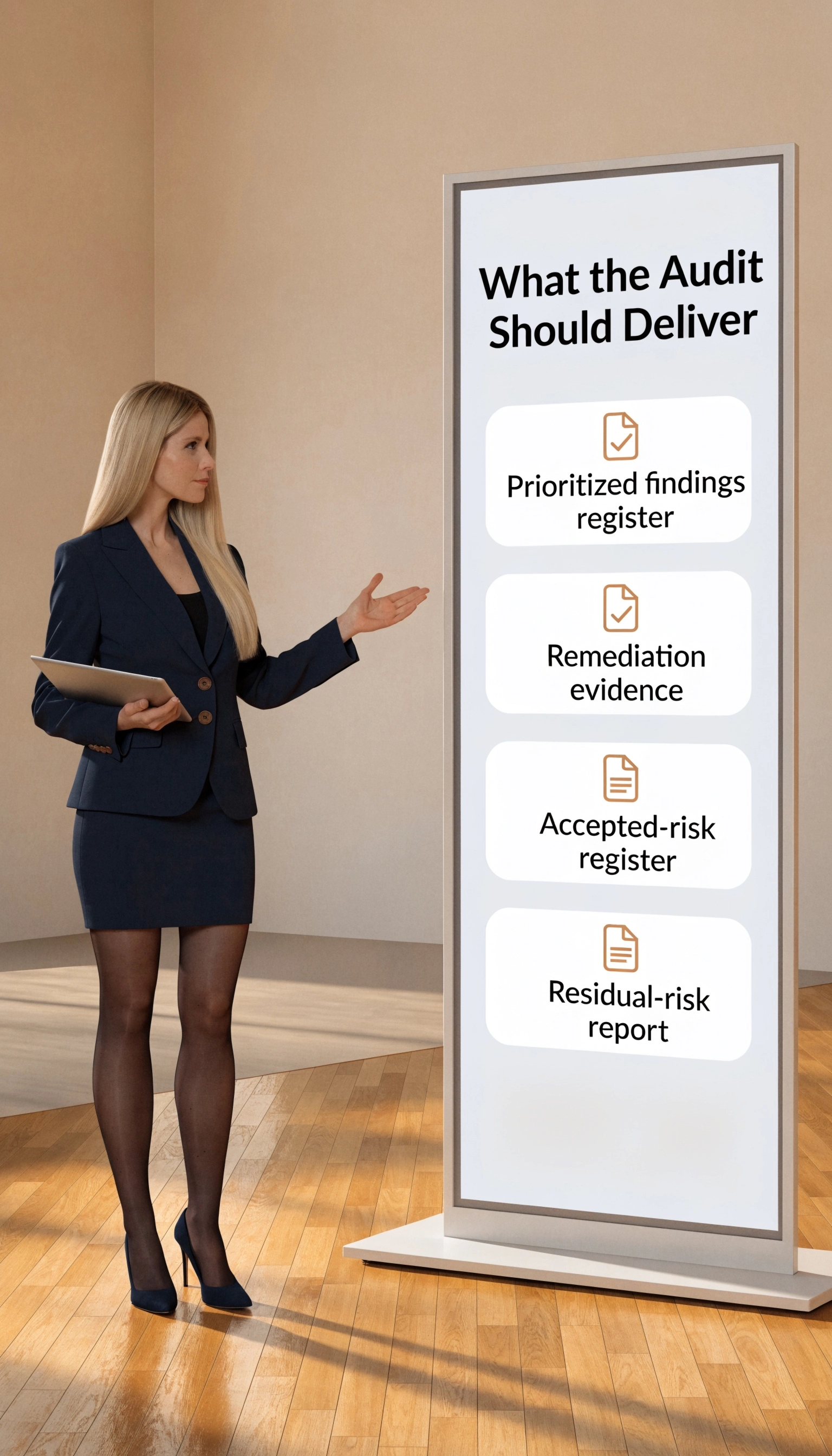
The audit should leave engineering leadership with a findings register that supports remediation, ownership and verification.
Four deliverables provide that foundation:
|
Prioritized findings register Affected repository or component, supporting evidence, severity, assigned owner and remediation deadline. |
Remediation evidence Test results, scan reports, code changes or other verification appropriate to the identified risk. |
|
|
Accepted-risk register Named approver, rationale, compensating controls and review date for findings that remain unresolved. |
Residual-risk report Coverage limitations, checks that were not performed, components outside the review scope and remaining manual-review requirements. |
These deliverables give CTOs a view of both identified vulnerabilities and the limitations of the audit itself.
What the Audit Should Deliver
The audit should leave engineering leadership with a findings register that supports remediation, ownership and verification.
Four deliverables provide that foundation:
Prioritized findings register
Affected repository or component, supporting evidence, severity, assigned owner and remediation deadline.
Remediation evidence
Test results, scan reports, code changes or other verification appropriate to the identified risk.
Accepted-risk register
Named approver, rationale, compensating controls and review date for findings that remain unresolved.
Residual-risk report
Coverage limitations, checks that were not performed, components outside the review scope and remaining manual-review requirements.
These deliverables give CTOs a view of both identified vulnerabilities and the limitations of the audit itself.

Keep the Audit Running After the First Pass
The audit findings should feed into development and release controls. Each layer has a corresponding practice that can be incorporated into the engineering pipeline.
- Dependencies: Enable NuGetAuditMode for all dependencies where supported, treat NU1903 and NU1904 as errors, and require review of new package references.
- Injection: Configure .NET analyzers, introduce build enforcement progressively and run CodeQL with a threat model appropriate to the application.
- Secrets: Run secret scanning on repository changes, scan historical commits and manage supported credentials through Azure Key Vault and managed identity.
- Provenance: Maintain visibility into AI coding tool adoption and require security review for changes to authentication, data access, input handling and external integrations.
- Duplication: Include repository-wide duplication analysis in periodic code-quality reviews and release assessments.
The pipeline should enforce controls consistently across human-written and AI-assisted contributions.
DORA's 2025 research describes AI as an amplifier of existing organizational practices. Teams with established review processes, automated build gates and reliable engineering platforms have mechanisms for applying those practices to a higher volume of code changes.

Building a Repeatable AI Code Audit Practice
An AI code audit gives engineering leaders a structured way to examine security exposure and maintainability across existing .NET repositories. Provenance establishes the review scope. Dependency and secret analysis identifies supply-chain and credential risks. Injection review examines vulnerable data flows. Duplication analysis identifies maintenance patterns that can leave security fixes incomplete.
The findings also provide a starting point for continuous engineering controls. Repository scanning, dependency policies, secret management, code analysis and security-focused pull request reviews keep the audit findings relevant as applications evolve.
Softwarium supports enterprise engineering through .NET development, cloud architecture, application modernization, cybersecurity software development and testing. Azure Certified Engineers are available through IT staff augmentation or dedicated development teams, working alongside client engineering leads.
Teams planning an AI code audit or strengthening existing .NET security controls can explore Softwarium's cybersecurity software development services or book a 30-minute consultation with Anna Moskalets, Head of Digital Enhancement, to discuss repository scope, technical priorities and the engineering work required.
FAQ
Is AI-generated C# code less secure?
Veracode's 2025 test of more than 100 language models found that 45% of generated results across all tested languages and tasks contained a detectable security vulnerability. C# results fell within the reported 38%–45% range for Python, C# and JavaScript. The study measures model output under test conditions, not the vulnerability rate of production .NET applications.
Does NuGet audit catch risky packages suggested by AI assistants?
NuGet audit identifies packages with known vulnerabilities from configured advisory sources during restore. It does not determine whether a package is unfamiliar, unnecessary or published by a trustworthy source. New package references still require review.
Does an AI code audit replace code review?
An audit identifies and prioritizes risks in an existing codebase. Code review, automated analysis and CI controls help prevent new changes, including AI-assisted contributions, from introducing similar problems. Human review remains necessary for business logic and authorization requirements that automated tools cannot fully evaluate.