EVENT RECAP:
UCX LONDON 2026
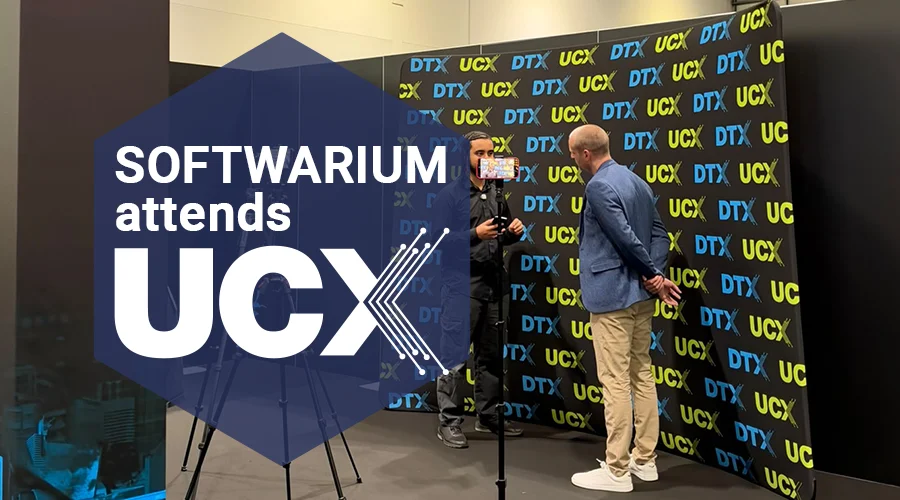
At UCX London the AI conversation centered on control and accountability
UCX London 2026 took place on 14–15 October 2026 at Excel London, co-located with the Digital Transformation EXPO (DTX). UCX is a UK event for unified communications, collaboration and customer experience technology, organized by Imago Techmedia. Anna Moskalets, Head of Sales EMEA at Softwarium, attended the show.
AI ran through the agenda on every stage Softwarium visited. The session titles set the tone: “AI, AI, Captain! Who’s really in control?”, “Outpaced: The reality of AI defence” and “Trust in agentic AI: When agents go rogue”. UCX’s own list of key themes named the underlying problem: “the implementation gap: deployment vs operationalisation”.
For engineering leaders, the sessions pointed to one practical conclusion. AI holds up in production when it has a named owner, a tested response plan, scoped access, rigorous testing and a stable team behind it.
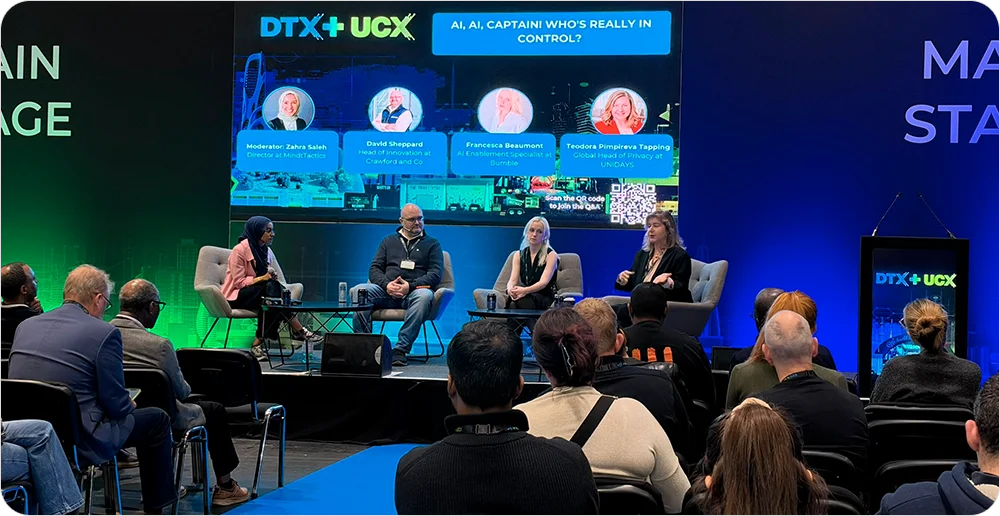
Main Stage, UCX London 2026: “AI, AI, Captain! Who’s really in control?” Left to right: Zahra Saleh, David Sheppard, Francesca Beaumont, Teodora Pimpireva Tapping.
1. Control over AI needs a named owner
On the Main Stage, Zahra Saleh, Director at MindTactics, moderated “AI, AI, Captain! Who’s really in control?” with David Sheppard, Head of Innovation at Crawford & Company, Francesca Beaumont, AI Enablement Specialist at Bumble, and Teodora Pimpireva Tapping, Global Head of Privacy at UNiDAYS.
The lineup itself said something about the topic. Control over AI touched innovation, AI enablement and privacy, and each of those roles had a seat on the panel.
In engineering terms, control starts with ownership. Every model or agent inside a product needs a named owner and a record of every change it makes. It also needs a rollback path that someone has tested before it is needed.
2. AI defence comes down to how a team responds
On the Risk & Resilience Stage, Egonna Bristol, Senior Information Security Analyst at RedCompass Labs, moderated “Outpaced: The reality of AI defence”, a panel of incident response and product specialists that included Aisosa Omere, Senior Product Designer at Asoro Automotive. One point from the panel stayed with the Softwarium team.
No one can predict every threat that AI brings. Every organization controls how it responds.
Response capacity gets built long before an incident. It depends on monitoring that flags unusual behavior early and on runbooks the team has already rehearsed. It also depends on engineers who know the codebase well enough to fix it under pressure.
The same stage covered the earlier links in that chain, with sessions on detection (“Into the unknown: Can you defend what you can’t detect?”) and on reporting to the board (“Reporting what matters: Cyber reporting that drives board action”).
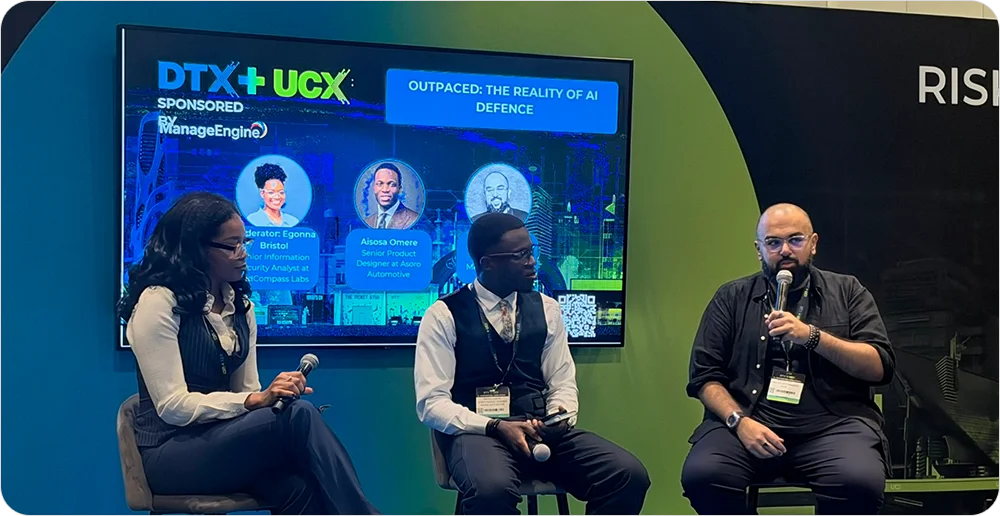
Risk & Resilience Stage: “Outpaced: The reality of AI defence”, moderated by Egonna Bristol (left), with Aisosa Omere (center).
3. AI agents need identities like any engineer
Later on the Risk & Resilience Stage, Olu Oshti, Solutions Architect EMEA at Teleport, presented “Undeterred: Identity security for AI” with a live demo of agentic classifiers, each result traced in an audit log.
The principle behind the demo is easy to state. An AI agent that touches infrastructure needs its own identity and permissions scoped to its task. Every action it takes belongs in an audit trail, the same standard a company applies to a new engineer. The panel that followed, “Trust in agentic AI: When agents go rogue”, focused on the failure case.
Code written by AI needs the same scrutiny. Veracode’s 2025 GenAI Code Security Report tested more than 100 large language models on 80 coding tasks and found security vulnerabilities in 45% of cases. Larger models did not perform significantly better than smaller ones.
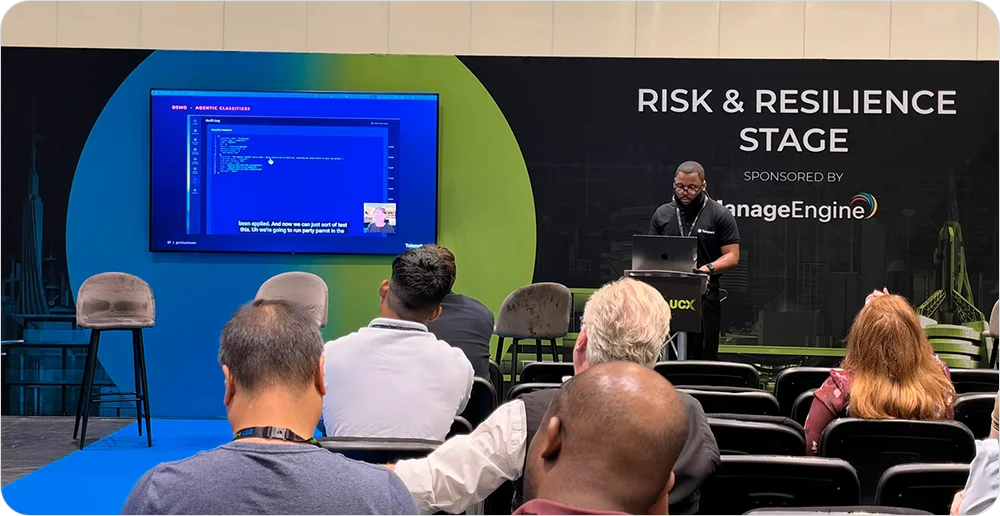
Olu Oshti of Teleport demonstrating agentic classifiers on the Risk & Resilience Stage.
4. Healthcare software raises the stakes for testing
On the Innovation Stage, Joseph Ballan, Senior Software & AI Engineer at Microsystem SE, spoke on “How can AI, software engineering & quantum computing revolutionise digital development? A use case from medicine.” His walkthrough of the software development life cycle singled out testing.
In medical software, a defect can reach a clinical decision. AI components make testing harder, because the same input does not always produce the same output. Test suites for AI features have to check acceptable ranges of behavior as well as exact results.
Softwarium’s engineering teams have delivered healthcare, clinical research and life science software, including a clinical decision support system for psychiatry.
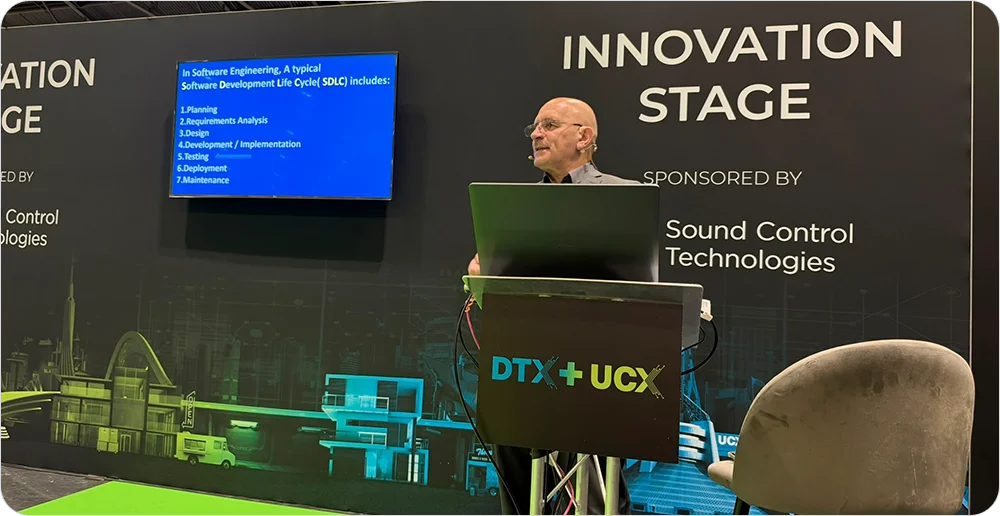
Joseph Ballan of Microsystem SE on the Innovation Stage.
5. The workforce question sits under every AI plan
Back on the Main Stage, “Build, Sustain, Retain: The Future Workforce Challenge” brought together Claire Lebarz, Chief Technology Officer at Malt, Phil Benson, Ecosystem Builder & Partner at Women’s Health Venture Builder, and Sunita Nicholas, Transformation Lead at Sisua. Steven Fuller, Director at The IN GROUP, moderated. UCX listed workforce, culture and talent strategy for technology change among its key themes for 2026.
Every takeaway in this recap depends on people. Ownership, incident response and testing all rely on engineers who know the system, and that knowledge leaves when they do.
Softwarium provides IT staff augmentation, dedicated development teams and co-managed engineering teams from European engineering micro-hubs and a Center of Excellence in Poland. One of Softwarium’s client partnerships, in supply chain and MRO, has run for more than seven years.
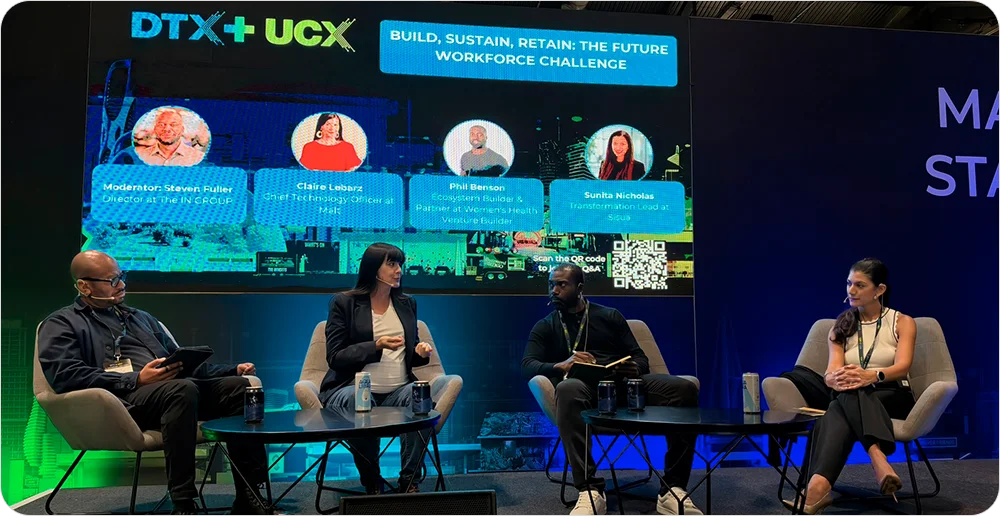
Main Stage: “Build, Sustain, Retain: The Future Workforce Challenge”. Left to right: Steven Fuller, Claire Lebarz, Phil Benson, Sunita Nicholas.
Thank you, UCX London!
Thank you to the UCX and DTX teams, and every speaker whose session appears in this recap. The next edition, UCX Manchester, takes place on 28–29 April 2027 as part of Manchester Tech Week. Looking forward to attend!
Continue the conversation from UCX London
Book a 30-minute call with Anna Moskalets, Head of Sales EMEA, to discuss engineering capacity for your AI roadmap.