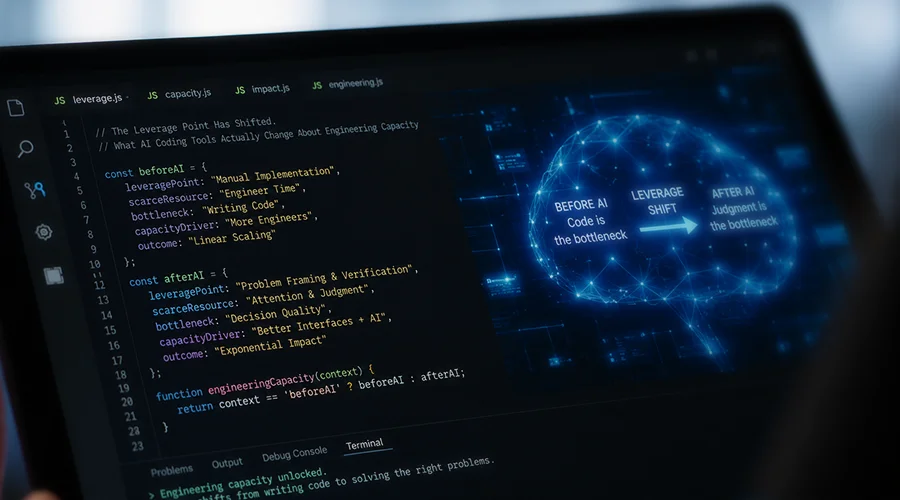
The Leverage Point Has Shifted.
What AI Coding Tools Actually Change About Engineering Capacity
AI Made Coding Faster. Why Senior Engineers Matter More
Your team shipped more code last quarter than in any quarter before it. Deployment frequency is up, but so is the incident count. Senior engineers now spend their time in review queues, correcting output they did not write. The board wants to know whether headcount is still right-sized, and the honest answer is more complicated than the productivity dashboard suggests.
AI tools shifted the leverage point in software development from rollout to the decisions that govern execution:
- what to build
- how to structure it
- which domain constraints apply
- and whether the result will hold at production scale
Two consecutive DORA reports found a negative relationship between AI adoption and delivery stability. The deployment layer got faster. The decision layer did not. What follows is what that gap costs, and how engineering leaders should sequence their response.
What The Tools Changed
A controlled study conducted by GitHub found developers completed coding tasks 55% faster with Copilot active; vendor research, and worth reading as such, but consistent with what most teams observe.
DORA's 2025 State of DevOps Report found AI adoption positively associated with software delivery throughput, a reversal from its 2024 finding.
Adoption is close to universal: Stack Overflow's 2025 Developer Survey, with more than 49,000 respondents across 177 countries, found 84% of developers using or planning to use AI tools, and 51% using them daily.
At the system level, that speed means three things: more work is arriving at decision and review points, faster than before, from more directions.
Alongside individual productivity gains, the 2024 DORA report estimated a 7.2% reduction in rollout stability and a 1.5% decrease in throughput correlated with AI adoption, with 39% of respondents reporting little or no trust in AI-generated code. DORA 2025 found the throughput drag had reversed but the stability relationship had not.
AI accelerates software development, but that acceleration can expose weaknesses downstream.
DORA, 2025 State of DevOps Report
AI accelerates the writing of code. It does not accelerate the testing, review, and release infrastructure that absorbs code safely. Teams that adopted the tools without strengthening those structures shipped more and stabilized less.
The code itself shows the strain. GitClear's 2025 analysis of 211 million changed lines from 2020 to 2024, found refactoring fell from 25% of changed lines in 2021 to under 10% in 2024, while duplicated code blocks rose eightfold in 2024 alone. Copy-pasted code exceeded refactored code for the first time in the dataset’s history. AI produces code that reads as finished while skipping the consolidation and reuse work that keeps a codebase maintainable. That work does not disappear. It relocates, downstream, onto whoever reviews the commit. There is a cost that none of the tooling touches.
Where the Leverage Moved
Cheap implementation raises the price of getting the upstream decisions wrong.
Scoping determines what gets built at all; the decision that wastes the most engineering capacity when it is made badly, because the code that results is correct and unnecessary. Architectural decision-making sets structural tradeoffs that compound over eighteen months and cost the most to reverse. Domain modeling encodes business logic, regulatory constraints, and operational requirements that exist in no public training corpus, which is precisely why a model cannot infer them from a prompt. These are the decisions where errors are most expensive, and the ones AI tools are least equipped to make.
The labor market has already priced this.



The code produced in the highest volume is the code that most needs experienced review.
Meanwhile the number of engineers qualified to give it has not moved. That gap is upstream work, and it is exactly what AI coding tools cannot replace.
Build with AI or augment with engineers: a sequence
The decision between building with AI tools and augmenting with experienced engineers is a sequence decision. AI tools create the most value at the implementation layer of a well-governed system. Experienced distributed engineers create the most value in the decisions that determine whether that system remains governable at scale.
Stage 1: Speed phase
At MVP and early validation, AI tools should be primary. Implementation is the bottleneck, the codebase is small enough to hold in one head, and structural debt is genuinely deferrable. The failure mode here is treating the speed phase as a permanent operating model: carrying Stage 1 habits into a codebase that has outgrown them.
Stage 2: The inflection point
After the product-market fit, Stage 1 catches up with you. The team ships faster and breaks more, senior engineers live in the review queue, and the codebase is full of duplicated code nobody planned.
DORA 2025 explains why teams split here: AI amplifies what a team already has. If you have solid platform engineering, automated tests, and disciplined version control, the extra volume goes through fine. If you don't, it goes through anyway and breaks things.
More delivery capacity won't fix it. Stage 2 teams already write more code than they can govern. What's missing is experienced judgment earlier: scoping that holds up, an architecture that someone will still own in eighteen months, and a domain model that matches how the business actually runs.
That is the structural fit for IT staff augmentation.
Softwarium places experienced distributed engineers inside the client's product team, working in the decision and governance layers rather than only in deployment.
The engineers own architectural direction, domain modeling, and the production standards that decide whether AI-accelerated output compounds or just piles up.
Stage 3: Production engineering at scale
At scale, both run at once. AI handles the implementation speed, while senior engineers govern the architecture, the domain model, and the development standards that keep that speed compounding instead of turning into maintenance debt.
GitClear's 2026 Maintainability Gap report shows what happens across the industry when that governance is missing:
- Cross-file function calls down 35% since 2023
- Refactoring line moves down 70%
- Long-term legacy maintenance down 74% against 2022 levels
A 2026 analysis of 806 repositories that adopted Cursor AI found roughly 41% higher code complexity and 30% more static analysis warnings, with velocity gains that faded while the debt stayed.
DORA 2025 calls the teams that get this right "harmonious high achievers" – about one in five, delivering speed and stability together. They built both halves. No amount of tooling substitutes for the discipline.
The Evidence at a Glance
| Source | Finding |
|
DORA 2024 |
Estimated 7.2% reduction in delivery stability and 1.5% decrease in throughput correlated with AI adoption; 39% report little or no trust in AI-generated code. |
|
DORA 2025 |
AI adoption positively associated with throughput; the negative relationship with rollout stability persisted. |
|
GitClear 2025 |
211M changed lines, 2020–2024: refactoring fell from 25% to under 10%; duplicated blocks rose eightfold in 2024. |
|
GitClear 2026 |
Cross-file calls down 35% since 2023; refactoring line moves down 70%; legacy maintenance down 74% vs 2022. |
|
MSR 2026 (Cursor) |
806 repositories: ~41% higher code complexity, ~30% more static analysis warnings; velocity gains transient, debt persistent. |
|
BLS 2024–2034 |
15% projected growth for developers, QA analysts and testers; ~129,200 openings per year. |
|
Stanford DEL |
Ages 22–25 down ~20% from late-2022 peak by mid-2025; ages 30+ in the same AI-exposed category up 6–12%. |
|
Veracode 2025 |
45% of AI-generated code carried a known security flaw; larger models are no safer. |
|
Stack Overflow 2025 |
84% of 49,000+ developers use or plan to use AI tools; 51% use them daily. |
The Bottom Line Question
Engineering leaders need to answer one question:
Who is making the decisions that govern your AI-generated code, and are they doing it early enough to matter?
The DORA data shows when that cost arrives: when throughput runs ahead of the systems meant to absorb it. The quality of the upstream decisions decides the outcome. Experienced engineers have always made those decisions, and AI has raised the price of getting them wrong.
|
Before you decide between tooling and headcount, work out which stage your product is in, and whether your governance layer can hold the speed your tools already provide. Talk it through with Anna Moskalets, Head of Sales EMEA. |