Five noteworthy startups building the software layer behind modern vehicles
Automotive Software Startups to Watch in 2026: 5 Companies Engineering the SDV Era
Picture the companies moving fastest in automotive right now. Some of the most consequential companies in the industry build no cars at all. They supply the software tooling that carmakers lean on to develop, validate, and operate vehicle software. Those are the companies worth watching, and the five below are our picks.
The automotive software startups in this roundup sit at different points along that curve: simulation and validation, battery intelligence, ADAS verification, remote operation, and autonomous trucking. They serve different buyers and solve different problems. What ties them together is that each one relies on engineering discipline that the rest of the software world rarely has to think about, because a bug here does not crash an app. It moves a two-tonne object.
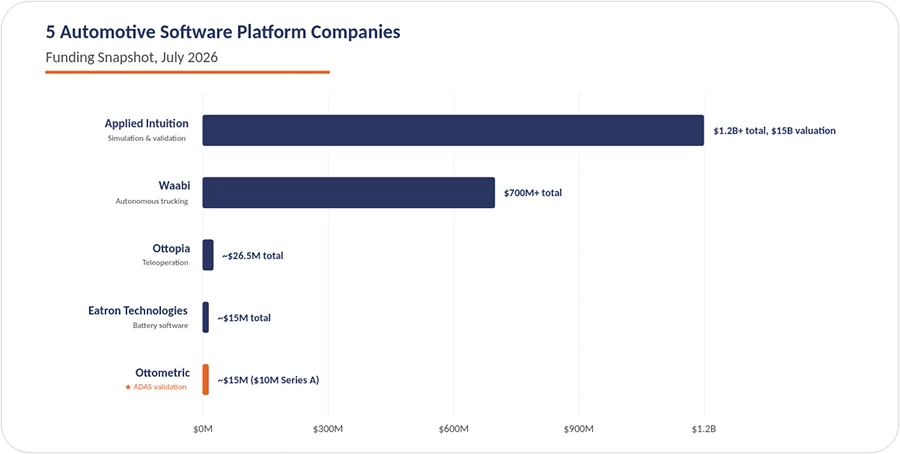
The Roster
★ Spotlight: Ottometric and the Paperwork That Ships the Car
Every safety-relevant function in a modern car has to prove it works before the vehicle goes into production, with documented evidence that it behaved correctly across a defined set of conditions. For ADAS features like automatic emergency braking or lane departure warning, that proof is enormous. Sensors generate petabytes of data, and somewhere in that pile a team has to show that every requirement maps to a test, every test ran, and every result holds up. Ottometric automates that work, sorting the flood of sensor data into structured evidence. It takes the manual grind out of a process that OEMs and Tier-1 suppliers have long staffed with rooms full of engineers.
The model that spots a lane marking is the routine part now. The value: turning millions of those reads into evidence a safety engineer will sign off on.
What safety-oriented validation actually demands:
- Traceability. A documented line from each requirement down to the individual test cases that exercise it.
-
Coverage. Proof that each safety-relevant function ran under the defined conditions, not a representative sample of them.
- An audit trail. Evidence a safety engineer will accept, generated automatically rather than assembled by hand after the fact.
Automotive safety validation aligned with ISO 26262 engineering processes asks for all three at once, which is what makes the tooling hard to build. The software has to understand two things in parallel: the system under test, and the evidence rules the safety case runs on. A tool that classifies sensor data, but can’t produce an acceptable audit trail solves only half the problem. The teams who do this well tend to build CI/CD pipelines that support traceability, automated testing, and the evidence generation that safety-oriented development depends on. That mix of deep validation knowledge and automation engineering describes some of the scarcest talent in the industry.
Where the build-versus-partner line tends to fall:
- Keep in-house: the validation logic closest to the product, owned by the engineers who own the safety case.
- Open to partners: the surrounding automation, data pipelines, evidence-generation tooling, and test infrastructure, which often moves faster with outside engineering capacity that understands regulated, safety-oriented development.
Automating safety validation rewards teams fluent in regulated delivery and rigorous QA. Softwarium brings that background from aerospace and other safety-critical software.
The Engineering Underneath
Look past the individual products and three engineering patterns run through the whole roster. They are worth naming, because each one marks a place where automotive software demands more than ordinary SaaS engineering.



Softwarium is a US-headquartered software engineering and IT staff augmentation company with an EU-based engineering delivery network, supporting software product companies and technology teams through co-managed engineering partnerships on platform development, systems integration, cloud-native architecture, and quality assurance for complex and regulated software environments.
What It Means for Engineering Leaders
The automotive software startups 2026 worth tracking share a common trait: they turn hard engineering discipline into products the rest of the industry can build on. Simulation, validation, battery intelligence, teleoperation, and autonomy all raise the reliability bar higher than typical software work. When these systems fail, the cost shows up in the physical world, beyond just an error log.
Softwarium builds dedicated development teams and co-managed engineering teams for product companies working under exactly those constraints. Twenty-five years of software engineering delivery, European engineering micro-hubs, and a Center of Excellence in Poland stand behind the work, along with regulated and safety-critical delivery experience that maps onto the QA, integration, and platform engineering the automotive industry is running on.
Explore Softwarium's dedicated development team and IT staff augmentation services →