Real Estate Apps Made with C# and .NET:
Examples from PropTech Platforms in the Microsoft Ecosystem

How C# and .NET Support Real Estate Software
CoStar Group, on a stated mission to digitize the world's real estate, powers CoStar.com, LoopNet.com, Apartments.com, and Homes.com. Its own engineering job postings identify C#, .NET Framework, and SQL Server among the company's primary engineering tools. RealPage, which provides AI-enabled software platforms to the real estate industry, hires for “Senior Software Engineer (C#/.NET)” roles. Property technology rarely gets named as C# territory, yet the language keeps turning up in the systems that run it.
Real estate software carries a specific set of engineering requirements: data at scale, document processing, workflow automation, financial calculation, and enterprise integration. Those requirements happen to line up closely with what C# and .NET were built to handle.
This post walks through five examples from across the property technology landscape, ending with a capital markets title search company where Softwarium built AI-powered document recognition and a .NET 6 platform modernization.
The examples at a glance
|
Example |
Where C# and .NET show up |
Evidence |
|
CoStar Group |
Named among the primary engineering tools for teams building shared services behind CoStar's marketplaces |
CoStar engineering job postings on Built In |
|
RealPage |
Required production skills for senior engineers working on backend services and APIs |
RealPage Sr. Software Engineer (.NET) posting, 2026 |
|
Azure Maps and Azure Digital Twins |
Official Microsoft .NET client libraries for map-based search and smart building models |
NuGet package pages published by Microsoft |
|
ProTitleUSA |
Title search platform migrated from WebForms to a .NET 6 Web API, working next to AI document recognition |
Two published delivery case studies |
CoStar Group:
The CoStar Tech Stack in Its Own Job Postings
CoStar Group is a member of the S&P 500 and the Nasdaq-100, and it has worked in real estate information for more than 35 years. Its brands cover commercial property research on CoStar.com, commercial listings on LoopNet.com, apartment rentals on Apartments.com, and homes for sale on Homes.com. A broker pricing an office building and a family comparing apartments use different sites, yet both rely on backend services that CoStar's shared engineering teams build for several brands at once.
The technology behind those services appears in plain language on CoStar's hiring pages. Senior backend engineering postings across several CoStar offices repeat the same line about the stack:
“Our primary tools are C#, .NET Framework, JSON, SQL Server, and AWS.”
CoStar Group, Senior Software Engineer posting, Product Data Services team (Built In)
Consider what that platform does. Institutional investors, commercial brokers, and rental seekers rely on it to search and analyze the property market, and the engineering job postings name C#, .NET Framework, and SQL Server among the primary tools behind it. The data-at-scale requirement shows up clearly here. Indexing billions of square feet of commercial space, holding decades of transaction history, and running search and analytics across four platforms calls for a reliable, performant engineering foundation. CoStar's postings point to C#, .NET Framework, and SQL Server as part of that foundation.
Crexi, a commercial real estate marketplace, also appears on Built In's list of top C# companies.
RealPage:
What a RealPage .NET Developer Posting Asks For
RealPage provides AI-enabled software platforms to the real estate industry, serving property owners, operators, and investors. Founded in 1998, the company employs roughly 8,000 people. Its property management platform covers leasing, resident screening, rent collection, maintenance, and analytics across thousands of properties.
RealPage engineering teams build property management software with C# and .NET, as documented in a published RealPage engineering job posting. The 2026 listing for a Sr. Software Engineer (.NET) states the core requirement in one line:
“Strong experience with C# and .NET in production environments”
RealPage, Sr. Software Engineer (.NET) job posting
Picture the system a property manager uses to track every lease, payment, and maintenance request across thousands of units. Engineering teams working in C#, ASP.NET Web API, and .NET Framework build that system. The workflow automation requirement lives right here. A single lease moves through multiple parties, compliance steps, and audit checkpoints from application to expiration, and the platform carries that whole operational arc. Financial calculation sits alongside it, since rent collection, lease math, and reporting all run through the same stack, and C# ships with the numeric types and enterprise libraries that transactional systems of this kind tend to rely on.
Azure Maps and Azure Digital Twins:
C# SDKs for Property Search and Smart Buildings
Two capabilities show up in a lot of modern PropTech products: geospatial property search and smart building management. Microsoft provides official .NET SDKs for both, confirmed on NuGet through packages including Azure.Maps.Search and Azure.DigitalTwins.Core.
Azure Maps gives developers a way to build geospatial property search using C#. Azure Digital Twins gives developers a way to build smart building platforms using C#, covering IoT-connected building management, energy monitoring, and space utilization analytics. In Microsoft's official documentation for both services, C# is the primary developer language.
The “search on a map” feature and the smart building dashboards that PropTech products ship are capabilities developers can build with Microsoft's official C# SDK libraries. Microsoft provides official .NET SDKs that allow developers to build these capabilities using C#. That framing matters, because it describes the engineering layer available to any team building on Azure rather than any specific product's internals.
ProTitleUSA:
Title Search Software Rebuilt on .NET 6
ProTitleUSA is a capital markets title search company that processes high volumes of mortgage documents, collateral loan files, title and tax reports, and due diligence packages. At that scale, document review becomes a core operational bottleneck. Softwarium built the engineering infrastructure to change that, across four connected workstreams, each one documented in a published case study.
Start with the AI recognition work. Softwarium built an AI-powered document recognition and validation system using Google Vision API, Google Cloud AI, and Vertex AI, with a custom NLP pipeline. Extracted fields such as parcel numbers, ownership details, lien indicators, and county references are presented to analysts side by side with the source document for validation. Softwarium reports an up-to-85% reduction in manual verification time per document. The document processing requirement runs straight through this case. Title searches, mortgage packages, lease agreements, and property deeds generate large document volumes, and C# and .NET support the kind of processing pipelines that handle them.
Then the .NET modernization, which anchors the Microsoft stack side of the engagement. Softwarium migrated ProTitleUSA's legacy .NET Framework WebForms application to Angular plus .NET 6 Web API, deployed in Docker with CI/CD. The migration ran with zero downtime, API response times came in 30% faster, and the new platform was built to support future AI and OCR integration.
A capital markets title search company at this volume needed a full engineering program: AI recognition, legacy modernization to .NET 6, workflow automation, and applied ML R&D. The .NET modernization became the architectural foundation that made the AI recognition system possible, and Softwarium built both.
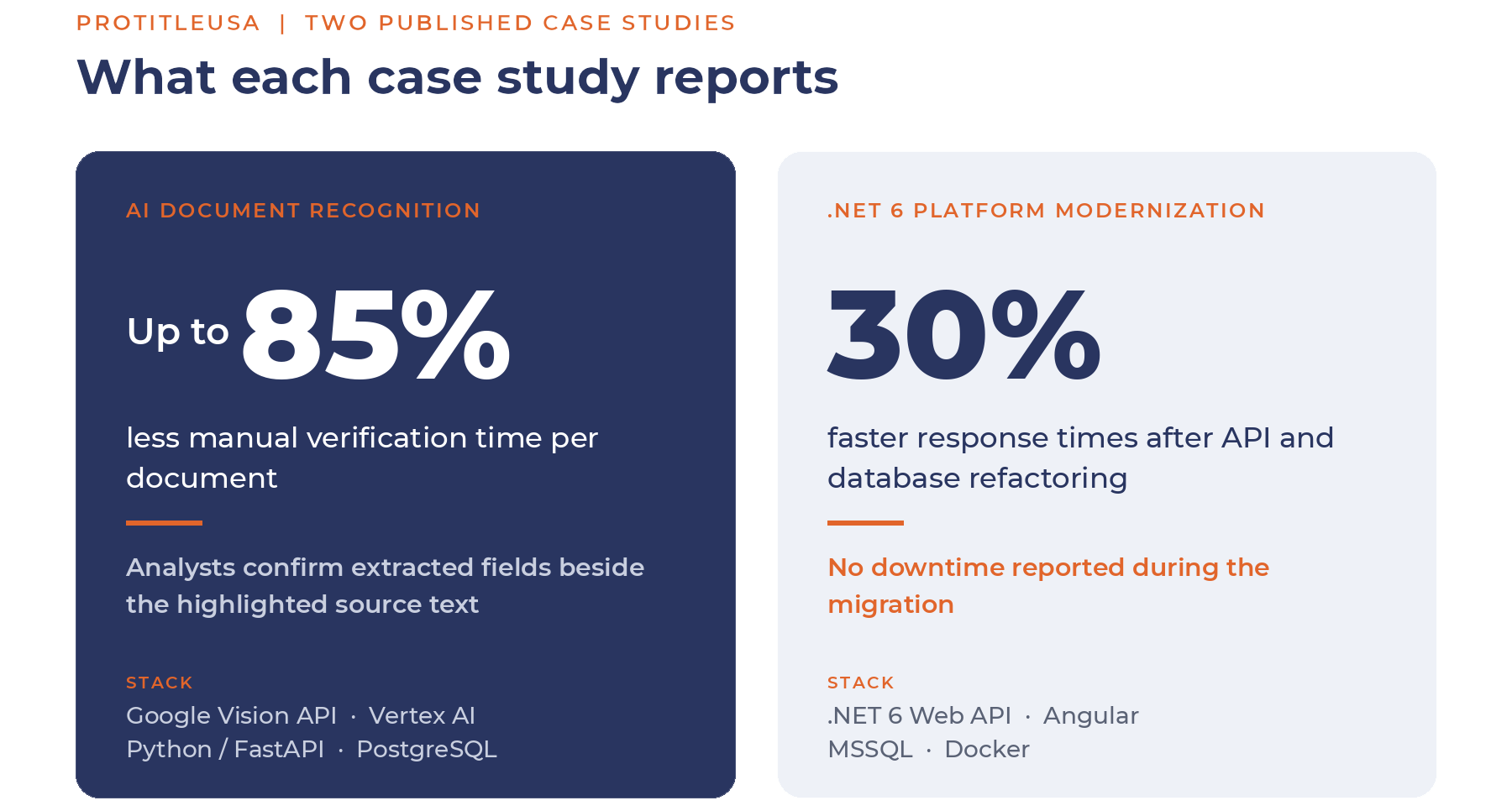
Sources: Softwarium case studies AI-Powered Text and Image Recognition for Real Estate (85% figure) and Legacy Modernization for Continuous Real Estate Operations (30% figure and downtime result).
Side by side, the two case studies describe a title business where a .NET 6 platform runs orders and document tracking while Google Cloud services read the documents themselves. Full details are in the case studies on AI-powered text and image recognition for real estate and legacy modernization for continuous real estate operations.
What .NET Real Estate Software Has in Common
C# and .NET turn up across the real estate technology landscape in roles developers don't always anticipate: as primary engineering tools at the platform powering major commercial real estate marketplaces, as the technology stack property management engineering teams build with, as the official SDK language for PropTech geospatial and smart building capabilities, and as the foundation for AI-powered document recognition at capital markets scale. The engineering requirements real estate software carries, from data at scale through document processing, workflow automation, financial calculation, and enterprise integration, map closely to what C# and .NET do well.
For teams evaluating the Microsoft stack for a new build, the pattern in these examples is worth weighing. Softwarium builds C#/.NET engineering for real estate and PropTech software, and the ProTitleUSA work shows what that looks like end to end. See the broader .NET applications hub post and the companion C# surprises post for more.
Build your PropTech platform with a dedicated .NET team
Softwarium is a software engineering and IT staff augmentation company, headquartered in the US with European engineering hubs. For ProTitleUSA, Softwarium teams modernized a live title search platform to .NET 6 and built AI document recognition.
To scope a dedicated .NET development team for your real estate software, book a 30-minute call with Anna Moskalets, Head of Sales EMEA, or review Softwarium's .NET development services.