
The Six Cybersecurity Software Trends Shaping 2026 Engineering Budgets

Cybersecurity Software Trends 2026: 6 Engineering Priorities
An estimated $227.59 billion went into the global cybersecurity market in 2025, and MarketsandMarkets projects $351.92 billion by 2030 at a 9.1% CAGR. The breach data explains where the money goes. Ransomware appeared in 48% of all breach chains in the Verizon 2026 Data Breach Investigations Report (DBIR). Software vulnerability exploitation climbed from 20% to 31% of breaches in a single year and took over as the leading initial access vector. Third-party involvement reached 48% of all breaches, up 60% year-over-year after a prior year that had already doubled. Every one of those numbers describes work that has to be engineered, not bought.
The 2026 Cybersecurity Landscape at a Glance
The constraint behind all of it is people. ISC2's 2024 Cybersecurity Workforce Study counted 4.8 million unfilled cybersecurity positions worldwide, up 19% in a year. The sharpest gaps sit in AI security, cloud security, and DevSecOps. Attack surface grows faster than security teams can be hired. That holds for the vendors building enterprise cybersecurity software and for the enterprises deploying it.
Six cybersecurity software trends 2026 follow. Each one ends in a build list, and each build list ends in the same question: who is writing this code. The trends are not independent, and the engineering capacity they compete for is the same pool.
AI Is Accelerating Cybersecurity Software Trends 2026 — on Both Sides
In 2026, AI accelerates both attacker operations and defensive security workflows. The attacker side moved first. IBM X-Force Threat Intelligence Index 2026 recorded a 44% year-over-year increase in the exploitation of public-facing applications, and attributes the acceleration to AI. The time needed to identify and weaponise a vulnerability has compressed from months to hours. Detection and response features now ship against a clock attackers set. Active ransomware and extortion groups surged 49% year-over-year in the same report, while publicly disclosed victim counts rose roughly 12%. Groups growing four times faster than victims means the ecosystem is splintering into smaller operators. Each new group brings its own tooling and infrastructure, and every variant becomes a detection problem someone has to engineer against.
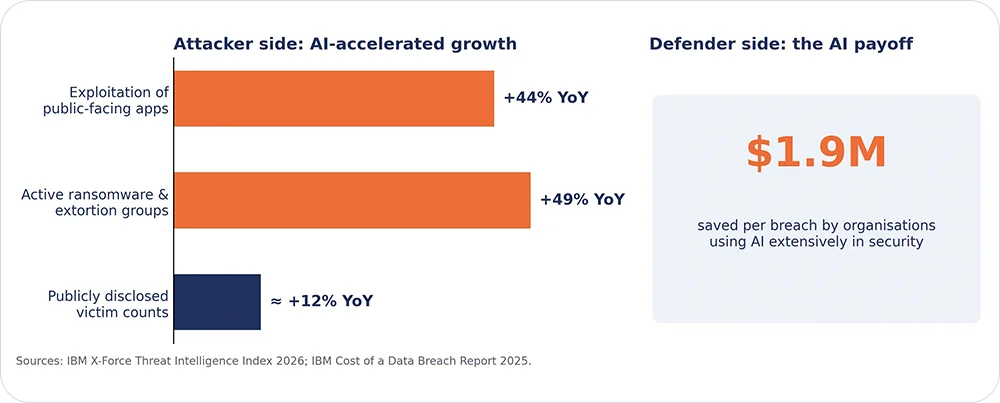
The defensive side has its own number. Organisations using AI extensively in security saved $1.9 million per breach compared to those that did not, per the IBM Cost of a Data Breach Report 2025. The same report found 97% of organisations with AI-related incidents lacked proper AI access controls.1 Both figures describe the same system. The saving is real, and so is the gap: deployment ran ahead of governance. An AI cybersecurity platform without model access controls reproduces the failures it was built to catch.
97% of organisations that experienced AI-related incidents lacked proper AI access controls.
IBM Cost of a Data Breach Report 2025
The scoping trap sits here. A detection model is the visible part of the work. The pipeline around it — ingestion, feature stores, retraining, monitoring, governance — is where the engineering hours go. AI security is one of the three most acute shortage areas ISC2 documents. Four workstreams carry the load:
- Machine-learning anomaly detection pipelines, needing data engineering and model operations capacity alongside data science headcount
- AI-powered SIEM integration with Microsoft Sentinel and Splunk, from connector engineering to detection-rule development
- AI governance architecture: model access controls, data provenance, prompt monitoring, adversarial testing
- AI incident response automation that shortens the loop between detection and containment
Scoped up front, that work is a roadmap. Deferred until after the model ships, it arrives as the 97% figure.
Zero Trust Requires Platform-Level Engineering
Zero Trust deployments saved an average of $1.51 million per breach compared to environments without them, per the IBM Cost of a Data Breach Report 2025.2 The figure prices zero trust security implementation as product engineering with a measurable return, rather than a control framework a security team adopts and a product team inherits.
The remediation data shows the distance most environments still have to cover. Only 23% of third-party organisations fully remediated missing or improperly secured MFA on cloud accounts, per Verizon 2026 DBIR root cause analysis. MFA gaps and weak permission misconfigurations took a median of eight months to close. Eight months is a long, quiet window, and attackers spent it inside the tooling IT already trusts. RMM tool abuse rose 240% year-over-year in the Verizon 2026 DBIR while traditional backdoor and C2 malware usage fell 27%. Attackers stopped bringing their own malware and started using the software already installed.
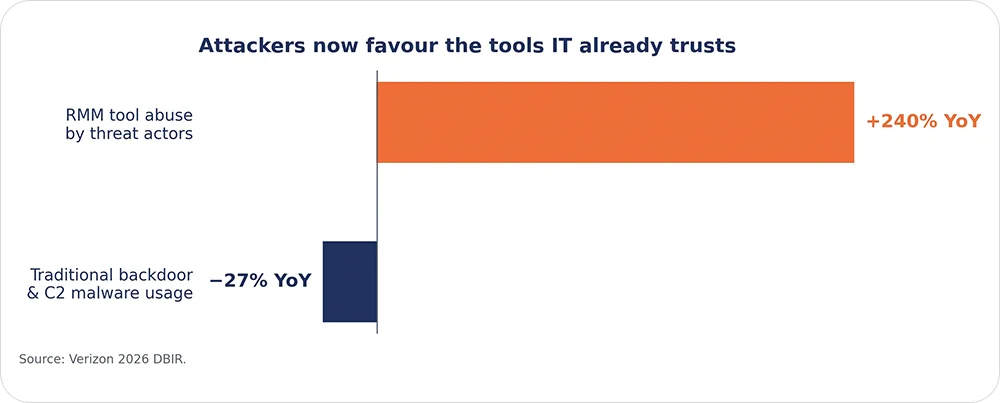
MFA gaps and weak permission misconfigurations took a median of eight months to remediate — and only 23% of third-party organisations closed them fully.
Verizon 2026 DBIR root cause analysis
That inversion lands directly on detection engineering. Signature matching identifies known-bad binaries; it cannot separate an administrator using a remote access tool from an intruder using the same one. The distinguishing signal is behavioural, which means session context, device posture, and continuous verification have to travel with every request. Machine identities widen the surface again: API keys, service accounts, and automation credentials outnumber human identities in most environments, and many sit outside any managed lifecycle. CSPM and CNAPP integration belongs in the initial architecture. Retrofitted after deployment, it repeats the eight-month pattern the Verizon data already documents, and the retrofit costs more than the original build would have.
The delivery scope:
- Zero Trust network architecture
- CSPM and CNAPP integration across Wiz, Orca Security, and Palo Alto Prisma Cloud
- Microsegmentation platforms
- Machine identity lifecycle management with HashiCorp Vault and CyberArk
- Identity orchestration across Okta, Ping Identity, and Microsoft Entra, on Azure-native cloud architecture
Privileged Access Management Has Expanded Into a Core Product Engineering Discipline
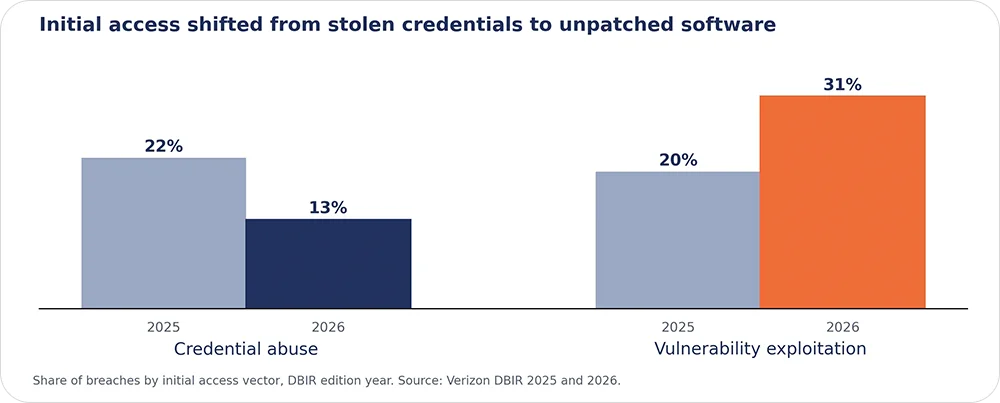
Credential abuse fell to 13% of breaches in the Verizon 2026 DBIR, down from 22% in the 2025 edition, while vulnerability exploitation rose to 31% and became the leading initial access vector. The proportion shifted. The stakes did not: the blast radius of a compromised privileged account is unchanged, and insecure authentication failures still account for a substantial share of cloud-based third-party incidents in the same dataset. Supply chain breaches cost an average of $4.91 million per incident, above the global average, per the IBM Cost of a Data Breach Report 2025. A vector that accounts for a smaller share of breaches can still account for the most expensive ones.
For vendors building privileged access management software, the roadmap follows. Privileged access now spans human accounts, machine identities, mobile sessions, and third-party paths, each needing its own product-grade engineering. Biometric authentication has moved from differentiator to baseline expectation on mobile. Session recording and audit trails carry weight in procurement reviews. Just-in-time provisioning replaces standing privilege as the default. Authentication failures in third-party cloud environments persist for months in Verizon's root cause data, so PAM features that find and fix them without a human in the loop carry direct buyer value.
SOFTWARIUM DELIVERY
The engineering surface:
- PAM API and mobile SDK engineering
- Biometric authentication across Face ID, Touch ID, and FIDO2/WebAuthn
- Privileged session recording and audit trail architecture
- Just-in-time access provisioning
- Secrets management with HashiCorp Vault, CyberArk, and Delinea
Cybersecurity product companies partnering with Softwarium gain access to distributed engineers with experience in PAM and privileged credential management engineering, mobile security platform development, Azure-native cloud architecture, and SDET-led quality assurance for security-critical software systems.
Scaling Your Cybersecurity Platform?
Software Supply Chain Security Has Become a Product Engineering Discipline
Major supply chain and third-party breaches have nearly quadrupled over five years, per the IBM X-Force Threat Intelligence Index 2026, and the last year carried much of that. The Verizon 2026 DBIR recorded a 60% year-over-year rise in third-party involvement, reaching 48% of all breaches. IBM X-Force logged a 44% year-over-year increase in exploitation of public-facing applications in 2025. Of the nearly 40,000 vulnerabilities it tracked, 56% could be exploited without any authentication. Supply chain breaches averaged $4.91 million per incident, against an IBM-reported global average of $4.44 million.
Supply chain exposure, quantified
A breach in a dependency does not stay in the dependency. A vulnerable package ships inside the product, the product ships to the customer, and the vendor answers for a defect it did not write. Software Bill of Materials (SBOM) generation and automated dependency scanning now appear as standard requirements in contracts and procurement frameworks rather than optional hygiene. Buyers ask for attestation evidence during procurement, before the first incident. A vendor that cannot produce an SBOM on request loses the deal to one that can, which moves supply chain security software into the sales cycle.
SBOM delivery and dependency scanning now sit in contract language. Buyers ask for attestation evidence during procurement, before the first incident.
The engineering work is concrete and mostly invisible from the outside. Dependency graphs need continuous scanning; a quarterly audit cadence leaves months of exposure. Build pipelines need signing and attestation so artifacts trace back to source. Secrets need detection tooling at the repository layer, because a leaked credential in a public commit is precisely the unauthenticated entry point the 56% figure counts. SaaS integration endpoints need the same authentication scrutiny as first-party APIs.
The delivery checklist:
- SBOM generation and automated dependency scanning with Snyk and OWASP Dependency-Check
- CI/CD pipeline security: signed commits, artifact attestation, GitHub Actions hardening
- Secrets detection in code repositories
- Third-party vendor access audit architecture, recording who connected, when, and with what privileges
- API security for integration endpoints
DevSecOps Adoption Closes the Gap Between Security Policy and Engineering Reality
Organisations fully remediated only 54% of perimeter-device vulnerabilities in the past year, per the Verizon 2026 DBIR. Nearly half stayed open. Median time from a critical vulnerability's publication to mass exploitation against edge devices reached zero days in 2025, per Verizon 2025 DBIR analysis carried into 2026 planning. A patch cycle that begins at disclosure begins after exploitation. Organisations with staffing shortages carry breach costs $1.76 million higher than well-staffed peers, per the IBM Cost of a Data Breach Report 2025. The gap between security policy and engineering reality has a price, and IBM publishes it.
Perimeter-device vulnerabilities, one year on
|
54% fully remediated |
46% unresolved |
Source: Verizon 2026 DBIR.
Median time from critical vulnerability publication to mass exploitation against edge devices: zero days.
Verizon DBIR analysis
DevSecOps moves the work to where remediation is cheapest. Automated SAST and DAST scanning catches vulnerable code before it merges. Container and infrastructure-as-code scanning catches misconfigurations before they deploy. Security testing owned by SDET engineers inside the sprint, rather than queued behind a separate review, shortens remediation time. The DevSecOps tools 2026 buyers evaluate reflect that pipeline-first model at every layer of the stack. A vulnerability caught at merge costs an engineer an hour. Caught in production, it costs an incident response.
The staffing constraint cuts twice for product companies. Internal pipelines need securing, and the security features on the roadmap need engineers, and both draw from the same pool. ISC2 names DevSecOps among the three most acute cybersecurity shortage areas. Engineering capacity with security tooling experience is the profile in shortest supply, which makes the transition a resourcing decision before a tooling decision. Buying the scanner is the cheap part; wiring it in and tuning out the noise is the build.
The toolchain work:
- SAST and DAST toolchain integration across Checkmarx, Veracode, SonarQube, and Snyk Code
- Container security with Trivy and Falco
- IaC security scanning with Checkov and tfsec
- Security test automation in the delivery pipeline
- Threat modelling embedded in sprint ceremonies
Ransomware Ecosystems Are Fragmenting — and the Engineering Response Must Adapt
Ransomware appeared in 48% of all breach chains in the Verizon 2026 DBIR, and the ecosystem behind them is changing shape. Active groups surged 49% year-over-year to 109 distinct operators tracked by IBM X-Force in 2025. Chainalysis estimates 2025 payments at $820 million, down roughly 8% from the prior year. The payments fell and the attacks did not. Refusal removes the operator's revenue, not the operator. A 64% victim refusal rate is squeezing operator revenue, and the squeeze splinters groups into smaller outfits that escalate to destructive tactics when payment is refused.
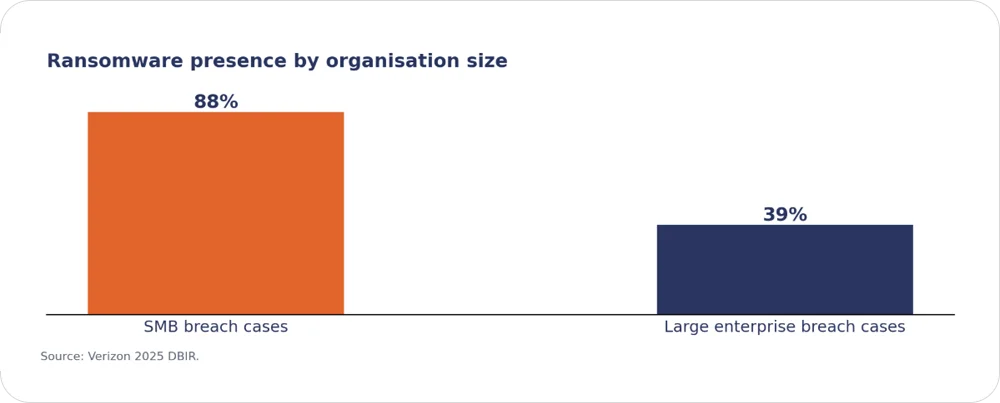
The exposure is uneven, and the unevenness shapes the product. Verizon's 2025 DBIR found ransomware in 88% of SMB breach cases against 39% for large enterprises. The organisations most likely to be hit have the smallest security teams, and the least capacity to run a recovery. For any ransomware protection platform serving that segment, recovery features have to work without a security operations team behind them. That means automated isolation, guided restoration, and defaults that assume no analyst is watching the console at 3am.
A 64% victim refusal rate is fragmenting ransomware groups into smaller, more volatile operators — and payments fell to an estimated $820 million.
Chainalysis estimate; IBM X-Force 2026
The architecture that reduces impact is specific and product-grade. Immutable backup infrastructure removes the attacker's leverage over recovery, which is the whole basis of the extortion. Network segmentation limits lateral movement from the initial foothold to the assets that matter. Incident response automation compresses the containment window. Recovery playbook engineering, with defined recovery point and recovery time objectives, turns resilience into a tested system. Tested is the operative word: a recovery objective that has never run against production-scale data is a projection, and the incident is a poor place to discover the difference.
The build list:
- Immutable backup system architecture
- Network microsegmentation
- Incident response orchestration and automation (SOAR)
- Recovery point and recovery time objective engineering
- Detection engineering for RMM tool abuse, up 240% in the Verizon 2026 DBIR
Cybersecurity Technology Trends in 2026 Are an Engineering Capacity Question
Read together, the six trends describe one condition. Attack surface expands faster than teams can be hired, and every IBM Cost of a Data Breach report prices the architectural shortcuts that follow. They also compound: AI shortens exploitation timelines, faster exploitation deepens supply chain exposure, and that exposure raises the cost of every identity gap left open for eight months.
The build lists tell the same story from the other end. AI governance architecture, machine identity lifecycle management, SBOM pipelines, SAST integration, immutable backup infrastructure, PAM mobile engineering — none of it is a purchase. It is engineering hours, drawn from a pool ISC2 counts 4.8 million people short. The tooling decision is the easy one; staffing decides whether any of it ships. Enterprise cybersecurity software absorbs the cybersecurity technology trends above only where the capacity exists to build them.
Softwarium works with cybersecurity software product teams as a co-managed engineering partner — from PAM platform engineering and identity workflow automation to cloud-native security tooling, DevSecOps pipeline integration, and mobile security platform development.
For teams measuring cybersecurity software trends 2026 against their own roadmap, the useful conversation starts in one place. Which of these six builds is already resourced, and which is still a line item without engineers behind it? Explore our dedicated development team model →