Cleaning Up Vibe Code:
A Playbook for AI-Assisted Systems
Part 3 was the true horror story, but Part 4 is here to give you some hope, or rather the damage-control manual.
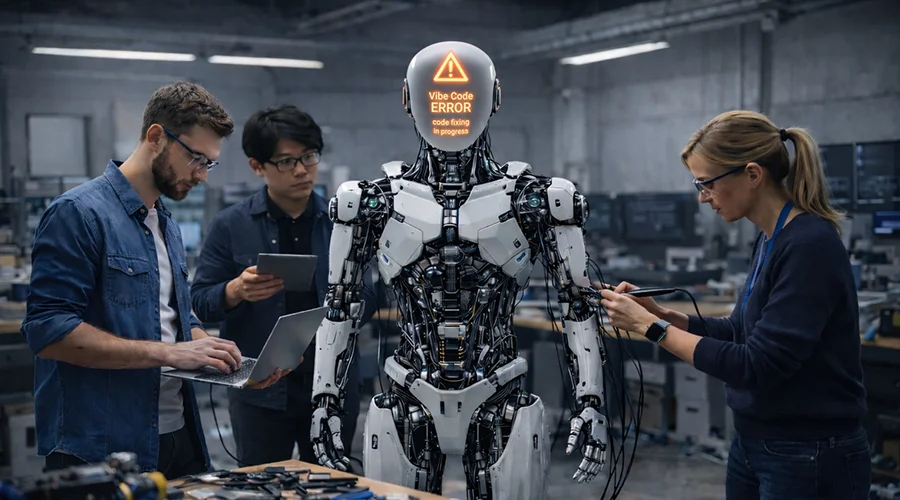
How to deal with your AI-assisted coding. Part 4
This is the part for teams who read the disaster cases and thought:
“We’re not that bad… but we have been letting AI do a lot of heavy lifting”
“We do have entire modules written with ‘help from Copilot’”
“We’ve never really gone back and audited what the model produced”
You’re not alone. Almost every engineering org that adopted AI assistants early is now realizing they need a second pass, a strict audit and thorough cleanup.
So how do you clean up unmanaged vibe coding without grinding your roadmap to a halt?
1. Start With a Map, Not With Blame or Stress
Cleaning starts with a very unglamorous exercise: a rough map of where AI has influenced your system.
You DON’T need line-by-line attribution. You DO need a sense of which services, modules, and scripts were heavily AI-assisted.
Where AI was used on migrations, infrastructure, auth, payments, and other sensitive areas.
Where junior or less-experienced developers leaned hard on AI for architecture and logic, not just syntax.
This is less about Git archaeology and more about honest conversation. If you treat this as a witch hunt, no one will admit anything. If you frame it as risk reduction, you’ll get a real signal.
The outcome you want is a simple picture:

High-risk & AI-touched
money flows, auth, compliance, PII, production infra

Medium-risk & AI-touched
shared services, internal tooling, APIs

Low-risk & AI-touched
non-critical UIs, reports, prototypes
You can’t fix everything at once. But you can start prioritizing.
2. Freeze the Riskiest Vibe Code
Once you know where the danger is concentrated, you don’t immediately refactor. You stop making it worse.
For high-risk, AI-touched areas:



Think of this like containing a chemical spill. Before you start cleaning, you put up barriers.
This doesn’t mean banning AI across the board. It means being honest about where AI is allowed to act and where it absolutely is not, until you have controls in place.
3. Decide What to Salvage and What to Rebuild
Not all AI-written code is a lost cause. Some of it is fine. Some of it is salvageable. Some of it is a quiet disaster. The art is deciding which is which.
Broadly:
Salvageable AI code tends to live at the edges: pure functions, utility helpers, simple endpoints, UI components where failure is noisy and obvious. A senior engineer can read it, write tests around it, and harden it.
Rebuild candidates are usually in the core: billing calculations, auth logic, data pipelines, migrations, key workflows. If no one can explain them clearly, and they lack tests and observability, trying to “patch” them may be more dangerous than replacing them.
This is where leadership has to accept a hard truth: some of your “AI-assisted velocity” was borrowed time. Paying it back may mean rewriting entire modules with a proper design and test-first mindset.
The good news: you can still use AI as a tactical helper during the rewrite—just not as the architect.

4. Turn Vibe Code into Verified Code
For the AI-generated code you decide to keep and harden, the process looks less like “cleanup” and more like retroactive engineering.
Four moves matter most:




This is slower than just “asking the model to fix it.” It’s also the only way to end up with a codebase your team can still understand in three years.
5. Change the Default: From Unmanaged Vibe Coding to Guardrailed Use
Cleanup without behavior change is just a very expensive reset button. If you don’t change how AI is used, you’ll end up right back where you started.
A few cultural guardrails go a long way:

AI is a junior collaborator, not a hidden cofounder.
If AI generates a non-trivial piece of logic, it must be treated like code from a junior contractor: fully reviewed, tested, and owned by a human.
No unsupervised AI on critical paths.
Migrations, auth, payments, compliance workflows, security-sensitive scripts: AI can draft, but cannot be the last word. Ever.

Make vibe coding visible.
Encourage engineers to explicitly note where AI was heavily involved—commit messages, PR descriptions, internal docs. This isn’t about shame; it’s about leaving a trail for future maintainers.

Reward the unglamorous work.
Cleaning AI-generated technical debt, improving tests and observability, and saying “we should rewrite this” are revenue-protecting actions. Treat them that way in performance and planning.
Ultimately, you’re teaching your organization a new reflex:
“The model wrote it” is not the end of the conversation. It’s the beginning of the review.
The Real Question for Leaders
By Part 4, the question has shifted.
It’s no longer: “Should we use AI for coding?” You probably already are.
The sharper question is: “Are we willing to do the boring, rigorous work required to clean up and contain AI’s clumsiness, so we get the upside without gambling the core of our business?”
If the answer is yes, then mapping your AI footprint, freezing risky areas, deciding what to rewrite, and turning vibe code into verified code isn’t optional overhead. It’s the cost of running a modern engineering organization in the AI era.
If the answer is no, but the need stays, the only option is to hire an experienced software development partner. Senior software developers are those who are capable of doing the stuff that AI polluted cheerfully and effectively.
While coding with your AI assistant, remember, you’re playing production roulette with a very talkative and optimistic assistant.
And as the last few years have shown, the market, the courts, and your customers don’t care whether the bullet came from a human keyboard or a generative model.
They only care that you pulled the trigger.