
Prominent logistics startups in 2026:
5 Companies Engineering the Modern Supply Chain
Supply Chain & Logistics Startups to Watch in 2026
A lot of what happens on a warehouse floor still lives in spreadsheets, clipboards, and radio calls, out of reach of any software. The supply chain runs the physical world, yet a surprising amount of it still runs on manual coordination that no software ever touched. That gap is exactly what the current wave of supply chain startups 2026 is built to close, and investors have noticed. Grand View Research puts the AI-in-warehousing market at $11.22 billion in 2024, on track to reach $45.12 billion by 2030 at a 26.1% compound annual growth rate. Warehouse robotics sits among the major investment areas within that shift, per the MHI and Deloitte 2026 Annual Industry Report.
The five companies below span visibility, freight decisions, dock automation, robotics, and procurement. They look like five different businesses, and in market terms they are. Look at what their engineering teams actually spend their days on, though. Each one is wiring intelligence into operational systems that were never designed to share data, and getting that wiring right is the difference between a demo and a deployment.
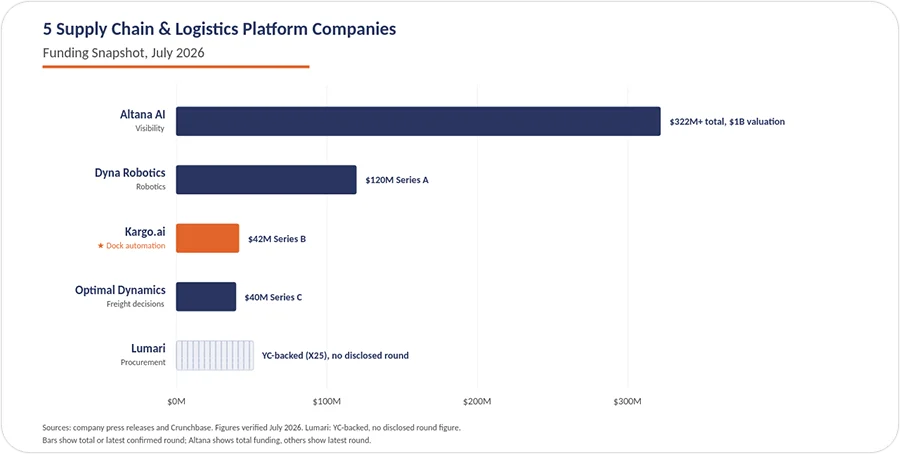
Five Companies, Five Corners of the Chain
★ Spotlight: Kargo.ai and the Hardest Fifty Feet in the Supply Chain
The loading dock is where the digital supply chain meets the physical one, and it has stayed fairly analogue. Trucks arrive, freight moves, and someone logs the pallet counts into a system a few hours later, if at all. Kargo puts computer vision on that: camera towers read inbound and outbound shipments, flag damage and miscounts as they happen, and feed cleaner data into warehouse systems. Its customers tend to run distribution centres for Fortune 500 manufacturers, where a bad count rarely stays small for long.
A camera tower at the dock sees a few million pallets a week. Every one of them has to turn into a number someone in the warehouse will act on before the truck pulls away.
Each truck sets off the same sequence, and it needs to finish before the next one backs in:
-
Classify the stream of visual events coming off the dock.
-
Reconcile each read against the paperwork, catching mismatches a manual count would miss.
-
Push it into the WMS fast enough to change what happens next, not to log it later.
The receiving systems come from different vendors, speak different formats, and assume a person will handle exceptions. Kargo has to close that loop with far less manual intervention, holding up well enough that operators trust the numbers. The demanding parts are the usual ones in operations software: latency judged against an arriving truck, edge cases that show up damaged or mislabelled, and integration with whatever WMS the customer runs.
For a team deciding what to build in-house, Kargo suggests a split:
-
Keep the differentiator close. The vision model and operational insight are the product, and they belong near the people who know the domain.
-
Reconsider the layer beneath. Data pipelines, legacy integrations, and the testing that keeps an operations platform steady rarely win a customer alone, and they still need to be dependable.
Softwarium has delivered supply chain analytics infrastructure for MRO operations, providing the engineering foundation for real-time operational visibility across procurement and maintenance workflows, which is the class of data-pipeline and integration work this category runs on.
The Patterns Underneath
Strip away the category labels and the same three engineering problems show up across all five companies.



Softwarium is a US-headquartered software engineering and IT staff augmentation company with an EU-based engineering delivery network, supporting software product companies and technology teams through co-managed engineering partnerships on platform development, systems integration, cloud-native architecture, and quality assurance for operational and enterprise software.
What It Means for Engineering Leaders
The supply chain startups 2026 worth watching are the ones turning fragmented operational data into decisions and actions that hold up on a live floor. Capital enables that work, but engineering is what carries it the rest of the way: the integration layer, the pipelines, and the reliability that keeps a platform running.
Softwarium builds dedicated development teams and co-managed engineering teams for product companies doing that translation. Twenty-five years of software engineering delivery, European engineering micro-hubs, and a Center of Excellence in Poland stand behind the work, alongside delivered supply chain analytics infrastructure for MRO operations.
Explore Softwarium's dedicated development team and IT staff augmentation services →