
Softwarium Origins:
A Conversation With CEO Petro Neverodsky
Softwarium began in a time when building anything in tech required persistence, creativity, and a strong sense of responsibility. In this interview, Petro Neverodskyi shares how it started, what shaped the culture, and why the company still prefers substance over buzzwords.
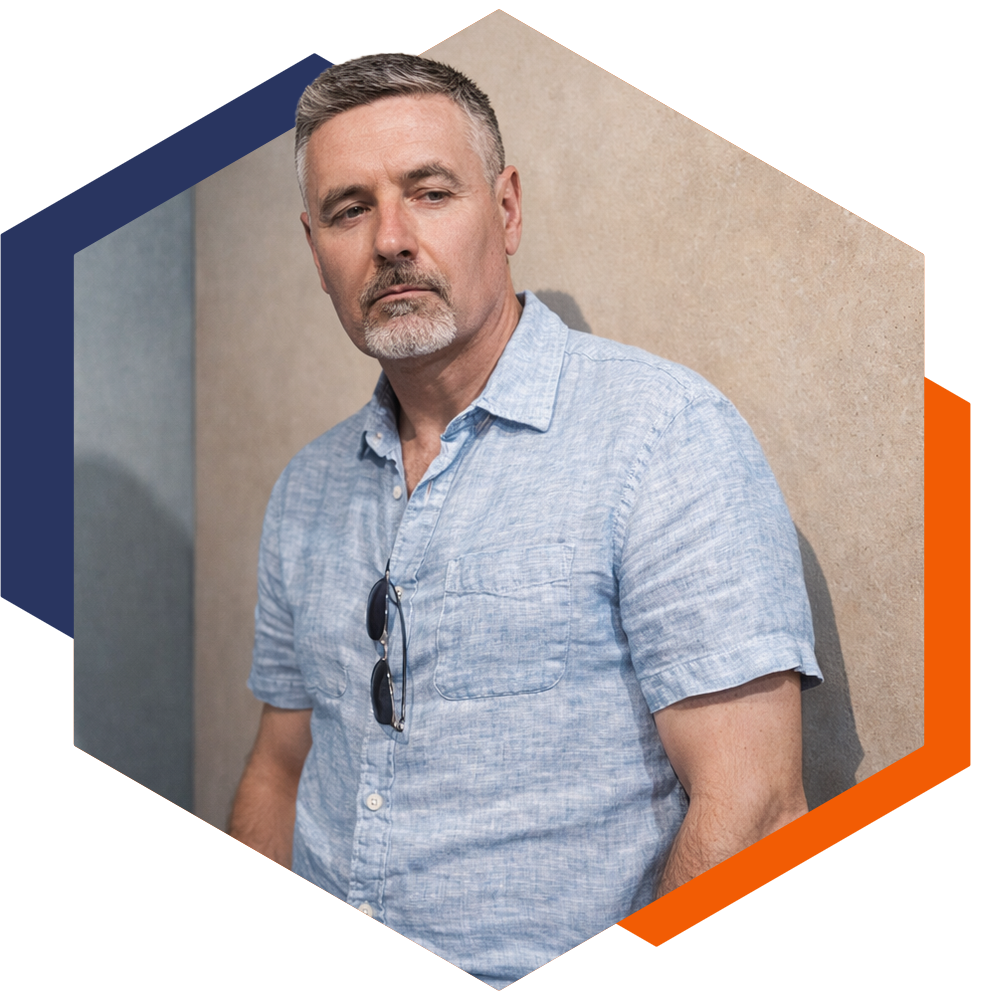
How Softwarium Started: CEO Petro Neverodskyi Interview
Some companies are born from ambition. Softwarium was born from a determination to get things to work.
Our story begins far from the usual tech narrative. A medical background, a research mindset, early computers, and the curiosity to seek out every piece of tech available.It’s a story about the people who kept things running.
Today we’re talking with Softwarium’s CEO, Petro Neverodskyi about the early years, the culture we grew, and the leadership choices that followed.
Host: How did this even happen? How did you move from the medical field to computers?
Petro: Before anything else, I should answer the hard question: how did all of this work out from the very beginning?
I have a medical education. I taught at a medical university long ago. So the question is fair: how did I end up in “this whole computer story”?
There were two coincidences that came together.
First: passion. I got obsessed with computers very early, around 1982. We started with programmable calculators. Tiny memory – something like a hundred memory cells. But even that changed everything.
At the time I was working with spectrophotometry in an institute. The calculations were painful. You’d take a long series of readings from the device, then run each point through a fairly complex formula with several parameters. Doing that by hand or on a normal calculator could take days for a single graph.
Then we wrote a small program on that programmable calculator. We built it so you could test it with a sample value first, confirm the input was correct, then enter points one by one. It would output results in 15–20 seconds per point. Suddenly a full graph took 20 minutes, not days.
“That moment was shocking in the best way. It’s hard to explain now, but it felt like stepping into a new reality. And that’s where it started.”
We got pulled in completely. A fellow graduate student was part of that early obsession too. When the first “real” computer arrived at the institute, it was like a miracle.
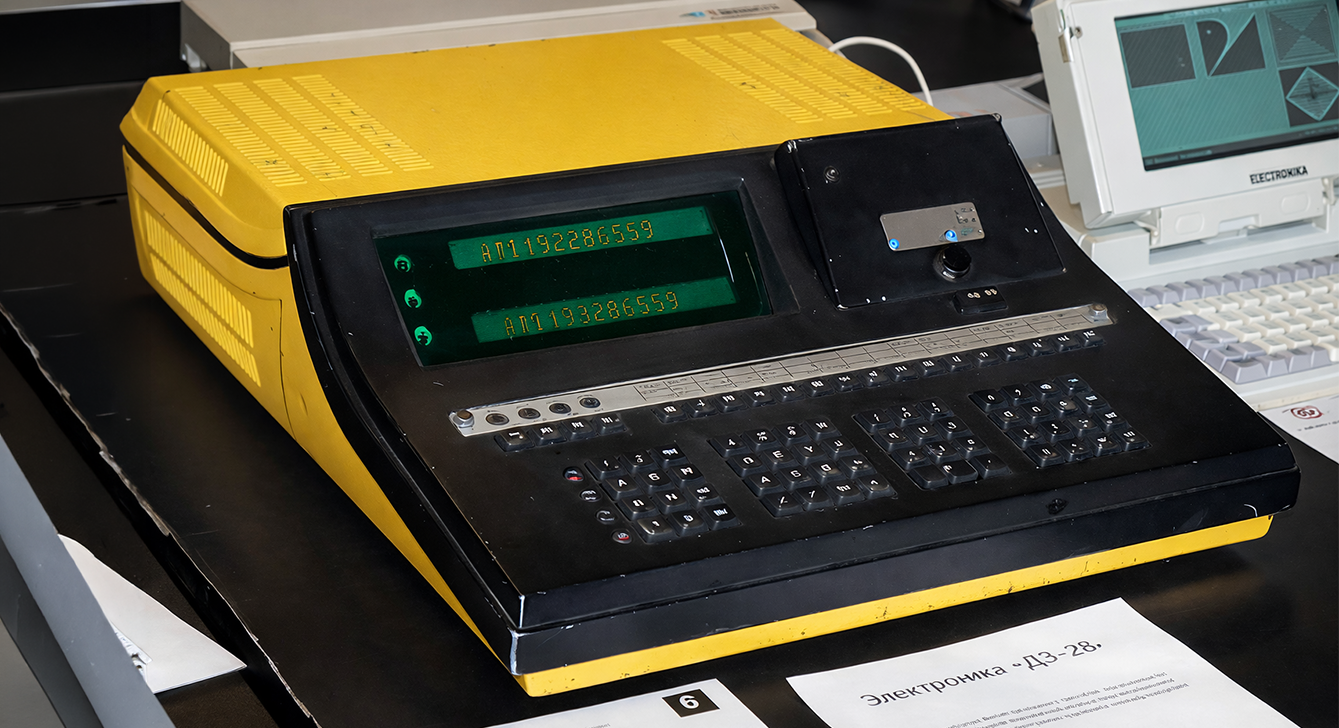
Interviewer: Tell us about the first machines you worked on. Was it something like a ZX Spectrum?
Petro: No, this was earlier, and it was the Soviet Union in 1982. No Spectrums for us (laughs).
We had a funny machine called D-328. Imagine a giant calculator, almost like a typewriter in size — awkward, ugly, but magical.
The leap was massive: from “100 memory cells” to something like 32 kilobytes—which was unimaginable to us. And it had tape storage—you could record programs and load them back. That alone felt like science fiction.
It ran a basic version of BASIC, very primitive. And we didn’t even have assembler. We wrote in machine code, literally entering numeric codes into memory cells. I still remember some of those numbers decades later. That’s how it etched itself into the brain.
I gained a strange reputation at the institute. During lectures I didn’t need, I’d sit with a grid notebook and quietly write strings of numbers—machine instructions—from memory, sometimes checking a thick reference book. People around me thought I was doing something… unhealthy. They’d ask: “What are you calculating?” And I couldn’t even explain it properly.
Around that time I saw images in Scientific American, early computer-generated fractal landscapes. Today you see similar ideas in games everywhere. Back then it was a revelation. It got into my dreams. I remember being genuinely disturbed that our monitor was black-and-white; I was seriously trying to figure out if we were “missing” something and could somehow get color.
That’s what passion looks like! It’s irrational and it just grabs you.
Interviewer: Before the web, you already had a kind of network. What was it, and what did it give you?
CEO: First came the passion. The second coincidence was access through people.
My father ran a network of youth technical clubs (children learning things like aviation modeling, ship modeling). On that base, there was also the Crimean Minor Academy of Sciences, basically a university-style path for gifted kids. If someone earned full member status there, they could enter top universities without admission exams. It had a real academic feel. And in that environment there were people close to early computing and cybernetics circles. Through that world I met a person who had access to real equipment and real know-how.
And then something happened that always happens when a person is ready: you suddenly get the next tool.
I got a modem and learned about dialing into early bulletin board systems—BBS. Imagine: a computer connected to a phone line. You call it. You see a menu. There’s a file archive. You can download something.
Today that sounds trivial. Back then, when software and documentation were scarce and everything was “write it yourself,” it was mind-blowing. It wasn’t “the internet” yet, but it was a doorway.
I managed to dial in. The line was noisy, connections dropped. And the absurd challenge became: download the tool that improves the connection so you can download reliably. I would come at three in the morning when the lines were quieter, trying to get just a few clean minutes.
We were shocked the second time: this was possible at all.
Interviewer: Was there a moment where you thought: “Okay, this is turning into something bigger”? Or did it grow quietly?
CEO: At some point we decided: we’ll build our own station. People started calling in. At first you think callers will be from a couple places—but then the geography expands. And then something happens: people don’t just call. They start showing up in person.
A community formed: very specific, very intense. Not only “programmers” in the narrow sense, but people who were drawn to the same curiosity. We were learning in public, together.
And then networking expanded. It became possible to route messages through other cities and even outside the country in hops. A letter could travel through nodes and eventually reach somewhere far away, and sometimes someone would answer. Even if it took days.
This wasn’t cheap. Calls cost money, and we were poor students, poor graduate students. But we were addicted to the possibility.
Interviewer: You were doing scientific work while all this was unfolding. What was your dissertation about, and at what point did networks become necessary for your research?
CEO: It’s hard to say simply. It was in biochemistry and immunology, around how blood proteins change their shape in response to certain physical influences, things like immunoglobulins and albumin.
Years later, work in this direction was recognized at the Nobel level, which is why I sometimes mention it as a reference point, not as my contribution, of course, but as a way to explain what area it was.
Back then it was still early steps. I was already writing programs that tried to model those changes, in a very basic, early form.
And then the practical problem hit: new information stopped coming in. No fresh papers, no new journals, nothing. Through those early networks I could reach universities, request materials, and get article copies. That helped me personally, and it showed us what “information access” really means.
It was the only way to get information and keep moving.
Interviewer: When did it stop being a hobby and start feeling like a real business?
CEO: Eventually, what we were doing started looking like a service. People began using it as a kind of “post office.” And yes, there were real risks and real uncertainty around that in those days. It wasn’t a stable, predictable environment.
Later, in the early 90s, we opened what you’d recognize as an internet provider. We bought a reliable channel to Kyiv (always-on compared to per-minute calling) and built from there. Over time, that provider became a major piece of regional connectivity, including education.
At some point we faced a dilemma. We had technical talent around us. People asked: “Let’s build something bigger. Let’s write products. Let’s do real software.” But for a while it didn’t bring money. The provider sustained us; product work didn’t.
Then the “miracle” happened!
The first serious external client arrived. An American missionary who was also a programmer, showed up with a task. We didn’t fully know how to do what he asked. But we took it seriously. We delivered.
And that’s important: that first paid job, the first time someone pays you because you created value they recognize – that’s a real beginning.
Before that, we were building many things “near business” but not as business.

Interviewer: So what counts as the real start of the company for you: registration, first client, or first lines of code?
CEO: For me, the start is simple: the first payment for real work. When someone buys the result.
We had been writing internal systems for years—billing, tooling, things that kept the provider going. Useful, yes. But the moment a true external customer pays for a solution that satisfies them, that is the start.
Softwarium as a “department” existed inside the provider structure for a long time. There was literally a room where programmers sat working.
Much later, I sold the provider. By then it had become a regulated technical machine, less a living curiosity. It turned into “telephony operations,” and I lost interest. Software stayed the living organism.
Interviever: Where did the name “Softwarium” come from? Was the name your idea, or did it come from the team?
CEO: I didn’t invent the name, but it is a perfect fit. I’ve always liked the idea of an aquarium: this small environment where a living system exists near you and depends on careful attention.
Back then it described reality: the provider had its own business, and our software department had its own life. Like an aquarium inside a larger room.
A strong brand has layers. If you can keep using the name as circumstances change, and it still makes sense – it’s a good name then. It doesn’t age out. That’s the point.
Interviewer: Our customers say Softwarium is unusually human. People-first. It’s felt, even if it’s not written on a wall. Where do you think Softwarium’s “people-first” feel comes from?
CEO: That comes from a good academic culture. It attracts real people.
It can create a contrast with the corporate style many people expect today. I’m not a big fan of heavy formality. In large organizations, a lot of energy goes into alignment, approvals, and stakeholder dynamics. That’s normal at scale, but we prefer to keep the work and the people doing it at the forefront.
We try to avoid that, knowing we’ll pay a cost for it. But our management team shares the view, which helps. It’s “our people,” and maintaining that kind of culture is not simple.
Interviewer: Do we have a “radar” for “our kind of people”? How do you know if someone shares our outlook?
CEO: One sign: you should be able to reach the person in a real emergency, day or night. Not because you constantly do it, but because responsibility exists.
It’s especially visible among strong admins. Something breaks, they show up. I lived that life. I remember systems collapsing at the worst moments, and your personal plans evaporate instantly because the system matters and people depend on it.
This creates mutual loyalty: if something is needed, we respond; and people respond back.
Another sign is values. Many companies officially exist “for profit.” Money matters, it’s like fuel. But fuel isn’t the entire car.
Looking at our success stories, we don’t start with money. We start with ethical judgment and long-term responsibility. That shapes leadership choices inside the company.
Interviewer: The company started around like-minded people. What happens when like-minded people disagree or the company must mature?
CEO: Every company passes stages.
The early stage is collegial. People don’t count hours or money; they work because it’s interesting. Great for momentum, terrible for scaling.
Then you try to hire your first “structured employee,” and it becomes chaos: they don’t know who they report to, what decisions mean, why seven people can override each other.
Transitioning from a young, collegial group into a mature hierarchical organization is painful. The most painful part is people: talented early teammates may not fit hierarchy, and parting ways is emotionally hard. But it happens: many drift away, a few stay.
“One thing we always did: when a tempting opportunity appears but clashes with values, we choose values. Money never fully overrides that for us.”
Interviewer: The world went remote in 2020. How hard was it to put office life on hold?
CEO: You never know whether what’s sent to you is good or bad.
COVID forced everyone out. For us, it became a training. When the disruption and upheaval of February 2022 came, we were already prepared. People moved geographically, but our structure stayed intact.
Also, infrastructure caught up. In 2005 remote work was barely realistic—home internet and tools weren’t strong enough. By 2020, reliability improved: bandwidth, software, resilience to outages. It made distributed work normal.
So for us the shift wasn’t dramatic. Operationally, almost nothing broke.

Interviewer: Let’s talk about cross-cultural trust. When you work with American clients, what feels familiar in how they approach the work?
CEO: Working across cultures is not simple, but Americans are surprisingly similar to us in one key thing: they respect the work itself. The work matters.
Where the difference is sharp: money culture. For Americans, money is often capital and leverage, an instrument to build and maneuver. That translates into building companies to look bigger, stronger, investable—often with a logic of future sale.
Historically, our instinct was opposite: keep the company less visible. Visibility could create risks. That shaped years of behavior.
I’m learning the other approach now: branding for growth, building a company that can scale, understanding how value is priced beyond profit. It’s interesting, but it’s a different world.
Interviewer: Clients sometimes expect “Ukrainian prices” as if they’re shopping for the absolute lowest cost. How do you reset expectations without losing trust?
CEO: There are layers of clients. Some come only for the lowest price – that’s a crowded space where survival is hard. Engineering partnerships aren’t truly about that.
Ukraine’s big achievement is a shift in positioning: We used to say “like others, but cheaper.”
Now we increasingly say “for a comparable price, but better.”
That shift created real global impact. Engineers from Ukraine hold key roles in the world’s IT infrastructure. That’s a serious achievement.
But there’s also a gap: we didn’t create many large capital-heavy giants at the scale of some other countries. Partly scale. Partly long-term instability. Big systemic growth requires tight coupling: universities, grants, capital, long strategy. Without that, you get what we have: huge talent, weaker national-scale structures.
Interviewer: From your perspective, what’s the most important shift in engineering over 25 years, and what shift is AI about to bring?
CEO: In 2000, “a programmer” was a programmer. Then segmentation began.
First big splits – platform ecosystems. Then segmentation inside platforms. Now it’s often not “what stack do you know?” but “what exact tools and environments have you lived in?” because mastery takes years.
This flips hiring. Before, we adapted people to the situation. Now we try to hire people already adapted to the situation. It’s always a compromise.
And the irony is: AI may compress this again.
With AI, the language matters less. What matters is understanding meaning and controlling results. “What” over “how.” We’re not fully there yet, but I believe the loop is closing.
History repeats itself: industries are often built not by old experts, but by newcomers who feel the direction. Like cars coming from bicycle workshops rather than carriage makers. New tools win because they fit the new reality.
Interviewer: When you say “boutique company,” what does that mean operationally day to day?
CEO: It’s real. And precise.
We customize a lot. It helps clients: we’re flexible, we adapt, we’re convenient.
But it also hurts. Clients sometimes pull us into their way of working, even when it’s not the healthiest for the project. We tolerate extra management costs because we choose to be convenient.
Our default is to adapt and meet the client where they are.We only step in when an approach clearly stops serving the outcome. That moment is hard to codify. Balance is felt, not written. It’s a kind of balance you learn over time, and help others learn through collaboration.
Interviewer: How do you keep your leadership flexible while staying consistent in values and style?
CEO: Leadership is about balance.
You keep one foot in the broader business world – watching what others do, trying to understand trends. But then you face the real question: “everyone did it this way; should we do it too?”
Sometimes you feel: no, it’s not us. Or it doesn’t fit our values. Other times you see something and adopt it quickly.
That constant navigation is leadership.
One thing that genuinely surprises me is how weak professional self-organization is in our industry. Associations should exist for real reasons: standards, protection, shared rules, trust mechanisms, accountability. That kind of structure protects professionals and raises the whole field.
Instead, many operate in isolation. It makes the industry less mature than it could be.
Interviewer: What’s the biggest myth people believe about building a company, especially from the outside?
CEO: There’s a public myth of how business works. Films show one thing. Reality is behind a small door that most people don’t notice.
You only really learn by doing: you try, you stumble, you fix it, and you try again. Business is always a risk. At minimum, it’ll cost you your time.
So when I hear simplistic “success stories,” I quietly disagree. The reflection is never the whole truth.
Interviewer: When did you feel you’d reached a real turning point as a company, and what made it feel like a success?
CEO: There was a moment that felt like a peak in 2013. A big office, a strong team, a gathering where you look around and realize: we built something real.
Then early 2014 shifted the trajectory sharply. Suddenly previous channels and assumptions stopped being stable. It felt like opening the news and realizing: the old model is gone. That’s what a real trajectory change feels like.
Interviewer: And what are you proud of?
CEO: Two things.
One: when major clients visited our headquarters in Kyiv and we delivered well. You don’t see dust in the corners until guests arrive. We had clear results in execution, finances, and growth.
Two: We survived the painful transition from young like-minded thinkers into an operating company. With mistakes, with difficult goodbyes, with hard decisions. That’s what maturity costs.
Interviewer: What’s your go-to way to recharge and stay sharp long term?
CEO: I’m an enthusiastic person. Many hobbies came and went.
One that stays: sometimes the best rest for me is pure programming. I have an internal system I built over years that supports parts of how things run. When I disappear for a few days and write code, it relaxes me. Strange, but real.
I also had serious photography exhibitions. Travel and culture interest matters too.
And then there was something unexpected: I discovered I’m an adrenaline person. For years I did off-road driving: hard routes, multi-day trips, extreme fatigue, even 24-hour competitions where hallucinations can happen from sleep deprivation. In those moments, physical exhaustion becomes a mental reset.
Interviewer: Ukraine as a sales factor. What’s the most honest way to address client concerns about stability, without overexplaining or overselling it?
CEO: There was a time when being Ukrainian triggered a wave of support. Then it becomes more complicated and sometimes becomes a perceived risk in deals. These cycles exist.
We try to position ourselves simply: we’re a team of very strong, experienced people with Ukrainian roots, but the value is in the work, not in slogans.
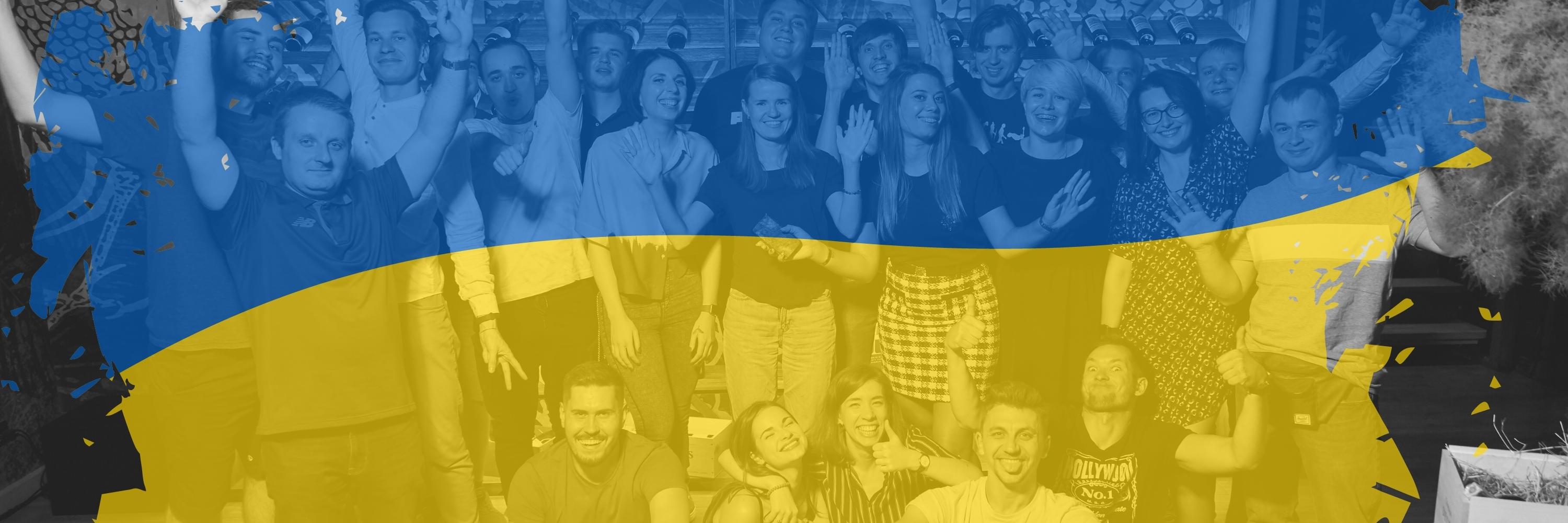
Interviewer: Where do you think AI will help the most in real business, and where is the hype likely to collapse first?
CEO: AI is a civilization-level challenge.
It’s extraordinary: it shifts programming from implementation to meaning. Less “how,” more “what.” You can build faster, the code can be ugly, but it works, and the ugliness will improve.
But the deeper question is: what happens to the “diggers” when the excavator arrives? Some transition. Many don’t. New people enter. That’s the uncomfortable part of progress.
Interviewer: What advice would you give to someone starting a company today?
CEO: Someone once told me the main quality of a leader is patience. Then corrected it: infinite patience. The word “infinite” is more important than “patience.”
If you go into this, understand the price. Every time you lose patience, you’ll regret it.
And another thing: this works only if it’s a deep passion. If it’s “extra income,” it fails almost always. The process must bring satisfaction because it will consume your life.
If you’re going to spend your entire life on something, it better be something you genuinely enjoy.
Interviewer: Let’s switch gears! If you had to introduce yourself at a party in one sentence, what would you say?
CEO: I’d probably say I’m a person shaped by the academic tradition: someone who tries to live and work without violence and heavy hierarchy, where authority comes from competence, not status.
I see this culture fading, and it worries me. When that layer disappears, consequences are serious.
In the end, the winners will be the ones who can think clearly, stay responsible, and keep learning faster than their own habits.
Interviewer: If you were a dog breed, which one would you be?
CEO: I’ve had a few dogs over the years, and you only really understand their character once you live with them day to day.
But if I had to pick, I’d go with an American cocker spaniel. We’ve had two, and they’re just… kind. Not the “tough guy” type. More like a warm, optimistic dog that adjusts quickly.
They’re good at adapting. They don’t argue with reality, they work with it. Something changes, they find a way to live in it and still stay themselves. I’d like to think that’s a bit like me too.