contact us

Five companies
turning aviation's paperwork and data into software

Aviation Software Startups to Watch in 2026

Aviation Software Startups to Watch in 2026: 5 Companies Building the Software Infrastructure Behind Modern Aviation

Softwarium

Aviation has spent decades making the aircraft themselves extraordinarily safe, and much of the software around them has not kept pace. That gap between how advanced the hardware is and how fragmented the supporting software remains. And this is where our roundup of the most notable aviation software startups have gone to work.

The five companies below each take on a different layer of that infrastructure: compliance documentation, airline operations, simulation and validation, pilot training, and private-aviation workflow. They serve different buyers, from aerospace manufacturers to flight schools to charter operators. What runs beneath all of them is the same demanding engineering problem: turning complicated, heavily regulated, safety-critical information into software people can trust.
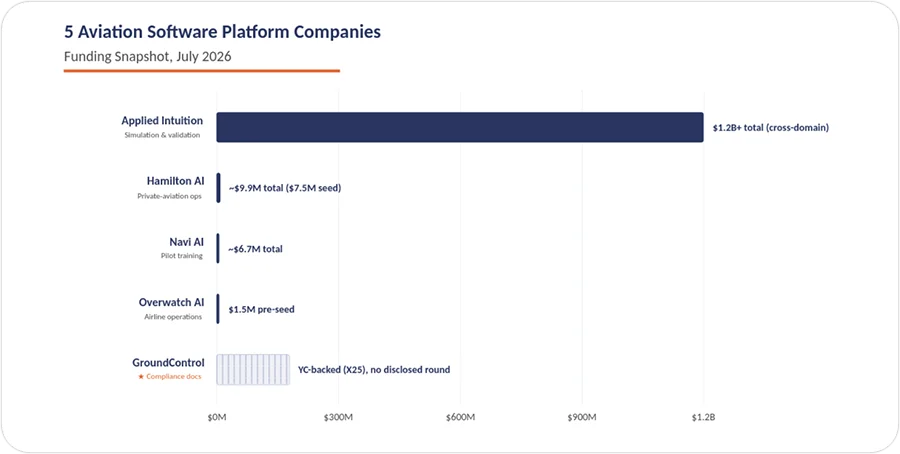
5 aviation software platform companies. Sources: company announcements and Crunchbase.

The Roster

GroundControl
★ COMPLIANCE DOCS

Y Combinator (X25). Serves 70+ aerospace facilities, 1,000+ reports/month.

GroundControl automates quality documentation for manufacturers in aerospace, defence, and medical. It was built specifically around AS9102, the aerospace standard for documenting First Article Inspections, and the AS9100 quality framework that sits around it. The platform reads engineering drawings, balloons the characteristics, pulls dimensions and callouts, maps results from CMM and metrology exports, and produces audit-ready inspection packages. The spotlight below explains why this particular sector of aviation turned out to be a software issue.

Overwatch AI
AIRLINE OPERATIONS

$1.5M pre-seed, May 2026; backers include United Airlines Ventures and Pegasus.

Founded in July 2025 by former commercial pilot Leo Kotil and technology entrepreneur Nikita Kaeshko, Overwatch AI builds a decision-support platform called Wingman for pilots, cabin crew, and operations teams. It pulls the scattered sources a crew needs, NOTAMs, weather, performance data, ops manuals, into one interface that answers plain-language questions with sourced, verifiable results. The platform runs across airlines handling more than 30,000 flights a month, and the company reports meaningful time savings per team member (company-reported). Having Pegasus join as customer, design partner, and investor at once is a strong signal that the tool solves a problem operators actually feel.

Applied Intuition
SIMULATION & VALIDATION

More than $1.2B raised; $600M Series F at a reported $15B valuation, June 2025.

Applied Intuition's primary domain is automotive and autonomous-vehicle simulation, so it sits in this roundup as a cross-domain reference rather than an aviation-native company. The reason it belongs here is the pattern it proves: simulation, validation, and software-in-the-loop tooling have become a high-value product category in their own right. The same engineering that lets carmakers test autonomy in simulation applies, with adaptation, to the validation demands rising across complex aviation software.

Navi AI
PILOT TRAINING

~$6.7M raised, out of stealth March 2026; backers include United Airlines Ventures.

Navi AI produces automated, detailed debriefs of training flights. It connects cockpit audio, aircraft telemetry, weather, and lesson plans, then turns each flight into a structured, moment-by-moment review that once took instructors hours to assemble by hand. Trained on more than 100,000 real flight hours and deploying at Embry-Riddle and other academies, Navi works inside the training-record and competency workflows that EASA and FAA requirements govern. The company is clear that the system does not fly the aircraft or make decisions; it gives instructors better data to teach with.

Hamilton AI
PRIVATE-AVIATION OPS

$7.5M seed, March 2026, led by TTV Capital; ~$9.9M total.

Hamilton AI serves private-aviation operators and brokers, taking the unstructured inputs that run a charter business, emails, PDFs, operational documents, maintenance records, and converting them into a system that handles quoting, scheduling, and payment reconciliation. Its founders describe a deterministic design meant to produce consistent, verifiable outputs rather than best guesses, which matters in a regulated, high-value setting. Named operators including Baker Aviation and Craft Aviation are already on the platform.


★ Spotlight: How GroundControl Is Making the Compliance Trail Auditable


In aerospace manufacturing, proving a part is correct can take longer than making it. Every safety-critical component carries a trail of documentation: First Article Inspection reports, dimensional results, material certifications, deviation notices, each one tied to a specific drawing and a specific requirement. A single missed callout or a mismatched drawing revision can trigger a source rejection, delay a shipment, or surface later as an audit finding. GroundControl builds software that automates this trail. It reads the drawing, identifies the characteristics that need checking, maps inspection results back to each one, and produces the AS9102 packages that customers and auditors expect, keeping every requirement linked to its evidence.


Getting a number off a drawing is the simpler task. Auditors want that number tied to a feature, backed by a measurement, and traceable to the revision it came from, and that is a much taller order.


What a defensible inspection record actually takes:

  • Structure. Capturing GD&T control frames, datums, and tolerances correctly, not just the raw numbers.
  • Mapping. Aligning metrology exports from tools like PC-DMIS and Calypso onto the right feature every time.

  • Validation. Catching missing data and revision mismatches before a human does, then exporting into AS9102, Net-Inspect, or a customer template.


All of it has to hold up under an AS9100 audit and, for defence work, inside ITAR and CMMC-secured environments. Getting it wrong does not read as a display bug. It reads as a rejected shipment or a compliance finding. Building it well means understanding both the manufacturing process and the evidence rules the quality system runs on, which is a narrower and scarcer skill set than general software engineering.

Where the build-versus-partner line tends to fall:

  • Keep in-house: the domain logic closest to the product, the quality expertise and the customer-specific rules, owned by the people who understand them.
  • Open to partners: structured data models, ERP and PLM integrations into systems like SAP and Teamcenter, and the audit-grade traceability underneath, which often moves faster with outside capacity that has built regulated software before.

Softwarium has done this class of engineering successfully: regulated software and enterprise integrations in aviation and aerospace.

The Patterns Underneath

Set the five companies side by side and three engineering patterns run through all of them. Each one marks a place where aviation software asks for more than ordinary product engineering.


Regulated documentation as a platform problem

Regulated documentation as a platform problem

GroundControl shows the compliance layer of aerospace manufacturing moving off paper and point tools onto integrated software. The engineering that takes structured data models, ERP and PLM integration, and traceability an auditor will accept, calls for the same discipline as regulated software delivery in any safety-critical field. The paperwork is the product, and it has to be exactly right.

Decision support against the clock

Decision support against the clock

Overwatch AI, Navi AI, and Hamilton AI all help aviation professionals act on fragmented information under time pressure. Building software that gathers, prioritises, and surfaces the right answer in seconds, while respecting the limits on what can be automated in a flight-critical or safety-critical context, is harder than it looks from the outside. It leans on aviation domain knowledge as much as on AI engineering, since an answer a crew cannot verify is an answer they cannot use.

Simulation and validation as their own infrastructure

Simulation and validation as their own infrastructure

Applied Intuition illustrates a category that grew out of a supporting role and became a product in itself. As aviation software platforms get more complex, the demand for simulation environments, test libraries, and evidence-generation tooling climbs alongside them. The teams who understand both the tooling and the regulated context around it are the ones positioned to build it.


What It Means for Engineering Leaders

The aviation software startups 2026 worth watching share one habit: they take the messy, regulated, safety-critical information aviation runs on and turn it into software people can act on with confidence. Compliance documentation, airline operations, pilot training, private-aviation workflow, and simulation each demand reliability standards that reach well past typical product software, because a wrong answer here carries real-world weight.

Softwarium builds dedicated development teams and co-managed engineering teams for product companies working under those constraints. Twenty-five years of software engineering delivery, European engineering micro-hubs, and a Center of Excellence in Poland stand behind the work, along with an Aviation and Aerospace delivery track record and regulated-software experience that sits close to the QA, integration, and platform engineering this category depends on.


Explore Softwarium's dedicated development team and IT staff augmentation services →

Read our full Aviation Software trends analysis →

Comments