Supply Chain and MRO Apps
made with C# and .NET

The Code Behind ERP and TMS Customization
Supply chain and MRO software spends most of its working life adapting to the business around it. A manufacturer running the same ERP for years adds its own approval rules and integrations along the way, and each of those changes is code that someone wrote and someone else now maintains.
Microsoft technologies appear in several supply chain and MRO platforms alongside other major enterprise ecosystems, and in the two examples below the Microsoft stack is where much of that adaptation work happens, from custom business logic in a manufacturing ERP to the application layer of a trucking TMS.
KEY TAKEAWAYS
- Epicor Kinetic customizations run as server-side C#, documented in Epicor's official Kinetic C# Programming Guide.
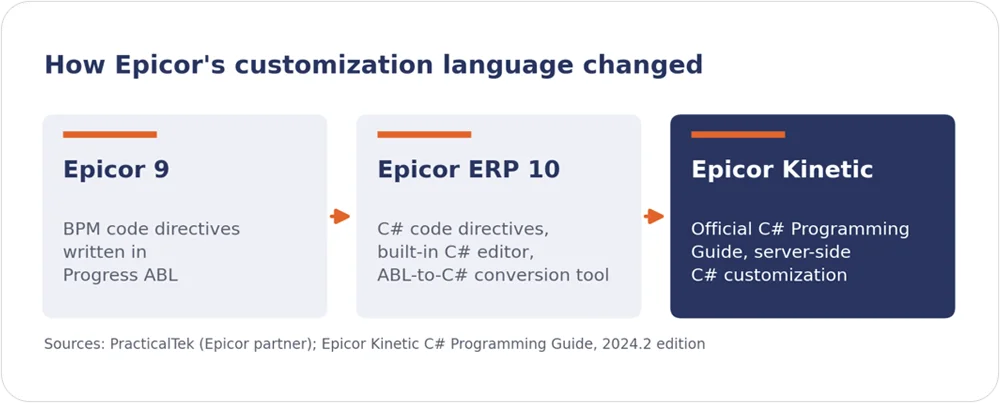
- Epicor moved its BPM code from Progress ABL to C# with ERP 10, and Kinetic carries that model forward.
- Trimble's release notes list Microsoft .NET Framework 4.6.2 as the baseline for its transportation applications, TMW.Suite included.
- TMW.Suite SaaS is hosted on Microsoft Azure through Trimble's Transportation Cloud.
The examples at a glance
|
Example |
Where C# and .NET show up |
Evidence |
|
Epicor Kinetic |
Server-side customization through BPM directives and functions, written in C# |
Epicor's Kinetic C# Programming Guide (2024.2) and EpiUsers community threads |
|
Trimble TMW.Suite |
Transportation applications built on Microsoft .NET Framework 4.6.2, with the SaaS edition hosted on Azure |
Trimble release notes, installation requirements and product pages |
Epicor Kinetic: C# Behind a Manufacturing ERP's Custom Logic
Epicor Kinetic is a manufacturing ERP with modules covering supply chain and maintenance operations. Companies shape it to their own processes through Business Process Management (BPM) directives, small units of logic that fire when a specific business event takes place. Two examples from Epicor partners show the range:

A guardrail
PracticalTek describes a directive that watches the discount field on a sales order and asks the salesperson for a reason once the discount goes above 15 percent.
A workflow
GingerHelp describes a directive where ticking a Purchase box on a sales order line creates a purchase order to the preferred vendor and sends it out by email.
The code inside those directives is written in C#. Epicor documents the practice in its Kinetic C# Programming Guide, whose 2024.2 edition carries the subtitle "Conversion from ABL" and walks developers through the tasks they meet in daily work, such as calling business objects and debugging their code. Epicor distributes the guide through its customer portal, and a copy is publicly available on Scribd.
The move to C# began a product generation earlier. In Epicor 9, BPM code directives were written in Progress ABL. Epicor ERP 10 switched them to C# and added a built-in C# editor to the BPM designer, according to PracticalTek, and customers with existing ABL directives could upload them to an Epicor conversion tool and receive C# equivalents. PracticalTek also notes that developers writing larger directives can work in Microsoft Visual Studio and call that code from a snippet inside the BPM. Kinetic carries the model forward, and customers who upgraded along that path brought years of business rules with them in C#.
The Epicor user community shows how much of that code is out in the field. Threads on EpiUsers, the Epicor user forum, treat C# as everyday working material:



"I inherited 1,000's of lines of C# Customization code."
Developer with 35 years of experience, EpiUsers community forum
ERP customization is mostly data work, where a directive reads the record that triggered it and writes changes to related parts or vendor records. C# handles that kind of work through LINQ, a set of query features that Microsoft describes as built directly into the C# language. PracticalTek notes that Epicor's C# BPMs rely on LINQ, and the Kinetic programming guide covers it as well, so a developer filters ERP tables with type-checked C# queries and the compiler catches a misspelled field before the directive ever reaches production.
Epicor also draws a clear line around where C# runs. The Epicor ERP Kinetic Customer FAQ, published by Epicor partner Encompass Solutions, states that Kinetic "does not support C# code on the Client," and user interface changes go through configuration in Application Studio. An independent review on ERP-Software.org describes the platform as built on the Microsoft .NET stack with SQL Server.
Where C# runs in Epicor Kinetic
Business logic and validations
Data exchange with other systems
in Application Studio
No C# code on the client
Source: Epicor ERP Kinetic Customer FAQ (Encompass Solutions); Epicor Kinetic C# Programming Guide
WHAT THIS MEANS FOR ENGINEERING TEAMS
C# work on Kinetic happens on the server, in the business logic layer where transactions are validated and the ERP exchanges data with other systems. Teams scoping a Kinetic project plan C# capacity for BPM directives, functions and integrations, and handle screen changes through Application Studio configuration.
Trimble TMW.Suite: The .NET Framework Under a Trucking TMS
Trimble describes TMW.Suite as its flagship transportation management system for asset and non-asset businesses, a range that covers carriers running their own fleets as well as brokers and 3PLs arranging freight on other companies' trucks. On its product page, Trimble explains the core job the system automates: capturing load details and working out miles and pricing, so each dispatch goes out correct and on time.
A TMS of this kind works as an integration hub for the business. Trimble highlights connections to tools ranging from fuel cards to asset tracking, and each connection brings a steady flow of data that has to land on the right load or invoice. The runtime underneath those connections is documented in Trimble's own release notes:
Trimble's documentation confirms the Microsoft stack at several levels:

Release notes
Trimble Web Products must run the same version as TMWSuite, and its 2025.4 release notes set the .NET requirement for the whole installation.

Installation requirements
The TMW Operations requirements list .NET Framework 4.6.2 or later as a prerequisite on both server and client machines.

Product classification
The TMWSuite 2024.2 release notes refer to the TMW.Suite Enterprise applications as .NET products.

Cloud hosting
Trimble markets TMW.Suite SaaS as powered by Microsoft Azure, and a 2025 Trimble blog post lists it among the solutions deployed on Azure through the Trimble Transportation Cloud.
A NOTE ON SCOPE
The 4.6.2 figure appears in Trimble's documents as a minimum installation requirement, so it sets a baseline for the runtime and leaves the rest of the architecture undescribed. The cited sources also stop short of naming C# as the implementation language, which is why this article describes TMW.Suite as running on the .NET Framework.
For a trucking company on the SaaS edition, both the application runtime and the hosting environment come from the Microsoft ecosystem.
Softwarium in Supply Chain and MRO: Synovos
Softwarium is a software engineering and IT staff augmentation company supporting software product companies and technology teams, including a Power BI Embedded data foundation and analytics layer built for Synovos, now RS Integrated Supply, across an engagement exceeding seven years.
Power BI Embedded is Microsoft's service for placing Power BI reports and dashboards inside a company's own applications, so the people who work with operational data find it in the tools they already use. Softwarium teams built the data foundation beneath that layer and have maintained it through the whole engagement, and the length of the relationship has kept knowledge of Synovos's data and reporting needs inside one stable engineering team.
What .NET Supply Chain Software Has in Common
C# and .NET show up in two different places across these examples. Epicor puts C# where a manufacturer's own business rules live, in the server-side directives that shape each transaction, while Trimble builds its transportation applications on the .NET Framework and hosts the SaaS edition on Azure.
Where the Microsoft stack appears in supply chain software, it carries the logic that companies adapt to their operations year after year.
Supply chain and MRO software draws on several enterprise ecosystems. Softwarium reviewed other major platforms while preparing this article, and their current flagship products run largely on Java-based stacks or lack public documentation clear enough to support a technology claim. In Epicor and Trimble, the Microsoft stack holds the long-lived logic of the business, which makes C# and .NET experience a practical asset for teams extending those systems.
Softwarium's companion posts on C# and .NET in oil and gas software and C# and .NET in energy trading software follow the same thread through the energy sector.
Extend Your Supply Chain Platform with a Dedicated .NET Team
Softwarium is a software engineering and IT staff augmentation company, headquartered in the US with European engineering hubs. For Synovos, now RS Integrated Supply, Softwarium teams built and have maintained a Power BI Embedded data foundation and analytics layer across more than seven years. To scope a dedicated .NET development team for integrations and analytics around your ERP or TMS, talk to Softwarium directly.