
Famous Apps Built
with C# and .NET:
From DraftKings to Microsoft Graph

C#, Azure, and the Apps You Already Use
C# has long had a reputation as the language of enterprise back offices, and DraftKings is one of several well-known platforms that don't fit it. Geocaching, the GPS treasure hunt played around the world, runs on a back end that Microsoft's .NET pages describe as built entirely with .NET. Microsoft Graph, the API gateway behind Microsoft 365, uses .NET to scale across Azure.
The examples below follow the stack from a sportsbook built for game-day traffic to Microsoft Graph, the API behind Microsoft 365, which uses .NET to scale across Azure.
The examples at a glance
|
Example |
Where C# and .NET show up |
Cloud named in sources |
Evidence |
|
DraftKings |
C# and ASP.NET Core in backend teams; hundreds of applications moved from .NET Framework to .NET Core |
AWS |
DraftKings careers site and engineering blog; AWS guest post by DraftKings' Director of Architecture, January 2021 |
|
Geocaching |
Back end built with .NET, per Microsoft; .NET web APIs serving players and partners |
Not named |
Microsoft .NET microservices page and .NET customer showcase |
|
Microsoft Graph |
ASP.NET Core on .NET 6 as of May 2022, scaling across Azure |
Azure |
Microsoft .NET customer showcase; .NET Blog case study, May 2022 |
DraftKings: C# Behind a Sportsbook Built for Game-Day Traffic
DraftKings is a Boston-headquartered sports entertainment and gaming company, publicly traded on Nasdaq as DKNG, and its products include a sportsbook and daily fantasy contests. Its engineers write about their stack in public on the DraftKings careers site and the company's engineering blog, and C# comes up in both places.
A July 2025 careers profile of Corey, a Lead Software Engineer on the Daily Fantasy backend team, lists the tools he works with:
The profile calls “spiky” traffic during high-stakes sporting events one of the team's biggest technical puzzles, since one player's touchdown can send millions of people to check the app at the same moment. The team meets those surges with distributed microservices and layered caching, read replication, Kubernetes autoscaling, and load tests that simulate game-day peaks.
DraftKings' Sports Intelligence team, writing on the DraftKings Engineering blog in July 2023, says its engineers use C# and SQL to ingest and transform raw sports data, with Kafka carrying real-time feeds and the cloud infrastructure deployed on AWS. A current Sportsbook posting for a Senior Software Engineer asks for C# and .NET Core and describes systems and APIs that process two million bets daily.
Hundreds of applications moved to .NET Core
A detailed account of how DraftKings arrived at that stack comes from David Musicant, the company's Director of Architecture, in a guest post on the AWS blog dated 7 January 2021. It covers the modernization of hundreds of DraftKings applications from .NET Framework to .NET Core on AWS, so it documents existing services moving to a newer runtime. The careers profile and job postings above describe the stack as it stands today.
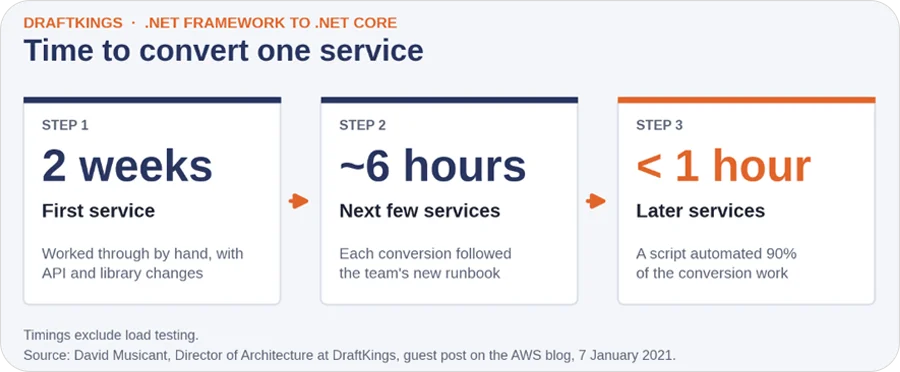
Musicant describes a starting point of .NET Framework and NServiceKit beneath the company's microservices. Converting the first service took two weeks while the team worked through .NET Core API changes and third-party library upgrades. A runbook brought the next few conversions down to about six hours each, and an automated script that handled 90% of the conversion work later cut a service to under an hour, not counting load testing.
Musicant writes that DraftKings operates in a highly regulated environment, where releases go through rigorous testing and some need approval from regulators. Converted services therefore went out as canary releases, with a load balancer sending a share of traffic to the new version while dashboards compared it with the old instances. Load testing also caught a defect the functional tests missed, an asynchronous call in the circuit-breaking library that looped under high load and pushed latency up.
According to the post, .NET Core also opened the way to Linux and containers, with Kubernetes following later, which matches the stack in Corey's 2025 profile. The DraftKings sources cited here place the company's infrastructure on AWS and make no Azure claim, so this example stands as evidence for C# and .NET at consumer scale on another provider's cloud.
Geocaching: A .NET Back End for a Worldwide Game
Geocaching is an outdoor game in which players use GPS coordinates to find hidden containers and then record each visit as an online log. Microsoft calls it the world's biggest game of hide-and-seek, and its page on building microservices with .NET says Geocaching grew from thousands to millions of customers and scaled across the globe “because their entire back end is built with .NET.” The company's entry on Microsoft's .NET customer showcase adds that it uses .NET web APIs to support its customers and partners.
The microservices page also quotes Mario Bellemare, who leads Geocaching's API and sustainment teams, on the load that API carries. By his account it handles more than 1,000 calls per second around the clock and serves several dozen partners along with Geocaching's own mobile app and websites. The system behind it holds over a billion geocache logs.
1,000+
API calls per second, around the clock
1 billion+
geocache logs recorded in the system
Figures quoted by Geocaching’s API team lead on Microsoft’s .NET micros ervices page.
Microsoft's page carries no publication date, so the figures describe Geocaching at the time of the quote. The same page describes Geocaching's overall technology stack as hybrid, with the .NET claim applying to the back end, and neither Microsoft page names a cloud provider for the platform.
Microsoft Graph: .NET and Azure at Microsoft's Own Scale
Microsoft Graph is the API gateway that gives applications unified access to data in Microsoft 365, and developers call it when their software needs to read a user's calendar or files from outside Microsoft's own apps. Microsoft's .NET customer showcase describes the service as using .NET “to scale and optimize performance across Azure.”
Microsoft builds both the product and the platform underneath it, so Graph shows .NET and Azure working together at Microsoft's own scale. The stack decision came from inside the vendor, which gives this example a different weight from DraftKings or Geocaching, where the companies' own engineers chose C# and .NET.
In that May 2022 case study, Paiva traced the service's path from ASP.NET on .NET Framework 4.6.2, hosted on IIS, to ASP.NET Core on .NET 6, with interim stops on .NET Core 3.1 and .NET 5. The move to .NET Core 3.1 cut CPU use by 30% for the same traffic volume, and the step from .NET 5 to .NET 6 cut it by another 10%.
Over the same four years, Microsoft Graph went from 1 billion requests a day to about 70 billion, while operational cost per billion requests fell by 91%. Paiva counts the .NET Core migration among the big contributors to that result, and at the time of writing the service ran in 20 regions worldwide.
MICROSOFT GRAPH · .NET ON AZURE
Four years on the .NET upgrade path
Requests per day
Four years earlier
May 2022
About a 70x increase in daily traffic
91%
lower operational cost
per billion requests
30% + 10%
less CPU at the same traffic, after
.NET Core 3.1 and then .NET 6
Paiva's post also names the C# and .NET features the team used to cut memory allocations, such as spans for string handling and ValueTask for asynchronous code. He describes Graph as a compute-bound service where new .NET releases reduce CPU cycles and garbage collection work without explicit effort from the team. The figures date from May 2022 and describe the service as it ran then.
MORE EXAMPLES ON THE MICROSOFT STACK
Softwarium's overview of real-world applications built with .NET and Azure covers Stack Overflow, Microsoft Teams, GitHub, and GE Digital's FlightPulse. It includes Nick Craver's 2016 breakdown of how Stack Overflow served about 1.3 billion page views a month from nine web servers.
What These Applications Have in Common
The three platforms put C# and .NET under very different kinds of load. DraftKings absorbs traffic bursts tied to live sporting events and ships changes under regulatory review, while Geocaching runs a public API that partners build on around the clock. Microsoft Graph was routing about 70 billion requests a day across the Microsoft 365 ecosystem by 2022.
DraftKings and Microsoft Graph also left detailed records of their migrations. Both teams moved large running systems off .NET Framework in stages and tested the new runtime on live traffic before a full rollout, DraftKings through canary releases and Microsoft Graph through A/B testing on part of its production capacity. Both write-ups name the problems the engineers ran into, from Kestrel's smaller default limit on request headers at DraftKings to URI encoding differences between ASP.NET and ASP.NET Core at Microsoft Graph. For a CTO weighing .NET for a high-traffic product, these first-hand accounts show what a migration of this size involves.
Softwarium's industry posts follow C# and .NET into narrower markets: real estate software, legal technology, oil and gas, energy trading, and supply chain and MRO.
Add C# and .NET engineers to a high-traffic product
Softwarium is a software engineering and IT staff augmentation company, headquartered in the US with European engineering hubs. Its distributed engineers deliver production systems in C# and .NET, and the team includes Azure Certified Engineers.
To scope a dedicated .NET development team, book a 30-minute call with Anna Moskalets, Head of Digital Enhancement, or review Softwarium's .NET development services.