
Future of Healthcare in 2026:
5 Companies Building AI-Powered Healthcare Platforms

Healthcare & Clinical Research Startups to Watch in 2026
Money came back to digital health in 2025. US digital health venture capital reached $14.2 billion, a 35% jump over the $10.5 billion raised in 2024 and the strongest year since 2022, with average deal sizes climbing to $29.3 million from $20.7 million (Rock Health, 2025 Year-End Digital Health Funding Report). But a strong funding year says more about investor mood than about which platforms actually work.
The five companies below earn their place on what they build. Each one builds an AI-powered platform that has to work inside a hospital, a lab, or a drug-discovery pipeline, which means each one runs headlong into the same wall: healthcare data is regulated, fragmented across incompatible systems, and unforgiving of error. What separates the companies that scale from the ones that stall is the engineering underneath.
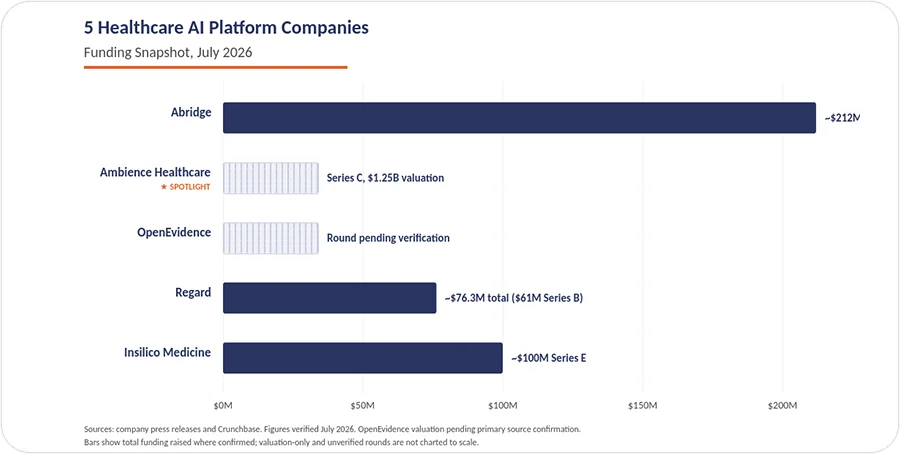
The Roster
★ Spotlight: Ambience Healthcare and the Engineering of Multi-Specialty Clinical AI
Ambience Healthcare sells AI-assisted clinical documentation to health systems, with a platform that spans more than 100 medical specialties. The buyer is a CMIO or a health-system CIO who needs documentation quality to hold up whether the clinician is a cardiologist, a pediatric oncologist, or an emergency physician. A single general-purpose model tends to struggle across that range, and that pressure shapes much of the engineering agenda.
Four hard problems run in parallel here:
- Multi-specialty NLP. Documentation across a hundred-plus specialties calls for specialised language models, curated training data, and validation routines that a general LLM never touches. Cardiology vocabulary, oncology staging, and psychiatric assessment each behave differently.
-
EHR integration. Connecting to Epic and Oracle Cerner means SMART on FHIR authentication, HL7 FHIR R4 API work, and interface testing across the countless ways individual health systems configure their installs.
- Regulated data handling. The platform processes protected health information under HIPAA Security Rule requirements, which forces encrypted data flows, granular access controls, audit logging, and a business associate agreement with every connected system.
-
Multi-tenant reliability. Health systems expect availability north of 99.9%. A documentation outage lands directly in the clinical workflow, mid-shift.
Ambience's own clinical accuracy figures come from company materials and should be read as company-stated, not as independently validated evidence.
For a healthcare software team, the build-versus-partner line gets drawn here. The clinical models and the product experience are the differentiator, and they stay in-house next to the specialists who understand the medicine. The infrastructure rarely wins anyone a deal: FHIR connectors, audit pipelines, tenancy isolation, and the QA coverage that keeps a regulated system stable through every release. Handing that layer to engineers who have built it before frees the core team to stay on the medicine.
Softwarium supports this layer through distributed engineers experienced in regulated software delivery, EHR integration architecture, and QA for complex healthcare systems.
Three Engineering Patterns Beneath the Roster
Different products, one shared constraint. Every company here handles clinical or biomedical data under regulation, and three engineering patterns recur across all of them.



Softwarium is a US-headquartered software engineering and IT staff augmentation company with an EU-based engineering delivery network, supporting software product companies and regulated technology teams through co-managed engineering partnerships on platform development, systems integration, cloud-native architecture, and quality assurance for complex and regulated software environments.
What This Means for Engineering Leaders
Healthcare technology startups in 2026 win on infrastructure as much as on models. The five companies here raised into a recovering market, and each now has to turn capital into platforms that hold up under EHR integration, regulated data handling, and clinical-grade reliability at health-system scale.
Softwarium builds dedicated development teams and co-managed engineering teams for product companies facing that exact conversion. Twenty-five years of software engineering delivery, European engineering micro-hubs, and a Center of Excellence in Poland stand behind the work, alongside a documented clinical decision-support delivery in a regulated psychiatric-care environment.
Explore Softwarium's dedicated development team and IT staff augmentation services →
Read our full Healthcare & Clinical Research trends analysis →