Legal & LegalTech
Software Trends in 2026:
6 Shifts Every Engineering Leader Should Act On

LegalTech Software Trends 2026: 6 Key Shifts
The global LegalTech market is estimated at $34.15 billion in 2025, growing to $38.67 billion in 2026 and projected to reach $71.95 billion by 2031 at a 13.22% CAGR (Mordor Intelligence estimate). That trajectory tracks a structural shift in how legal work gets done. AI adoption among legal professionals has accelerated sharply: 92% of legal professionals now use at least one AI tool in their daily workflow, per the Wolters Kluwer 2026 Future Ready Lawyer Survey of 810 lawyers across the US, China, and nine European countries. Corporate legal departments have outpaced law firms — in-house AI adoption in the US rose from 23% to 52% in a single year, and 64% of in-house teams expect to depend less on outside counsel (ACC/Everlaw GenAI in Corporate Legal Survey 2025).
The constraint shaping these legal technology trends 2026 is the integration complexity and specialist engineering capacity required to connect AI tools to entrenched legal workflows — DMS platforms, billing systems, practice management stacks, and the governance controls that legal work demands. LegalTech digital transformation now turns on engineering execution.
The six shifts below map where that work concentrates in 2026 — and what each one demands from the teams building and buying legal software.
Two audiences feel this differently.


Each trend below carries a takeaway for both. The Wolters Kluwer survey also found 62% of lawyers report 6–20% weekly time savings from AI and 52% report revenue increases — which is why the question has shifted from whether to adopt to how to build and integrate responsibly.
The adoption surge behind LegalTech digital Transformation
|
92% use at least one AI tool daily |
23 → 52% US in-house AI adoption, one year |
79% of lawyers use AI in some form |
Six shifts reshaping legal software in 2026
The six shifts at a glance — each maps to a distinct engineering demand.
.webp)
TREND 1: How AI Agents Are Reshaping Legal Technology Trends in 2026
AI use among legal professionals has moved from edge case to baseline. 79% of legal professionals now use AI in some capacity, up from 19% in 2023 (Clio Legal Trends Report 2025). The time returned is concrete: lawyers using generative AI save between 1 and 5 hours per week (38%) or 6 to 10 hours (14%), per the Thomson Reuters Generative AI in Professional Services Report 2025. Everlaw's 2025 eDiscovery Innovation Report found that people reporting five hours saved per week project savings of up to 260 hours per year — roughly 32 working days. McKinsey's legal-spend analysis (2024) estimates that automation could account for approximately 30% of legal professionals' current working hours by 2030.
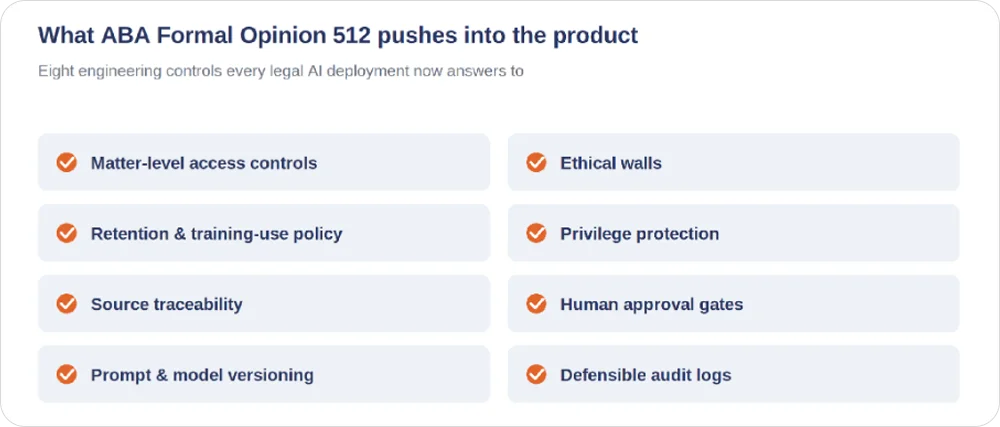
The shift in 2026 is from AI as assistant to AI as agent — systems that chain steps, call tools, and execute multi-stage tasks rather than answering single prompts. Harvey's valuation reached $11 billion in March 2026, a market signal of how much capital is backing agentic legal AI. But agency raises the governance stakes. 53% of firms have no AI policy or are unaware of one (Clio), and ABA Formal Opinion 512 addresses competence, confidentiality, communication, supervision, and fees when lawyers use generative AI. That opinion is the professional responsibility framework every legal AI deployment now answers to. In practice it pushes specific requirements down into the product: matter-level access controls, ethical walls between conflicted teams, retention and training-use policies, source traceability for every generated assertion, human approval gates before any agent action lands, and defensible audit logs. An agent that cannot show its work is an agent that cannot ship into a regulated legal setting.
For LegalTech product teams: Agentic workflow orchestration is the new engineering surface — frameworks such as LangChain/LangGraph are options, not defaults, and you must evaluate security exposure, vendor lock-in, and human approval gate design before prescribing any of them. The build list extends to LLM integration, matter-level access controls, ethical walls, audit trail architecture, model and prompt versioning, and defensible logs that hold up under scrutiny.
For legal technology buyers: Tool selection must satisfy ABA Formal Opinion 512. Vendors who cannot demonstrate privilege protection, retention and training-use policies, and source traceability will not survive procurement review. Treat legal AI governance — matter-level access, defensible audit logs, human approval gates — as a gating requirement, not a feature to add later.
TREND 2: Contract Lifecycle Management Has Become the Fastest-Growing LegalTech Engineering Category
CLM shows the highest growth rate within LegalTech at 18.35% CAGR to 2031 (Mordor Intelligence estimate). The driver is structural: 64% of in-house teams expect to depend less on outside counsel because of AI capabilities they are building internally (ACC/Everlaw). Contract lifecycle management software is now an enterprise infrastructure layer, not a law firm tool — which changes who builds it and what it has to connect to. When procurement, sales, and legal all touch the same contract data, the CLM becomes a system of record that finance and revenue operations depend on, and that raises the integration and reliability bar accordingly.
Vendor-reported gains are substantial, and they belong to the vendors who report them. Thomson Reuters materials report more than doubling of review and drafting speed, and reduction in document review time of up to 80%, for their AI review tools — these are product claims attributed to Thomson Reuters, not independent benchmarks. Luminance reports 127% year-over-year North American revenue growth in 2025, on AI that has analysed more than 220 million documents (company-reported). Kira (Litera) is used by approximately 70 of the top 100 global law firms and more than 80% of top 25 M&A practices (company-reported). The pattern is clear: legal document automation in contracting has crossed from pilot to production.
CLM has crossed from pilot to production
|
2x+ review & drafting speed |
127% YoY NA revenue growth |
220M+ documents analysed |
70 of 100 top global law firms use Kira |
For LegalTech product teams: The core build is NLP/NLU models for clause extraction and risk flagging, ML pipelines for obligation tracking, and an API-first CLM architecture. Salesforce CRM and Microsoft 365 integrations are no longer optional — they are where the contract data already lives.
For legal technology buyers: Evaluate CLM on integration depth with your existing procurement and CRM systems, not feature count. AI-suggested clause changes need auditable governance controls — if you cannot trace who or what changed a clause and why, the tool creates risk faster than it removes it.
TREND 3: eDiscovery Has a New Dimension: AI-Generated Content as Discoverable Evidence
A new evidence category has arrived: AI-generated content. Copilot artifacts, AI note-taker transcripts, and shadow AI outputs are becoming discoverable material, and Relativity's own guidance on enterprise AI conversations and associated metadata reflects how quickly this is moving from theory to matter strategy. 46% of legal professionals believe AI will impact eDiscovery most within the next five years (US Legal Support 2026 survey of 2,000+ respondents). The engineering consequence is that the universe of discoverable data has expanded faster than most eDiscovery pipelines were designed to handle — a deposition or production request can now reach into Copilot session history, meeting-assistant transcripts, and the metadata trail those tools leave behind.
Vendors are repositioning around this. DISCO described its February 2026 launch as the industry's first scaled agentic AI tool for fact investigation and eDiscovery — a market-first framing that is DISCO's own claim. Pricing is shifting too, with specific scope in each case: Relativity included specific aiR features (aiR for Review, aiR for Privilege) in standard RelativityOne pricing, and Everlaw made selected single-document Review Assistant and Writing Assistant features available at no additional cost. Neither is a blanket free GenAI review offer; each is a scoped change tied to specific features, and the distinction matters when a buyer is forecasting cost at enterprise volume.
LegalTech product companies partnering with Softwarium gain access to distributed engineers experienced in AI and ML engineering for document intelligence and legal workflow automation, cloud-native SaaS architecture, Microsoft and Azure integrations, and SDET-led quality assurance for enterprise legal software platforms.
For LegalTech product teams: Build for scale and provenance — large-scale document processing pipelines, ML relevance classification, Microsoft 365 / Teams data export handling for AI artifacts, semantic vector search, and chain-of-custody data architecture that can prove where every artifact came from.
For legal technology buyers: eDiscovery protocols need updating to address AI-generated content. Counsel and legal ops should define data source maps that include AI tool outputs at matter outset, not after a dispute surfaces them.
Scaling Your LegalTech Platform?
TREND 4: Legal Document Intelligence Has Become Core Platform Infrastructure
The legal industry's document volume — contracts, title searches, pleadings, regulatory filings, court records — has historically been managed through manual review and fragmented storage. AI document intelligence platforms replace that with automated extraction, classification, and validation pipelines, and the move is now infrastructure rather than experiment. Cloud-based platforms account for an estimated 64% of LegalTech deployments (Mordor Intelligence estimate), which means document intelligence is increasingly built cloud-native from day one.
Softwarium built an ML-powered document processing pipeline for ProTitleUSA — a title search company — using Google Cloud AI and OCR technologies to automate document extraction and validation. That is the kind of legal document automation work that separates a platform from a document store: the value is not storing the file, it is reading it, structuring it, and validating the result reliably enough to act on. Title search, like contract review and regulatory filing, is exactly the high-volume, high-variation document problem that manual review scales badly against.
|
DELIVERY PROOF POINT — PROTITLEUSA |
For LegalTech product teams: The build stack is OCR and document digitisation pipelines (Google Vision API, Azure AI Document Intelligence — the service Microsoft renamed from Azure Form Recogniser in July 2023), ML-based document classification and entity extraction, structured data output APIs, and vector database architecture for semantic document search (Pinecone, Azure AI Search).
For legal technology buyers: Document intelligence integration with an existing DMS (iManage, NetDocuments) is an engineering engagement, not a configuration task. Plan for integration, data migration, and validation as distinct workstreams with their own timelines and owners.
TREND 5: Legal Analytics Is the Capability Separating Competitive LegalTech Platforms From Feature Libraries
Analytics is the fastest-growing segment within the LegalTech market at 14.7% CAGR to 2033 (Grand View Research estimate). Demand is concrete: 38% of legal professionals plan to use AI-powered predictive analytics for trial preparation (US Legal Support 2026 survey). The capability gap between a legal analytics platform and a collection of dashboards is widening, and it is an engineering gap as much as a data science one.
Honesty about what these models do is itself a selling point to sophisticated buyers. A May 2026 research study using 835,190 civil-litigation filings reported class-specific AUC values between 0.74 and 0.81, with higher accuracy only for a selected high-confidence subset. Predictive analytics tools provide probabilistic risk signals that inform litigation strategy — they are not outcome guarantors. Calibration, explainability, and clear model limitations are what matter to legal buyers evaluating these systems, and platforms that overstate accuracy lose credibility the first time a prediction misses. The AUC range tells the real story: these models discriminate meaningfully but imperfectly, and they perform best on a narrow high-confidence slice rather than uniformly across every matter. A platform that surfaces a confidence band and the factors behind a prediction earns more trust from a litigation team than one that prints a single number with no context.
For LegalTech product teams: Build legal data warehouse architecture, case outcome ML model pipelines with calibration and explainability requirements baked in, integration with Westlaw and LexisNexis research databases, and matter analytics dashboards (Power BI or embedded analytics). Explainability is a requirement, not a roadmap item.
For legal technology buyers: Predictive analytics needs clean, structured historical matter data. The engineering readiness gap here is usually a data quality problem before it is a model problem — budget for data preparation accordingly.
TREND 6: Legal Teams Have Stopped Tolerating Point Solutions — Integration Depth Is the Differentiator
Cloud reliance is now the norm: 73% of firms rely on cloud-based legal tools, and approximately 75% of attorneys used cloud computing for work tasks (ABA Technology Survey 2024 / ABA April 2025 report). What buyers reward has shifted accordingly: 43% of legal professionals prioritise integration with trusted software as their top criterion when choosing AI tools (ABA Legal Industry Report 2025). Consolidation is following the same logic — Clio's $1 billion acquisition of vLex in 2025 combined practice management with a 1B+ document global legal research database. Thomson Reuters invests more than $200 million annually in AI enhancements for Westlaw Precision and CoCounsel (company-stated figure).
The market signal is consistent across all of it. Microsoft and Azure integrations, deep DMS connectors, and clean cross-platform data flow now decide whether a tool earns a place in the stack or generates overhead. Law firm technology modernisation has become an integration problem before it is a feature problem.
Integration depth is the differentiator
- API-first integration architecture
- Clean DMS, billing & PM connectors
- Microsoft 365 / Azure embedding
- SSO & role-based access
- Standalone, disconnected tools
- Manual data transfer between systems
- No clean path to your DMS
- A governance & efficiency liability
For LegalTech product teams: The architecture priorities are API-first integration, Microsoft 365 and Azure embedding (Copilot extensibility), matter management system connectors, SSO and role-based access for enterprise legal environments, and event-driven architecture for cross-platform data synchronisation.
For legal technology buyers: Evaluate integration depth before feature capability. A tool that cannot connect cleanly to your DMS, billing system, and practice management stack will generate more overhead than it saves. Standalone AI tools that require manual data transfer between systems are a governance and efficiency liability.
The Common Thread: Legal Software Trends Now Turn on Engineering Execution
The six shifts share one demand. LegalTech product teams and legal departments need engineering partners who understand legal workflows, integration complexity, and the professional responsibility obligations that govern how AI can be used in legal contexts. Across legal software trends in 2026, the gap between organisations running on integrated, AI-native platforms and those managing disconnected point-solution stacks widens every quarter — and it widens fastest where engineering capacity is the bottleneck. Softwarium works with LegalTech product teams and legal technology departments as a co-managed engineering partner — from document intelligence platform development and legal workflow automation to data pipeline engineering, enterprise system integration, and AI governance infrastructure for regulated legal environments.
For LegalTech product companies: Softwarium builds and scales engineering teams for LegalTech product companies.
Explore our dedicated development team model →
For legal departments: Softwarium also works with enterprise legal departments on platform integration, legacy modernisation, and workflow automation.
Talk to our team →