
From Manual QA
to Test Automation:
Practical SDET Roadmap
A practical roadmap led by SDETs for teams moving from manual QA toward a pipeline that can be trusted.
Use this guide as a diagnostic tool, an implementation plan, and a vendor evaluation sheet.

What you'll learn
- Why manual QA starts to fail once release speed increases
- What an SDET does differently from a QA engineer
- How to assess your current QA maturity
- How to roll out test automation in six practical steps
- What a realistic first 90 days looks like
Download the PDF version
to keep the roadmap offline.

A team is shipping every day. Releases move faster than they did a year ago. The pipeline looks healthy on paper. Then a bug reaches production, customer-facing, expensive, and avoidable. In the post-mortem, the same pattern shows up again: the issue sat in a part of the product nobody had time to regression test properly before release.
DevOps made shipping easier, but it didn’t solve the question of what enters each release. When delivery speeds up but quality checks stay manual, regression backlogs grow, test cycles get skipped, and more defects slip into production.
This is the point where SDET-led automation starts to matter. An SDET is there to build the test infrastructure, quality gates, and pipeline logic that make defects harder to ship in the first place.

Why manual QA breaks at scale

The defect cost curve
Production defects are not only technical problems. They are budget problems. NIST research has long shown that the cost of fixing a defect rises sharply the later it is found. A defect caught during integration testing can cost about 10 times more to fix than one addressed at the requirements stage, and the cost rises further after release. CISQ also estimates that poor software quality costs the US economy trillions of dollars each year. In other words, weak quality control is not a harmless delivery tax. It becomes an expensive operating model. According to NIST research, fixing a defect late is far more expensive than catching it early, and CISQ places the wider cost of poor software quality at $2.41 trillion in the US economy.
For an engineering leader, that changes the question. The question is not whether test automation takes investment. The question is whether the current method of finding defects is worth its cost.

The manual regression trap
A team deploying daily cannot run full manual regression on every build without paying for it in one of three ways. First, regression gets skipped. Releases stay fast, but quality becomes luck. Second, releases wait for manual checks. Quality gets protected, but delivery slows down. Third, developers absorb the regression burden. The release keeps moving, but coverage becomes uneven and context switches grow.
None of these options age well. A simple example makes it plain. If 10 engineers spend one hour a day covering manual regression work across five days a week, that turns into 2,600-plus person-hours over a year. Those hours are real. They come out of feature work, platform work, refactoring, and problem-solving time.
This is how test debt builds up. The suite stays manual because the team is busy, and the team stays busy because the suite is manual.
Five signs your QA model is holding back delivery
| Symptom | Likely root cause | Fix path |
|---|---|---|
|
Regression takes longer than your sprint cadence |
The suite is still heavily manual or too broad to run often |
Set a regression cycle time target and redesign the suite around the test pyramid |
|
Flake rate is above 5 percent |
The pipeline signal is noisy and no one owns cleanup |
Give the SDET team a flake budget, quarantine flow, and root-cause routine |
|
Defect escape rate is rising |
Tests run too late or do not cover the critical paths that actually break |
Measure defect escape rate for 90 days and tie coverage work to those misses |
|
QA is the release bottleneck |
Quality still depends on manual approval at the end |
Move core checks into quality gates before merge and before staging |
|
There is no shared quality dashboard |
Delivery metrics and QA KPIs are tracked separately |
Track DORA metrics and QA KPIs in one view |
If any two of these feel familiar, the issue is not a missing tool, but a maturity problem.
What is an SDET, and how is it different from QA?
Definition and origin
The “software development engineer in test” role took shape in companies that needed to keep shipping without letting quality collapse. The role is best understood by output, not by title. An SDET builds and owns the automation architecture that makes it harder for defects to reach production. That work includes the test framework, the test pyramid, the quality gates, CI/CD integration, and the ongoing work of keeping the pipeline trustworthy.
A QA engineer may execute test scenarios against a build. An automation engineer may write test scripts. An SDET works one level deeper. They build the system that decides how testing happens, where it runs, what blocks a merge, and how the team keeps that setup reliable over time.

SDET vs QA comparison
| Role | What they own | Where they work in the pipeline | What the pipeline looks like without them |
|---|---|---|---|
|
Manual QA engineer |
Exploratory testing, release checks, scenario coverage |
Mostly after a build exists or near release |
Releases depend on human availability and repeated manual passes |
|
Automation engineer |
Scripts for selected flows, often around an existing suite |
Usually after test cases are already defined |
Some regression is automated, but ownership of pipeline quality stays unclear |
|
SDET |
Test architecture, quality gates, flake control, CI/CD integration |
From sprint planning through pull request and release design |
Quality becomes a property of the pipeline, not a separate last-mile activity |
Four things an SDET owns inside a pipeline




The four stages
of QA maturity
Most teams do not move from fully manual QA to an engineered automation model in one jump. They move through stages. A useful QA maturity model gives the team a shared language for where it is now and what has to change next.
In practice, Softwarium usually joins teams at Stage 1 or Stage 2, where testing is still reactive or only partially integrated into delivery. The near-term goal is Stage 3 — that is the point where test automation starts acting like infrastructure instead of a side project.
Most teams start at Stage 1 or Stage 2. Stage 3 is usually where Softwarium meets our customers.

 1
Stage 1: Reactive
Testing happens near the end. The team relies on people, not systems. Quality is measured after the fact through complaints, incidents, or rushed bug triage.
 2
Stage 2: Scripted
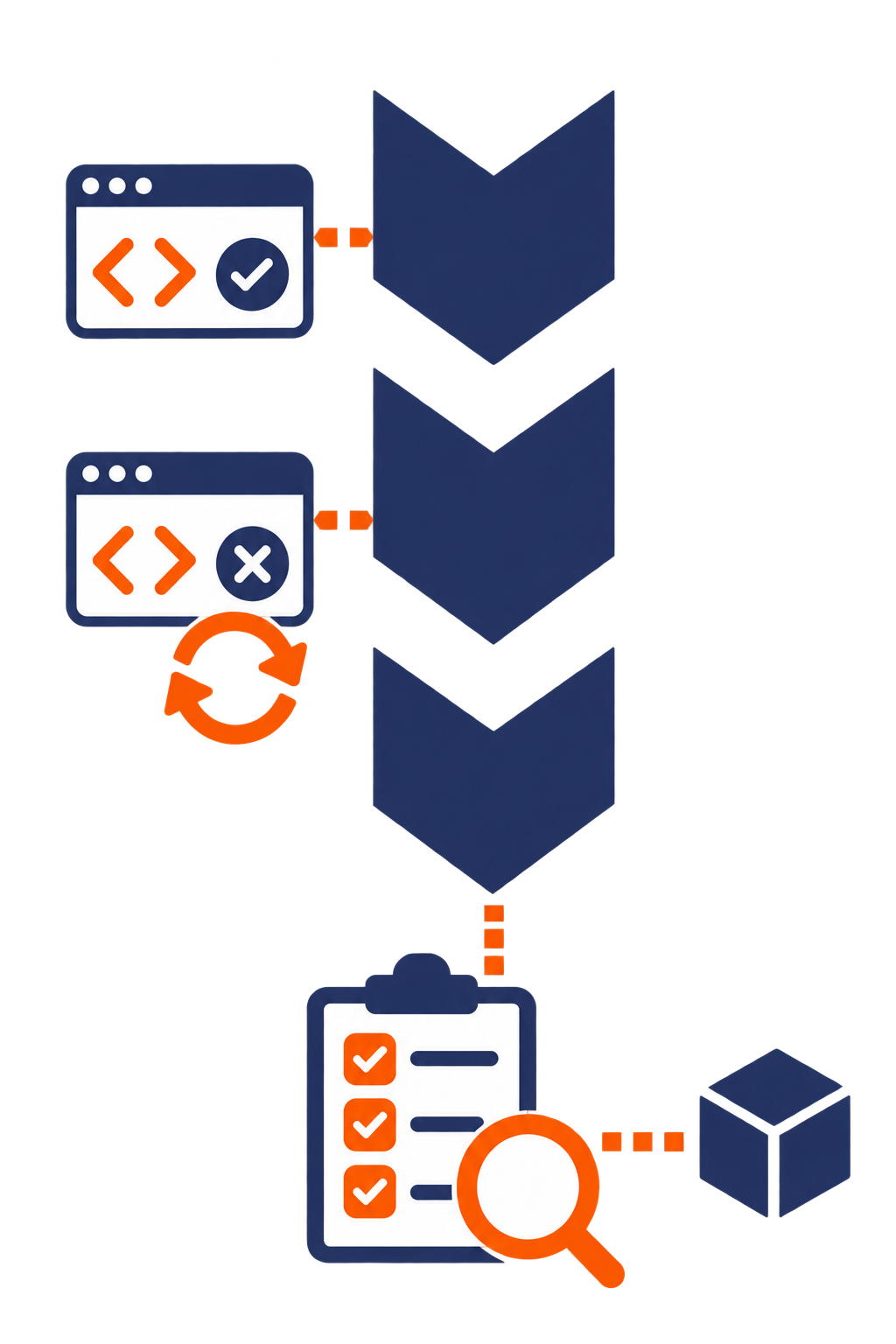
Automated tests exist, but they sit outside the real CI/CD pipeline. Manual regression is still needed before release. Flake rate is high. The team has scripts, but not a stable automation model.
 3
Stage 3: Engineered
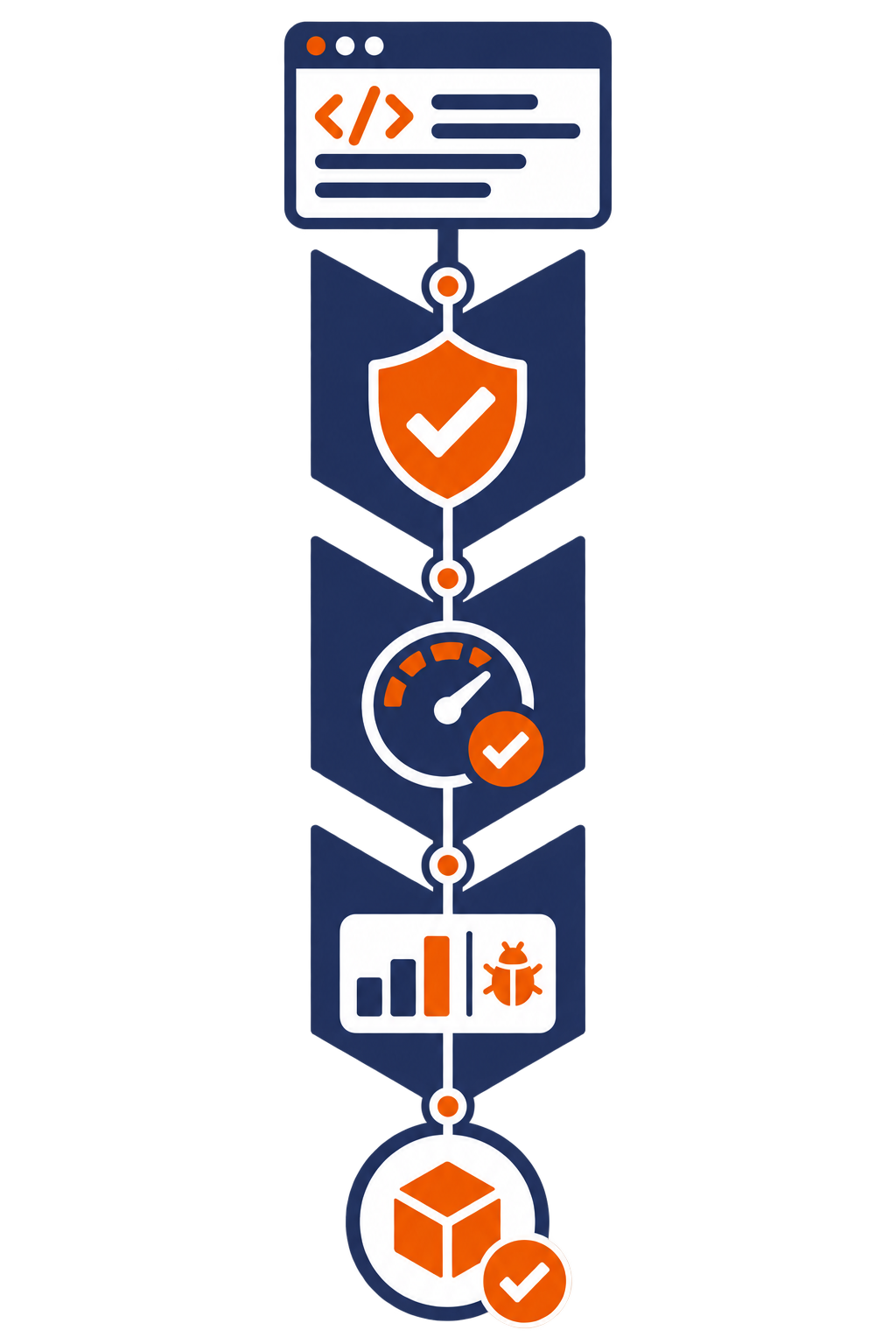
The team has SDET-owned test architecture, quality gates in CI/CD, a visible defect escape rate trend, and regression that runs in under 30 minutes. This is where quality becomes a delivery capability, not a cleanup task.
 4
Stage 4: Optimised
Quality is measured across the engineering org. Coverage is visible. AI-assisted test generation may be in use. Predictive patterns begin to support planning. This is mature quality engineering, not just automated checking.
Six-question self-assessment
Answer yes or no.
-
Count your “yes” answers and find your result below:
The six-step automation roadmap
This is the operational core of the guide. Test automation goes wrong when teams start with tools, write a large number of brittle E2E scripts, and hope the suite will sort itself out. Strong programs start with a baseline, a small set of KPIs, and architecture choices that fit the actual pipeline.
- Step 1

Audit before you automate
Start with a baseline. Review current coverage, the automation-to-manual ratio, flake rate, CI/CD integration, defect escape trend, and access controls in test environments. The output is a prioritised backlog, not a wish list. A good QA assessment also shows which quick wins will improve confidence in the first month.
Output: prioritised improvement backlog and baseline metrics.
- Step 2

Define KPIs before writing a single test
Agree the targets before implementation starts. Teams need shared numbers for defect escape rate, flake rate, regression cycle time, MTTR, and the percentage of regression work that should become automated. Otherwise the program turns into activity without proof of progress.
Output: a quality scorecard that will later support ROI review.
- Step 3

Build the test pyramid, not the test wall
Many legacy suites are upside down. They rely on a heavy E2E layer because that is the most visible place to automate. It is also the most expensive layer to maintain. Keep unit tests fast and developer-owned. Build integration and contract testing at the API layer where service boundaries matter. Keep the golden path E2E suite narrow and tied to the business flows that truly matter.
Output: a test pyramid that supports speed instead of fighting it.
- Step 4

Choose your stack for your pipeline, not your CV
Framework choice should follow the product surface and the existing delivery stack. Playwright is often a strong fit for modern cross-browser work. Cypress can work well in JavaScript-heavy environments. Selenium still has a place in legacy ecosystems. Appium belongs where mobile coverage matters. Pipeline execution may run through Azure DevOps or GitHub Actions. Contract testing with Pact is useful at service boundaries. The point is fit, not fashion.
Output: a stack decision that respects the client's toolchain and keeps IP ownership clear.
- Step 5

Embed the SDET in the squad
A pooled testing function tends to appear late and behave like a release gate. An embedded SDET works inside the feature squad, joins standups, reviews pull requests, and shapes testability during planning. That is where shift-left testing becomes real. For fast-moving product teams, one SDET for two or three developers is often a workable model on high-change features.
Output: a working SDET pod model instead of end-of-sprint QA handoffs.
- Step 6

Wire quality gates and make them the source of truth
Quality gates should decide whether code advances. Pre-commit checks can cover unit tests and linting. Pre-merge checks can include coverage deltas and flake controls. Pre-staging should run the API suite and SAST. Pre-production should run the full regression pack, performance baselines, and any DAST or release-critical scans. Once these gates are trusted, release decisions stop depending on manual reassurance.
Output: data-driven release control and lower change failure rate.
Start with an audit
Softwarium's 10-day QA assessment is built to produce the baseline, backlog, and quick wins this roadmap starts from.
Request a free QA assessment or explore SDET services.

| Metric | Target | Alert threshold |
|---|---|---|
|
Defect escape rate |
< 5% |
> 10% |
|
Flake rate |
< 2% |
> 5% |
|
Regression cycle time |
< 30 min |
> 45 min |
|
Automation-to-manual ratio |
> 75% of regression |
< 50% |
|
MTTR |
Team-specific target |
Trend worsening over 2 sprints |
|
Coverage delta on critical services |
No blind spots on changed code |
Unreviewed risk accepted |
|
Change failure rate |
Downward trend |
Spikes without root-cause action |
Security and compliance in the pipeline
Fast and tested is not enough in a regulated product. The pipeline itself has to be secure. Test data, service accounts, logs, and secrets all sit inside the attack surface. That means the SDET team's work and the DevOps team's work meet in the same place.
Five controls matter here.
 DevSecOps integrationSecurity checks such as SAST and DAST should run in the same pipeline as the regression suite, not as a disconnected audit track.
 Least-privilege test environmentsTest accounts should have only the permissions needed for the scenario being validated.
 Secrets managementCredentials belong in Key Vault or Secret Manager, not inside test scripts or loose pipeline variables.
 Test data maskingTeams should use masked production subsets or synthetic test data. Test environments should not hold real customer records.
 Audit-ready traceabilityEvery test should map to a requirement, and every pipeline run should leave a reviewable trail.
Red flag:
If your QA partner does not ask about security posture on day one, and your DevOps partner does not ask about test data governance, neither is treating quality as a first-class concern.
Your first 90 days
with an SDET team
The point of a 90-day plan is simple: reduce uncertainty. A serious engagement should show the baseline, the early build-out, and the first useful outcomes quickly enough that a client can judge whether the model works.
| Phase | Work | Output | KPI milestone |
|---|---|---|---|
|
Days |
QA assessment, coverage review, flake audit, CI/CD integration check, defect escape baseline |
Prioritised backlog plus quick wins |
Baseline set for all KPIs |
|
Days |
Framework setup, golden path E2E suite, shared quality dashboard, unit layer review |
First automated regression running in pipeline |
Flake rate measured and capped |
|
Days |
API and contract testing layer, coverage expansion, first quality gates |
Problematic changes blocked earlier |
Defect escape rate trend becomes visible |
|
Days |
Stable regression flow, embedded SDET cadence, phase-two plan |
Team starts owning the pipeline day to day |
KPIs at or moving toward target |
What good looks like at 90 days
Save this checklist for your next QA planning session.
10 questions
to evaluate an SDET partner
This section is meant to be used in real vendor calls. Take it into meetings. A strong partner should answer plainly and with implementation detail.
| Question | What a strong answer includes | Red flag |
|---|---|---|
|
Do you start with an audit, or go straight to automation? |
A strong partner insists on discovery and will not recommend a framework before seeing the pipeline. |
Tool advice arrives before anyone has seen the real constraints. |
|
What KPIs do you set at kickoff? |
Look for defect escape rate, flake rate, MTTR, regression cycle time, and the automation-to-manual ratio. |
The whole conversation collapses into test coverage percent. |
|
What does your security posture for test environments look like? |
A strong answer includes test data masking, least-privilege access, and managed secrets. |
Security is described as someone else’s problem. |
|
Who owns the IP: source code, frameworks, and pipelines? |
You should own the assets and avoid lock-in through proprietary tooling. |
Ownership language stays vague. |
|
How do you manage flaky tests? |
There should be a flake budget, quarantine flow, and root-cause protocol. |
The answer is simply rerun the suite. |
|
Are your SDETs embedded in squads or assigned from a separate QA pool? |
Embedded SDET work supports shift-left testing and better PR feedback. |
Testers appear only near release. |
|
What CI/CD integration experience do you have? |
The answer should name real pipelines such as Azure DevOps or GitHub Actions and explain how gates are configured. |
Lots of confidence and no implementation detail. |
|
Have you worked in regulated environments? |
Look for audit-ready testing, traceability, and care around data governance. |
The vendor pivots back to speed only. |
|
What will our team be able to do without you in 12 months? |
Good partners describe capability growth inside your team, not long-term dependency. |
The model assumes permanent outside ownership. |
|
Can you show a live quality dashboard from current work? |
Real trends beat a polished demo every time. |
The answer is “we can mock one up later.” |
How does Softwarium answer these questions?

Frequently asked questions
- What does an SDET do that a QA engineer does not?
An SDET builds and owns the test automation architecture that makes quality checks repeatable inside the pipeline. That includes the test pyramid, quality gates, CI/CD integration, and flake control. A QA engineer may still own strong exploratory work and user-facing validation, but the SDET's output is infrastructure, beyond a one-time test report.
- What is a good defect escape rate target?
For a team at Stage 3 QA maturity, a defect escape rate below 5 percent is a healthy target. Teams that begin an SDET-led transition often start much higher. The first 90-day milestone is a reliable baseline and a visible downward trend.
- How long does SDET-led automation take to show results?
A structured engagement should produce usable results within 90 days. In that window you should expect a baseline, a first regression flow in CI, API coverage on critical boundaries, early flake reduction, and initial quality gates. Teams that skip the opening audit usually take longer to reach stable results.
- What is the difference between a flaky test and a failing test?
A failing test points to a real product issue and fails consistently. A flaky test changes result without a relevant code change. It may pass on one run and fail on the next. Once flake rate rises, teams start distrusting the pipeline, which slows delivery and weakens release decisions.
- Do we need to replace our QA team to use this model?
No. Manual QA still matters for exploratory work, edge cases, and user experience checks. SDET-led automation removes repeated regression work from the human path so QA specialists can focus on the checks that benefit from judgment and product intuition.
- What is the business case for SDET investment?
It is usually a mix of lower defect cost, less time lost to manual regression, faster release confidence, and better developer focus. Teams that move toward an engineered QA model tend to spend less time on repeated verification and more time on product work.