
QA Automation & SDET Services for Fast, Safe Releases
Own your quality, control your roadmap, and reduce defect escape.
Cost-efficient coverage | Security-first approach | 25+ Years of Shipping Production Software
Softwarium builds automation frameworks, SDET pods, and AI/LLM-assisted testing that actually fit the way your team ships. Fewer production surprises, calmer releases, and real numbers your leadership can follow.
We work with teams that need:
QA automation services aligned with business KPIs

SDET teams embedded into existing squads

CI/CD-integrated testing that keeps pipelines moving

LLM-assisted test generation and triage under human control
Why Choose Softwarium
For over 25 years, we have delivered QA automation that ships fast and proves value early. Our engineers work daily with Azure DevOps, .NET, Playwright, Cypress, Selenium, Power BI and the usual mix of enterprise tools and constraints.
One of our QA engineers recently described a typical engagement:
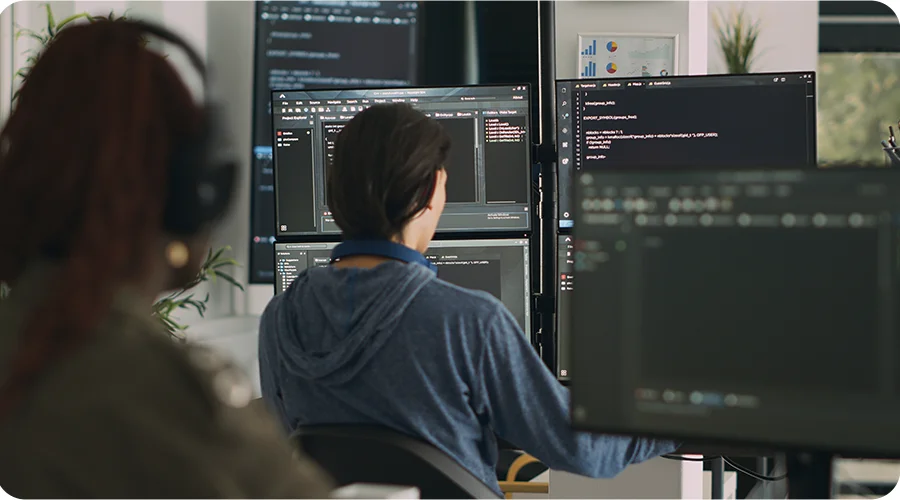
“We test a cross-platform desktop application used by banks to connect securely to servers and equipment. We validate strong authentication using NFC-enabled security keys, run tests on remote VDI machines, deal with strict security rules, and still keep releases smooth. There hasn’t been a ‘disaster release’ on our watch.”
That is the standard we aim for across projects.
What you can expect








Types of Solutions We Provide
Test Automation for Web, API, and Mobile
When a growing product needs reliable regression without slowing releases, we assemble a lean automation layer covering E2E UI, API, contract, and mobile tests.
Our QA engineer summed up the way we prioritise:
“Key scenarios are the actions without which the product cannot work: login, payment, provisioning, connecting to equipment. We also take the most painful bugs from support and customers and lock them in with automation so they do not return.”

Where this shines
- You want to launch or relaunch automation without creating a heavy suite that nobody wants to maintain.
- You want to keep control of test data and coverage targets while staying within budget.
- You want to replace fragile checks gradually instead of trying to rebuild everything in one go.

What you get
-
Playwright/Cypress/Selenium frameworks aligned with your stack, with Allure or ReportPortal for readable reports.
-
API test automation and contract tests so you are not tied to a fragile UI layer.
-
Mobile automation with Appium, XCUITest or Espresso, plus cross-browser and cross-device labs where needed.
-
CI/CD wiring into GitHub Actions, Azure DevOps, GitLab CI or Jenkins with clear quality gates.
-
Test data management using seeded datasets, masked production subsets or synthetic data.
-
Optional checks for accessibility, performance and basic security in the same pipelines.
Our testers are used to .NET-centric stacks, but they are flexible by design. They use Appium, Selenium, xUnit and REST API tests, switching tools when the product or platform requires it.
-

Results to expect
- Fewer escaped defects and cleaner rollbacks when issues appear.
- Faster, safer releases with visible coverage growth per sprint.
- Quality targets agreed and tracked openly.
.png) Book QA Automation Assessment
Book QA Automation Assessment
SDET Pods & Team Augmentation
Turn test debt into a steady engineering habit your team trusts.
Our SDETs often join support triage too:
“When a complaint arrives from a customer, our SDET team looks into it with support, reconstructs the scenario, and then captures it in tests. We do not wait until the next major incident; we try to stay ahead, not just react.”

Operational view that helps
- Pod-based SDETs embed with dev squads and product owners, pairing on design and testability.
- Dashboards highlight flaky tests, bottlenecks and risky change sets instead of dumping raw logs.
- A golden path E2E suite plus layered API checks keep cycle time short and feedback relevant.

Impact to aim for
- Shorter MTTR, lower flake rate, and a steady rise in the automation-to-manual ratio.
- More stable velocity during peaks and releases because the suite is trusted.
- Less time spent reconciling different tools and reports; more time fixing real problems.
You can hire SDET engineers individually or as a managed pod that owns framework health, coverage strategy and day-to-day test work.

Migration & Modernization (Selenium → Playwright/Cypress)
Improve reliability and speed with incremental migration that respects your sprint cadence.
Our engineers know the trade-offs well: Selenium remains powerful for certain enterprise cases, Cypress has limits such as no native Safari support, and Playwright is strong for cross-browser coverage. We help you decide where each fits instead of chasing trends.

Planning clarity
- Risk scoring by feature and dependency so we do not start in the hardest corner.
- Parallel runs, selective backfills and contract-first tests to cut down UI load.
- Coverage maps that show business importance, not just the number of tests.

Floor changes
- Fewer last-minute surprises and brittle selectors breaking important flows.
- Stand-ups focused on real issues instead of long discussions about test noise.

How we roll it out
- Start with one critical flow or service and define success clearly.
- Prove the improvement in runtime and stability, then extend migration.
- Keep day-to-day delivery running while suites evolve in the background.

.png) Plan a Migration Workshop
Plan a Migration Workshop
Security & Compliance for QA
We meet your standards and supply clear evidence of what was tested and how it was verified.
On the PAM desktop project mentioned earlier, that means:
- Secure connections to many types of servers and devices
- Strong authentication including YubiKey
- Tests that run on remote VDI machines under strict access rules
That same mindset carries into all QA automation services we offer.

Built in from the start
- Least-privilege access; secrets in Key Vault or equivalent; encryption in transit and at rest.
- Signed runners and agents; tamper-evident logs; policy-as-code for gates.

Run and respond
- Monitoring from tests and pipelines wired into your SIEM or SOC.
- Clear runbooks for flaky tests, incidents and scheduled reviews.
- Evidence packs that make audits straightforward for compliance teams.

Straight talk
- No invented certifications or vague security promises.
- Privacy and data boundaries handled in your environment wherever possible, with clear documentation of what runs where.
AI/LLM-Assisted Testing
Put AI in the flow of QA work, where it speeds learning and triage, not decision accuracy.
Our teams already work with corporate-approved AI such as Copilot and internal AI services that can safely connect to company accounts.
A QA engineer describes the pattern:
“AI is great for generating test ideas or summarising a failure, but the final decision sits with the engineer. We always read what it suggests, clean it up, and make sure the method is valid and does not break anything before we commit it.”

Where it helps
- Test idea generation from specifications, user stories and change diffs.
- Failure summaries across logs, traces and screenshots to speed up triage.
- Natural language draft tests that humans refine into stable code and assertions.

How we keep it safe
- Human review gates for every model-generated change.
- Seeded data and reproducible flows, no blind autonomy.
- Prompts and changes tracked in your Azure tenant, with approvals and phased rollouts.
- The same governance we use for security-sensitive work now supports QA flows and has already shown measurable savings in analyst time and flake triage.

.png) Discuss AI in Your QA Process
Discuss AI in Your QA Process
Our Technology Stack
Secure, scalable, and yours to own.
- 01Azure and DevOps
Azure AD, private networking, Key Vault, Monitor, Pipelines.
- 02Automation
Playwright, Cypress, Selenium, Appium, xUnit, REST API testing, contract tests such as Pact.
- 03Observability
Grafana, Prometheus, App Insights, OpenTelemetry, Power BI scorecards.
- 04Data and AI
Azure ML, embeddings for search, guarded LLM helpers in your tenant.
- 05DevOps/MLOps
registries, environments, CI checks, blue-green and canary patterns, drift alerts.
- 06Ownership
you own source, infrastructure, and data. No lock-in, no hidden platforms.



On the desktop PAM project, tests run on remote machines across different operating systems with nightly runs to catch regressions early, and additional builds during the day when teams need feedback fast. This kind of setup is typical for our QA outsourcing work.
Case Studies
SharePoint Permissions Utility
for MetaVis / Metalogix / Quest
A long-term client in the SharePoint ecosystem (MetaVis → Metalogix → Quest) asked us to help turn a set of ideas about permissions into a reliable product.
Our team started small (2–3 people) and, over more than ten years, grew into a 16-person group of developers and QA engineers working directly with the CTO. Together we:
- Helped build a SharePoint utility from scratch that manages permissions, analytics, and permission cloning.
- Covered key flows with automated tests: permission inheritance, cloning when employees change roles, and reporting for specific users, files, and site collections.
- Validated that only authorised users could inherit permissions and that cloning rules worked exactly as expected, even across complex SharePoint and Office 365 environments.
Because the client was working with large enterprises and going through M&A, every release had to be evidence-ready. Our QA work gave them:
-
- Confidence that migrations and upgrades preserved permissions correctly.
- Proof for stakeholders during acquisitions that access control and reporting worked as designed.
This partnership now spans SharePoint migration, administration, backup, Office 365 admin/migration/backup and unstructured content transformation, all supported by the same mix of automation and hands-on SDET work.
Salesforce ML Data Deduplication App
A startup building a data deduplication app for the Salesforce AppExchange needed to move quickly and still compete with established players. Their product was the only dedupe tool on the marketplace powered by machine learning instead of static rules, which added both value and testing complexity.
Softwarium assembled a compact team (frontend, backend, QA) and worked closely with the co-founders to:
- Integrate the Node.js application with Salesforce without extra downloads or configuration for users.
- Design and validate ML-driven deduping algorithms, including merge rules, data cleansing, and verification flows.
- Build and maintain regression coverage around every new feature and UI tweak, so frequent releases did not break existing customers.
Our QA engineers tested each release end-to-end: from configuration in Salesforce to matching, merging, and reporting on cleaned records. As the product grew, automation around core merge logic and API integration helped the team:
-
- Roll out new dedupe and cleansing features safely on a regular cadence.
- Reach functional parity with bigger competitors and then move beyond them with ML-driven behaviour.




Talk to our experts to benefit from:
- 40% fewer escaped defects
- Stronger CI quality gates
- Smarter LLM-assisted triage
- KPIs that guide decisions
- A 10-day start plan

FAQs
- How is a custom automation framework cheaper than tool vendor lock-ins?
You avoid per-seat and per-run fees, keep all IP, and tune the framework to your stack and release rhythm. Over time, fewer regressions, faster releases and less manual retesting tend to outweigh the licence and subscription costs of closed platforms.
- Can you integrate with our CI/CD and cloud testing labs?
Yes. We integrate with GitHub, Azure DevOps, GitLab and Jenkins, as well as BrowserStack, Sauce Labs or your existing device and browser labs. We usually go through a sandbox, then a pilot pipeline, and only then roll out widely so your current releases stay safe.
- How long does it take to reach 70–80% regression automation?
This depends on domain, architecture and data. For many teams, a stable core regression suite takes around 8–16 weeks. We start with golden paths and high-impact flows, then expand coverage gradually. Nightly runs and bug leakage metrics show when you are ready to move more scenarios from manual to automated checks.
- How do you handle security in QA?
We follow zero-trust ideas: restricted access, secrets rotation, signed runners, clear separation of client and server responsibilities, and SIEM integration where needed. Test data is masked or synthetic when regulations require it. All of this is documented in runbooks that your security and compliance teams can review.
- Who owns the IP?
You do. Source, frameworks, infrastructure as code, pipelines and data are client-owned. If you later decide to hire your own SDET team or change partners, you keep the full setup.
- Do you support mobile apps?
Yes. We work with Appium, XCUITest and Espresso and can run tests on your in-house labs or third-party device farms. Performance and basic UX behaviour on real devices can be included where it affects customer experience.
.png)
Book a QA Automation & SDET Assessment