
DevOps Audit Services.
Find Risks, Fix Workflows, Ship Faster
Softwarium's structured DevOps audit offers an unbiased perspective on cloud maturity and delivery, identifies security vulnerabilities and capability gaps, and recommends a prioritized set of actions to fix them.
Expert DevOps Services | 25+ Years of Engineering Experience |
Certified Kubernetes & Azure DevOps Engineers
Why DevOps Audit Matters
DevOps synchronizes development and operations to maximize output, but mere adoption does not guarantee a permanent competitive advantage. Sustaining peak performance requires periodic DevOps audits to ensure your automation scales and remains free of manual friction.
The majority of DevOps issues are undetectable until they result in an incident. Technical debt builds up during the delivery process in addition to in code. Non-standard pipelines result in snowflake environments and manual release gating that slow down delivery as teams grow. Your infrastructure becomes opaque without a high-level view, full of hidden exposures and undocumented settings that frequently only come to light during audits, under load, or in production.

Common signs we see:
Teams scaling fast but lacking standardized pipelines and release gates
Security vulnerabilities hidden inside infrastructure as code and misconfigurations

Slow delivery cycles caused by manual handoffs and unclear ownership

No baseline metrics, so teams cannot prove improvement from a defined starting point
When those operational red flags appear, a DevOps audit can identify the root causes.
A structured DevOps audit gives you clarity, numbers, and a plan.
When teams benefit most from DevOps assessment:

teams experiencing risky releases or recurring incidents

teams planning cloud/Kubernetes migrations

teams in regulated industries

teams undergoing scaling

teams facing "release friction"

leadership seeking a DORA‑based maturity baseline

pipelines vary across teams

drifting or hand-build infrastructure

cloud costs/governance lack visibility

preparation for compliance and customer due diligence
Softwarium’s DevOps assessment provides the external perspective needed to baseline your current architectural maturity, closing the gap between "working" and "optimized."
Why is Auditing DevOps Important?
When DevOps is data‑driven, it’s safer and faster. Regular audits help manage these risks:


Spotting inefficiencies:
Without regular audits, outdated processes can slow down your team.
Improving security:
Audits ensure your infrastructure aligns with compliance standards.
Minimizing downtime:
Identifying constraints in pipelines reduces release delays and potential outages.
Boosting collaboration:
Clear workflows help dev and ops teams stay on the same page.
When auditing is done consistently, you create a feedback loop that builds trust and keeps software delivery reliably on track.
What Covers DevOps Audit
Our audit spans the following domains, each produces concrete findings, mapped to risk and business impact.
| Audit Domain | What We Assess | Why It Matters |
|
Workflows & Culture |
Team collaboration, communication patterns, and DevOps adoption maturity. |
Tools follow culture. We identify human-caused blockers that prevent automation from succeeding. |
|
CI/CD Pipelines |
Build, test, and deploy automation; pipeline reliability, and feedback loop speed. |
Bottlenecks in the pipeline directly slow release frequency. |
|
Infrastructure & IaC |
Terraform, Ansible, or CloudFormation code quality; drift detection and environment parity. |
Undocumented or manual infrastructure changes create hidden risks and scaling limits. |
|
Security (DevSecOps) |
SAST/DAST integration, secrets management, access controls. |
Security left unshifted = expensive breaches. |
|
Release Management |
Branching/trunk‑based, feature flags, canary/blue‑green, rollback paths, approvals. |
Clean release hygiene enables fast, confident delivery with instant rollback. |
|
Monitoring & Observability |
Centralized logging, proactive alerting, and SLO/SLA definitions. |
Visibility drives recovery. Better observability means faster MTTR. |
|
Tooling & Tech Stack |
Overlaps, redundancies, license usage, ownership and support model. |
Right‑sizing reduces cost and cognitive load while improving standardization. |
Softwarium’s DevOps Audit examines CI/CD, IaC, release practices, and team maturity, to deliver clear, sequenced actions to strengthen reliability, security, and speed.
Let’s discuss how you can benefit
from DevOps Audit
How the DevOps Assessment Works
Our audit is structured in short, focused phases so you see progress and deliverables fast. We follow a proven framework that protects your engineers’ focus while we go deep on the details.
How We Run a DevOps Audit: Steps and Outputs

What to Expect from DevOps Audit: Steps and Outputs
 1
1Phase 1: Kickoff & Discovery (Week 1)
What Happens: Stakeholder interviews, team questionnaires, and access provisioning.
Establishing specific goals for the audit (tools, workflows, culture, deployment frequency, etc.), auditing your entire engineering organization or a particular product team.Output: Finalized audit scope document and success criteria.
 2
2Phase 2: Deep Technical Audit (Weeks 2–3)
What Happens: Hands-on review of CI/CD pipelines, IaC analysis, architecture deep-dives, and toolchain evaluation.
Using this evaluation to uncover capability gaps and process inefficiencies.Output: Findings log (a live, transparent document of observed risks and gaps).
 3
3Phase 3: Analysis & Scoring (Week 4)
What Happens: We measure your performance against DORA benchmarks and industry standards for your specific domain.
Combining the knowledge gained from the earlier stages to create a visual report.Output: DevOps maturity score.
 4
4Phase 4: The Roadmap & Report (Week 5)
What Happens: Current-state report, gap analysis, short- and long-term roadmap. Transformation of raw data into a prioritized action plan, categorizing findings by "Immediate Risk," "Efficiency Gain," and "Long-term Strategic."
Output: DevOps Audit Report + Roadmap Deck.
 5
5Phase 5: Final Readout & Handover (Week 6)
What Happens: Presentation to leadership, Q&A, implementation guidance.
Output: Recorded session + Actionable next-steps register.
Deliverables
You get practical, prioritized actions to standardize workflows, improve speed, reliability, and long‑term infrastructure costs.
What You Receive


Current-State DevOps Assessment Report

DevOps Maturity Score with DORA benchmark comparison

Risk Register — prioritized by severity and business impact

Gap Analysis document (current state vs. target state)
Prioritized Improvement Roadmap (90-day, 6-month, 12-month)

Executive Summary slide deck for leadership presentation
Readout call recording and Q&A transcript
.png)
DevOps Audit gives you a custom path to safer, faster delivery
Talk to our DevOps audit experts.
Why Softwarium
We have years of extensive experience in building resilient infrastructure based on DevOps methodology approaches, implementing microservice architecture using Kubernetes and other orchestrators, setting up CI/CD pipelines, and organizing dev/stage environments.


Audit-to-Implementation continuity
We don't just leave you with a report. Softwarium offers end-to-end DevOps-as-a-Service to help you implement every recommendation in the roadmap.

25+ years of experience in software engineering
Founded 2000; 80% of projects are 5+ year engagements

Multiple domain expertise
We bring extensive experience in DevOps practices, having successfully implemented solutions across different industries like Legal Tech, Healthcare, Logistics, Education and more.

Certified
DevOps experts80%+ of our developers are mid‑level and senior-level experts

Enterprise-grade delivery
20% of our portfolio are Fortune 500 companies

Data‑led
cost controlTrack, forecast, and optimize cloud costs





DevOps Case Studies Insights
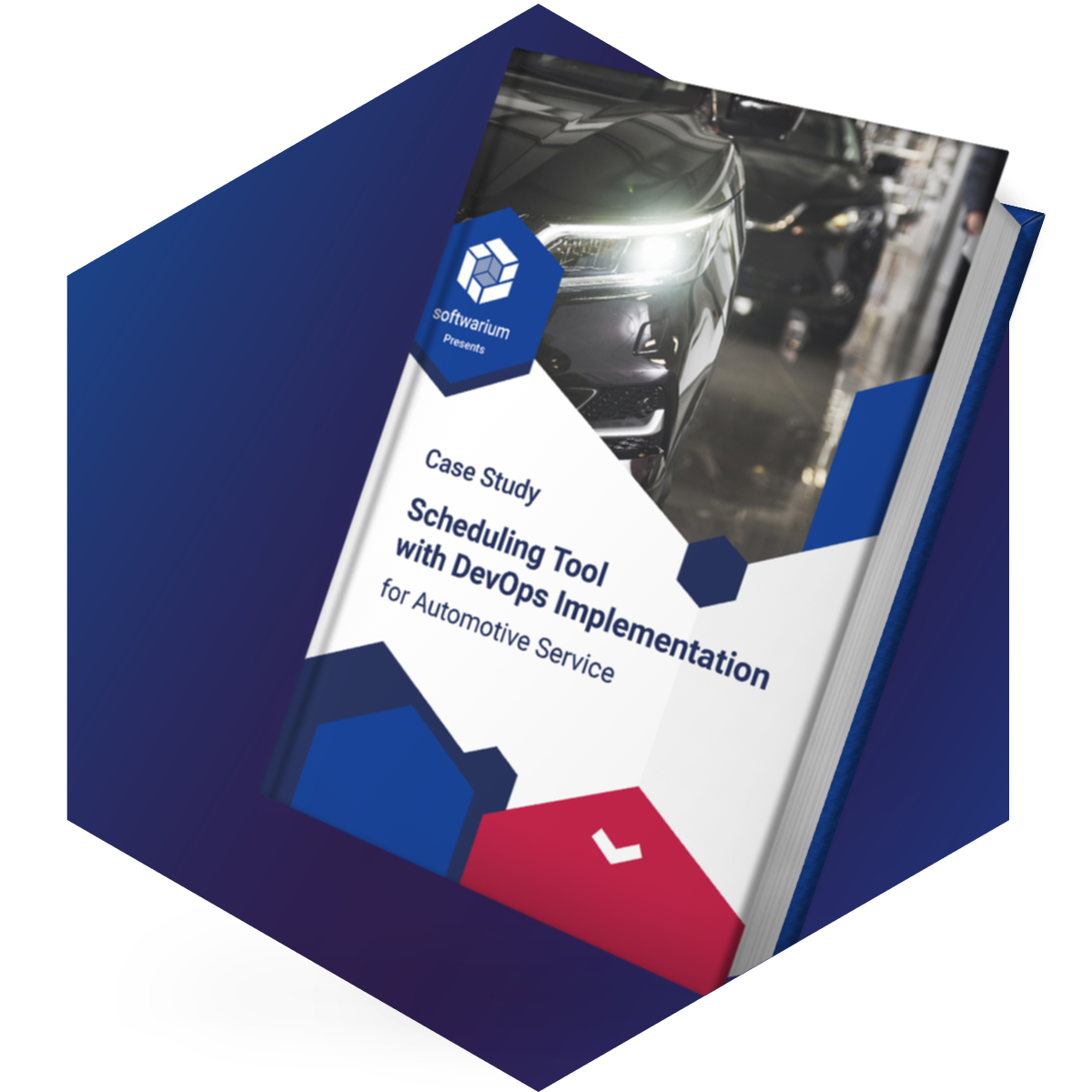
Scheduling Tool with DevOps Implementation
Softwarium built a scheduling tool that automated CI/CD for an automotive client, cutting release times, improving reliability, and speeding delivery cycles. With DevOps baked into their day‑to‑day, the team now iterates rapidly and runs with far greater operational efficiency.
Read the Case Study
Legacy Modernization for Continuous Real Estate Operations
To advance our partner’s digital transformation, Softwarium helped modernize DevOps practices enabling rapid, zero‑downtime deployments.
Key improvements included:
- Implementation of CI/CD pipelines
- Automation testing and code quality checks
- Real-time performance and error monitoring
Client: ProTitleUSA (www.protitleusa.com) — a nationwide title search and analysis company serving residential and commercial estate markets.
Read the Case Study

Find What's Slowing
Your Delivery
Releases shouldn't feel risky. Incidents shouldn't keep mounting. Your infrastructure shouldn't be the thing slowing delivery down. DevOps Audit by Softwarium pinpoints precisely where to intervene, so you can engineer your way to faster, safer, more reliable delivery.

FAQs:
- What is DevOps audit?
A DevOps audit gives you an independent perspective on delivery: it reviews processes, tooling, and culture to see what’s working, what isn’t, and where to get better, so your engineering effort tracks directly to business outcomes.
- What does a DevOps audit include?
A DevOps audit reviews how your teams work (workflows & culture), how code moves (CI/CD, release practices), where it runs (infrastructure & IaC), how it’s protected (DevSecOps), how it’s measured (observability), and what supports it (tooling stack). The outcome is a set of prioritized fixes tied to root causes and business impact.
- How is a DevOps audit different from DevOps consulting?
An audit diagnoses and prioritizes issues. Consulting implements the fixes. Softwarium offers both. Start with the audit, then engage us to implement consulting.
- Who should get a DevOps audit?
Teams scaling quickly, planning cloud/Kubernetes migrations, or seeing recurring incidents. It also fits when pipelines vary, infrastructure is hand‑built or drifting, cloud costs lack visibility, or compliance/due diligence is ahead. It’s equally valuable when leadership teams seek a DORA‑based maturity baseline and a prioritized set of improvements.
- What deliverables will we receive?
You get a current‑state report, DevOps maturity score with DORA benchmarks, a risk register, gap analysis, and a prioritized roadmap with 90‑day, 6‑month, and 12‑month horizons, plus an executive deck and readout recording.
- What is a DevOps maturity score?
A DevOps maturity score measures your delivery and operations performance against DORA benchmarks (deployment frequency, lead time, change failure rate, recovery time) and best practices across the audited areas. A higher score signals greater speed, stability, and control.
- Why do we need an audit if our systems are "working"?
Systems that are "working" often hide massive technical debt, manual workarounds, and security vulnerabilities. An audit moves you from reactive (fixing things when they break) to proactive (building a resilient, automated delivery system that scales).