Why Forward Deployed Engineers Are in Demand, and When to Hire One
Forward Deployed Engineering Services
A prototype can work in a demo and still be months away from production. Enterprise data sits across systems with different owners. Real workflows diverge from the process described in a requirements document. Identity, permissions, security reviews, monitoring, and user adoption all decide whether a solution can go live. When discovery, engineering, and rollout sit with separate teams, critical context gets lost at every handoff, and the project stalls between a promising pilot and a dependable workflow.
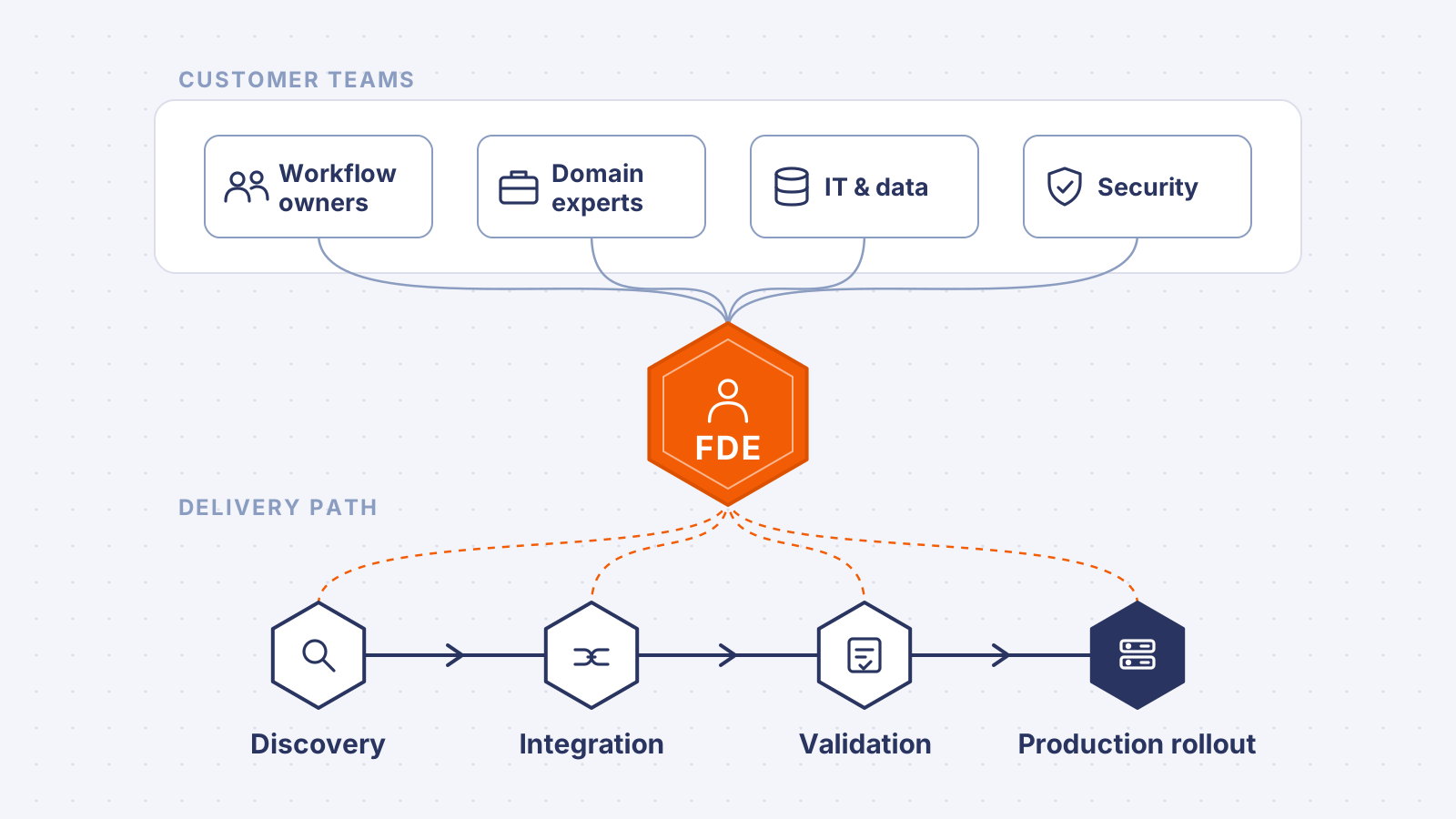
Forward deployed engineering is a response to that gap. A Forward Deployed Engineer (FDE) is a software engineer who works closely with a customer team to discover a business problem, build or adapt a technical solution, integrate it with existing systems, and help deliver it into production. The role combines hands-on engineering with direct collaboration across technical and business stakeholders.
The title varies by company. Hiring teams and buyers should define responsibilities, decision rights, customer contact, production ownership, and success measures before recruiting or signing an engagement.
Why demand for forward deployed engineering is rising
Several operational forces have increased demand for engineers who work directly inside customer environments:
- Enterprise AI involves more than model access. Data permissions, identity, evaluation, security, human review, monitoring, and workflow adoption determine whether an AI feature works safely in practice.
- Real workflows contain exceptions. Process documentation rarely captures every workaround, handoff, or source of inconsistent data. Working alongside users uncovers these details during discovery.
- Existing systems shape implementation. Legacy APIs, inconsistent records, access rules, and deployment windows influence architecture from the first sprint.
- Business value needs operational evidence. A narrow workflow released and measured under real conditions gives decision-makers a basis for the next investment.
- Short feedback loops reduce rework. Direct contact between the engineer and the people using a solution allows assumptions to be tested while changes are still cheap.
Job-board data reflects the trend. Indeed data shared with Business Insider showed 5,330 FDE job postings in April 2026, compared with 643 in April 2025, an increase of roughly 729%. Posting growth measures employer interest in the title. It does not prove hiring outcomes, and part of the increase may reflect existing roles being renamed.
Public role descriptions show how individual companies frame the work. OpenAI's Forward Deployed Engineering page describes stages from discovery and prototyping through validation, go-live, and scaling. Its FDE job posting asks engineers to own technical delivery from first prototype to stable production. Palantir's posting describes embedding engineers directly with customers and owning projects end to end. McKinsey's October 2026 explainer, "What is a forward-deployed engineer?", links interest in the role to the difficulty of fitting off-the-shelf AI tools to specific business problems and notes its overlap with consulting.
These are individual organizations' definitions. None of them is an industry standard.
Dedicated engineer vs. Forward Deployed Engineer
Both roles require strong engineering, and either can involve direct customer contact. The difference lies in the level of uncertainty, the engineer's part in problem discovery, and responsibility for connecting implementation to an operational outcome.
A dedicated engineer is typically assigned to a project or team under an agreed scope; a forward deployed engineer is additionally expected to work directly with customer stakeholders to clarify the problem, make implementation trade-offs, and connect delivery to operational outcomes. In a dedicated model, the client or product team usually owns requirements, priorities, and delivery direction.
|
Role |
Primary focus |
Typical deliverable |
Customer and production involvement |
|
Dedicated engineer |
Implement agreed scope within a project or team |
Features, fixes, integrations, components |
Varies by assignment; customer discovery may sit elsewhere |
|
Forward Deployed Engineer |
Discover and engineer a solution around a customer's real problem |
Working implementation, validation, rollout, feedback |
High customer proximity; production ownership should be explicit |
|
Solutions engineer |
Technical evaluation and pre-sales solution fit |
Demos, architecture guidance, proof of concept |
Often strongest before contract; production coding varies |
|
Implementation consultant |
Configuration, process rollout, and adoption |
Configured platform, implementation plan, training |
High stakeholder involvement; custom coding varies |
|
Product engineer |
Build capabilities for a broader user base |
Reusable product features and platform capabilities |
Usually works through product and engineering teams |
These boundaries describe common patterns. Some organizations combine responsibilities in a single role.
The models also work well together. An FDE can deliver a validated first implementation and turn vague requirements into clear technical ones. A dedicated engineering team can then extend reusable components, add features, and maintain the roadmap. Forward deployed engineering also differs from staff augmentation: the engagement is defined by a problem to solve and a production outcome to reach, with headcount as a secondary detail.
When the FDE model fits
An FDE engagement makes sense when the business problem is clear enough to investigate, but the implementation path still contains significant uncertainty. Typical indicators include:
- Requirements are incomplete, and discovery will shape the first useful version.
- Several systems of record, inconsistent data, or complex identity and access rules affect the design.
- An AI-enabled workflow needs evaluation with real users and representative data.
- Security, auditability, or regulatory constraints influence architecture from the beginning.
- User feedback has to inform implementation decisions throughout delivery.
Other delivery models are often a better choice:
|
If the project looks like this |
Consider instead |
|
A stable, well-specified feature on an existing roadmap |
Dedicated engineer or product team |
|
A technical evaluation before a purchase decision |
Solutions engineer |
|
A platform rollout dominated by configuration and training |
Implementation consultant |
|
No accessible domain experts or decision-makers |
Secure stakeholder access first; no delivery model compensates for its absence |
The FDE model adds the most value when engineering decisions depend on direct investigation of the customer's systems, processes, and constraints.
What a Softwarium FDE engagement can involve
A Forward Deployed Engineering engagement should connect discovery and engineering work to a defined production outcome. A typical Softwarium delivery plan includes six stages, adjusted to the project's scope:
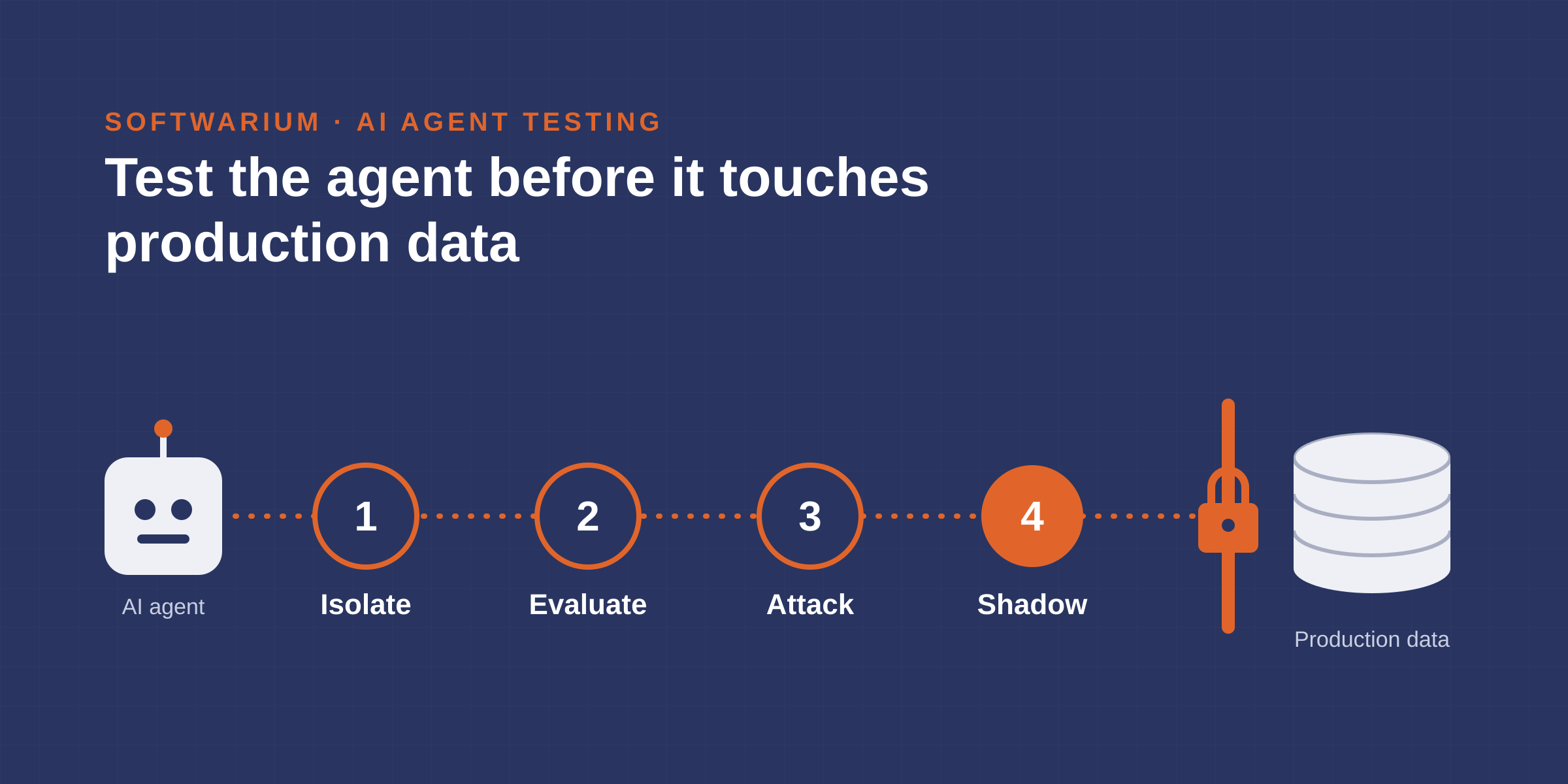
For AI-enabled workflows, validation and rollout carry particular weight. Related guidance covers testing AI agents before production, enterprise AI integration patterns, and moving enterprise AI from pilot to production. Teams building on Microsoft's stack can also review the guide to building and deploying AI agents on Azure.
The customer contributes access to domain experts, relevant systems, and decision-makers. Before development begins, both sides should agree on deliverables, decision rights, security controls, production ownership, and the process for handling scope changes.
Economics and trade-offs
The financial case for an FDE engagement depends on the cost of uncertainty in the project. Early validation can expose integration problems, data limitations, adoption barriers, and operating requirements before a larger investment is committed. The potential value lies in learning this before the wrong solution is built in full.
The model also carries costs and dependencies:
What a sound proposal defines
The initial scope, the assumptions to validate, dependencies, acceptance criteria, and the decisions that follow each stage. Estimates should cover integration and operational work alongside initial development.
How to evaluate an FDE provider or candidate
Start with engineering depth. The provider or individual should be able to design, test, debug, secure, and operate production systems. The evaluation should also cover:
- Discovery. Identifies workflow owners, investigates root causes, and turns business problems into technical requirements.
- Architecture and integration. Understands APIs, identity, data flows, observability, and failure handling.
- Security. Explains access controls, data handling, and security review processes.
- Testing and evaluation. Defines how software and AI components will be validated before release.
- Production responsibility. Names post-launch owners and defines the support period.
- Communication. Documents decisions, risks, and trade-offs in language business stakeholders can act on.
- Outcome measurement. Establishes baselines, targets, and metric owners before delivery.
The choice between an external provider and an internal hire depends on how often the organization needs this model:
An enterprise AI readiness assessment can help decide which path fits.
If you hire internally
Write a role charter first: scope, decision rights, customer contact, production ownership, and success measures. A weighted scorecard then keeps the interview loop consistent.
Rate each competency on a 1 to 4 scale with written evidence. Set minimum thresholds for engineering, integration, and customer collaboration so that strength in one area cannot hide a critical gap.
First-90-day expectations make the charter concrete:
Questions to ask before signing
Before choosing a provider, clarify how the engagement will work in practice:
A scenario discussion of 30 to 45 minutes provides additional evidence without asking for unpaid production work.
SCENARIO EXERCISE
A hypothetical request for an AI assistant in a workflow with inconsistent data and unclear ownership.
A strong provider or candidate:
✓Clarifies the business objective
✓Identifies the relevant systems and stakeholders
✓Defines access boundaries
✓Proposes a manageable first implementation slice
✓Names the main risks
✓Explains how the solution would be tested before rollout
Weak answers start with model or tool selection before the workflow is understood.
Define success before delivery starts
Success measures should reflect the workflow and the business outcome. Relevant metrics include:
Each measure needs three things in place before delivery starts:
Without a baseline, an improvement after rollout cannot be demonstrated. These measures also provide the basis for deciding what to extend, standardize, or retire after the first release.
Buyer checklist
Before committing to an FDE engagement, confirm that each point is covered:
FORWARD DEPLOYED ENGINEERING
Discuss the right delivery model with Softwarium
A software or AI initiative can stall between a promising prototype and a dependable production workflow when discovery, integration, and engineering decisions lack clear ownership.
Softwarium can help assess the technical scope, investigate integration requirements, and define an engagement model that connects engineering work with the customer's operational needs.