WHEN THE SIGNALS POINT
IN DIFFERENT DIRECTIONS

When to Modernize vs. When to Rewrite from Scratch
An engineering organization that spends 60 to 70 percent of its capacity maintaining a system that can’t evolve is not maintaining a system. It is paying a compound tax on a decision made a decade ago. The U.S. federal government runs roughly 80 percent of its IT budget through legacy maintenance, by GAO accounting. Two-thirds of global technology spend goes to keeping legacy systems alive.
The choice between modernizing that system and rewriting it from scratch is a cost and risk question before it is a technical one. The two paths carry different cost curves, different payback periods, and different failure profiles, and the decision sets the organization's strategic options for the next five to ten years.
The framework below gives technical leaders a way to make the call and defend it to a board.
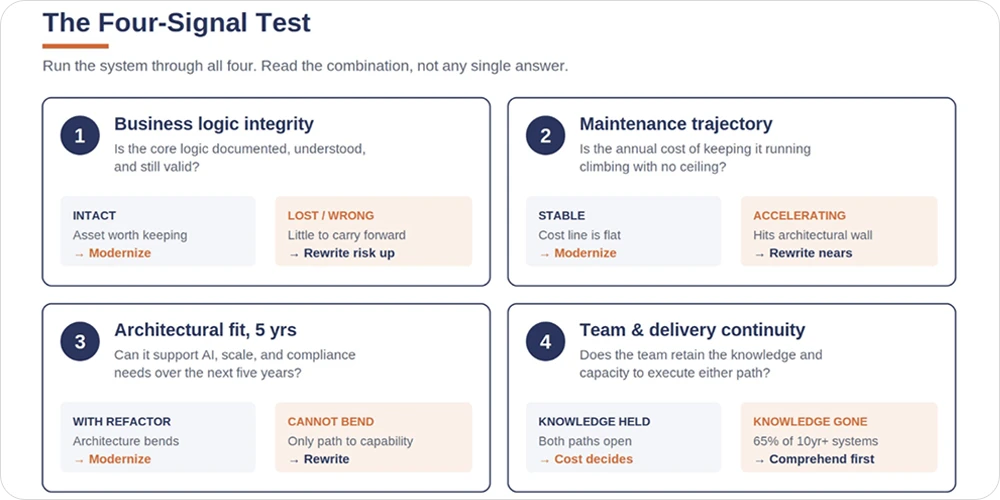
The modernize-vs-rewrite decision comes down to four signals:
- Is the business logic intact and understood?
- Are the maintenance costs accelerating without a ceiling?
- Can the architecture support the next five years
- Does the team retain the knowledge to execute either path safely?
The Four-Signal Test
Each signal is a diagnostic question with a directional answer. Run the system through all four, then read the combination. The signals are not weighted equally in every case, but together they point clearly toward one path or expose the work that has to happen before either path is safe.
Signal 1 — Business logic integrity
Is the core business logic well understood, documented, and still valid? If yes, the logic is an asset worth preserving, and modernization keeps it intact.
If the logic is undocumented, the people who wrote it have left, or the rules encoded in the system are simply wrong, the case for a full rewrite strengthens — there is little of value to carry forward.
Signal 2 — Maintenance cost trajectory
Is the annual cost of keeping the system running — maintenance, specialized staff, security patching, accumulating workarounds — climbing with no ceiling in sight?
A stable or declining cost line supports incremental modernization. A cost line accelerating against an architectural wall signals that the rewrite threshold is approaching.
Signal 3 — Architectural fit for the next five years
Can the current architecture, with modernization, carry the AI integration, scalability, and compliance requirements the business will place on it over the next five years?
If refactoring gets it there, modernize. If the architecture cannot bend that far, a rewrite is the only path to the required capability, and no amount of incremental work changes that.
Signal 4 — Team and delivery continuity
Does the team hold the institutional knowledge and the spare capacity to execute either path without halting product delivery?
When the knowledge exists and capacity is manageable, both paths are open and cost and risk decide. When the knowledge is concentrated in one person or has already left the building, rewrite risk multiplies.
A 2025 Gartner survey found that 65% of legacy systems older than 10 years have lost the institutional knowledge of their original developers. When that knowledge is gone, the hidden complexity of a rewrite multiplies — and AI-assisted code comprehension becomes a prerequisite to estimating the work accurately, regardless of which path is chosen.
Read the signals in combination. A system that fails Signal 3 but passes Signal 1 — its architecture is exhausted, but its business logic is intact and understood — is a strong rewrite candidate with lower-than-usual risk, because the team knows exactly what it is replacing. A system that fails Signal 4 is a high-risk candidate for either path until a code comprehension phase rebuilds the missing picture. The signal that fails tells you as much as the signal that passes.
The Case for Modernization
Modernization keeps the system running while it improves. It preserves business logic that has been tested against years of real-world edge cases, maintains delivery continuity so the product roadmap never goes dark, and carries a lower execution risk when the architecture still has life in it. The team that knows the system keeps working in it, which means the knowledge never has to be reconstructed from scratch. The financial case, though, is the strongest argument, and it is the one that travels to a board.
Incremental modernization delivers payback in 6 to 18 months. Full rewrites at mid-market scale typically require 36 to 48 months to reach break-even. That gap — reported by Bayone / Nexa Devs in 2025 — is the financial argument that most modernization business cases need to make.
Forrester's Total Economic Impact analyses of cloud-platform modernization, commissioned by Microsoft, model multi-million-dollar three-year benefits well above program cost, but with a caveat worth stating to any board: those returns depend on operational-model changes, not architecture alone. Modernizing the code without changing how the organization runs it leaves most of the value on the table.
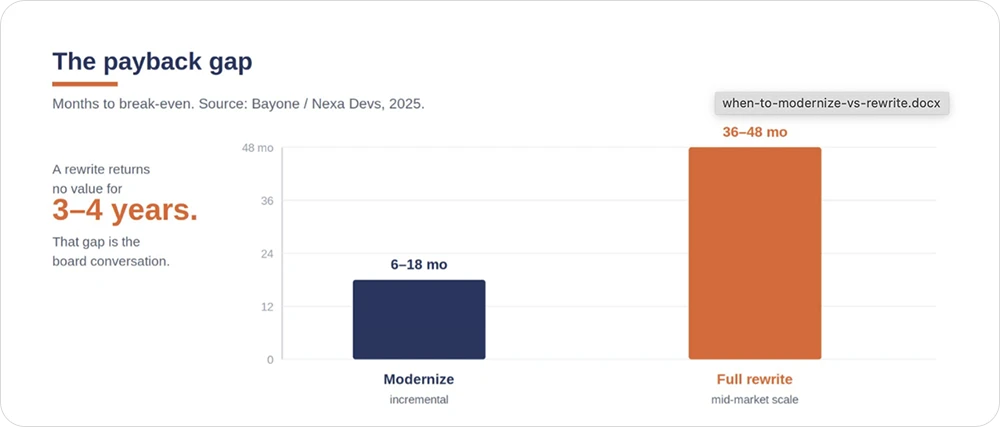
Incremental modernization delivers payback in 6 to 18 months. Full rewrites at mid-market scale typically require 36 to 48 months to reach break-even. That gap is the financial argument that most modernization business cases need to make.
Source: Bayone / Nexa Devs, 2025
The failure mode is specific. Modernization compounds existing debt when it is applied without architectural intent. A team that refactors module by module while leaving the data model untouched ends up with modern code sitting on top of a broken schema — cleaner to read, slower to run, and harder to diagnose than what it replaced. Incremental improvement to a fundamentally broken architecture produces a tidier mess, not a healthy system.
This is where a co-managed delivery model earns its place. Distributed engineers embedded inside the client's product team make architectural decisions incrementally and in context, rather than receiving a specification and returning months later with a handoff. Softwarium's 7+ year supply chain and MRO engagement with Synovos is the type of sustained relationship this work requires — modernization is a continuous program of judgment calls, not a point-in-time delivery.
The Case for Rewriting
A rewrite buys architectural freedom: a clean data model, modern tooling and AI integration without legacy constraint, and the chance to discard undocumented business logic that turned out to be wrong. It removes the accumulated workarounds that no one remembers the reason for and replaces them with decisions the current team can defend. The rewrite that succeeds does so for one reason — the team had a clear, complete picture of what it was replacing before the first line was written. The rewrite that fails almost always skipped that step.
Full software rewrites fail to deliver on time and on budget approximately 70% of the time, according to Standish Group research — not because teams are incompetent, but because the hidden complexity of the system being replaced is almost always larger than estimated before the project begins. Every legacy system carries years of edge cases, regulatory workarounds, and undocumented integration dependencies. The team finds them mid-rewrite, after the timeline and budget are already fixed. The overrun is structural, not a matter of effort.
Full software rewrites fail to deliver on time and on budget approximately 70% of the time — not because teams are incompetent, but because the hidden complexity of the system being replaced is almost always larger than estimated before the project begins.
Source: Standish Group
The mitigation is an AI-assisted code comprehension phase before committing to the rewrite path. The Gartner finding — 65% of legacy systems older than 10 years have lost their original developers' knowledge — is the reason. When the knowledge has left, estimating a rewrite without first reconstructing what the system actually does is guesswork dressed as a plan. Comprehension first, commitment second.
A rewrite is the right call under three conditions: Signal 3 fails and the architecture genuinely cannot support the required capability; Signal 1 fails and the business logic is wrong or undocumented beyond recovery; or the maintenance cost trajectory has crossed the point where incremental modernization cannot bring it down fast enough to matter. Outside those conditions, the 70% failure rate is the base case, and the burden of proof sits with the rewrite.
The Decision You Actually Have to Make
Most organizations don't get a clean answer. They get a system that passes on two signals and fails on two — sound logic on exhausted architecture, or a flat cost line with knowledge thinned to one or two people. The framework surfaces that tension precisely; it doesn't resolve it. Two anchors help when the signals split.
First, the payback-period gap sets the board conversation. A CFO who sees that a rewrite returns nothing for three to four years applies a different lens than the team weighing technical elegance. The 6-to-18-month versus 36-to-48-month gap reframes the choice as capital allocation — the frame the board will use anyway.
Second, the hybrid path — modernize what can be modernized, rebuild what cannot — is underused because it demands more architectural judgment upfront, not less. The hard part is sequencing the work so delivery never stops, and it's where most specification-driven plans fall apart.
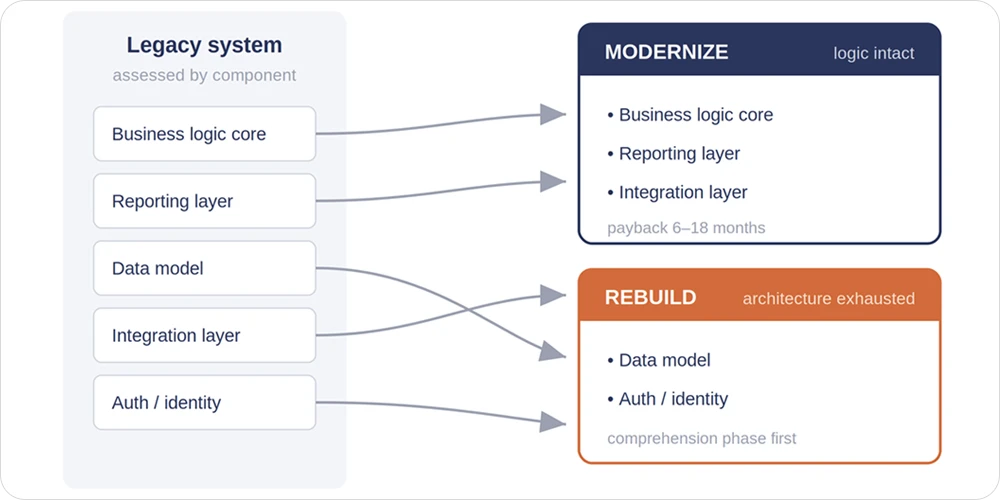
This is the decision Softwarium's dedicated development team model is built to fit. Softwarium's distributed engineering teams execute legacy modernization engagements as embedded co-managed delivery — working within the client's product team to rebuild incrementally without halting product development or compressing the existing team. The hybrid path needs engineers who have run both modernizations and rewrites, embedded closely enough to make the sequencing calls in real time rather than from a document.
The One Thing That Separates the Successes
The companies that handle legacy systems well make this a money decision from day one. The four signals tell you what kind of system you're dealing with. But the final call still depends on what your team can realistically pull off. If you're the one who has to make the decision, the best next step is to talk to engineers who have done both — modernized and rewritten — so they can tell you which fits your situation.
Talk it through with Softwarium's Head of Sales EMEA, Anna Moskalets
Evidence at a glance
| Source | Figure | What it supports |
|
Standish Group |
~70% rewrite failure / overrun rate |
Hidden complexity is the structural cause of rewrite failure |
|
Bayone / Nexa Devs 2025 |
Modernization payback 6–18 mo; rewrite 36–48 mo |
The financial argument for the board |
|
Gartner 2025 |
65% of 10+ yr systems lost original-developer knowledge |
Signal 4; comprehension phase prerequisite |
|
Forrester / Microsoft TEI |
Multi-million 3-yr benefit, returns depend on op-model change |
Modernization ROI case, with caveat |
|
Forrester 2025 |
~66% of global tech spend sustains legacy |
Cost of the status quo |