Hire Microsoft Developers
Microsoft AI agents are only as good as the .NET services, Azure data, Power BI reports, and Dynamics 365 records behind them. Softwarium engineers have delivered those systems for mission-critical industries. Hire Microsoft developers who build both the agent and the stack it runs on.
Azure Certified Engineers | Clutch: 5.0  |
25 years in software engineering

The Four-Layer Microsoft Agent Stack
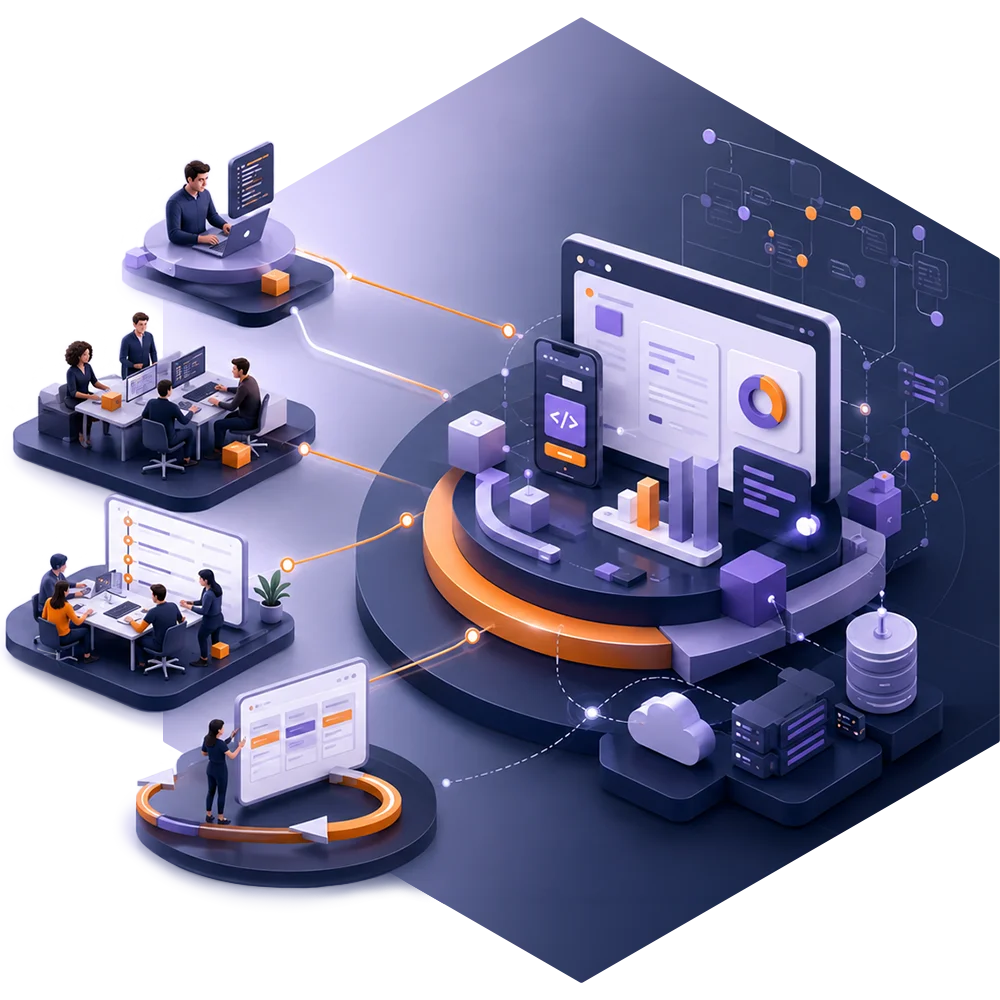
The Four-Layer Microsoft Agent Stack consists of the data layer, the agent layer, the runtime and governance layer, and the surface layer where employees use the agent in Teams or Microsoft 365 Copilot.
- 1

Data layer
SharePoint, Dynamics 365, Azure SQL, Azure Cosmos DB, and Azure Data Factory pipelines. These are the systems an agent reads from and writes to, and they hold the permissions that decide what each agent can see. Gaps in this layer surface later as incomplete or wrong agent answers.
- 2

Agent layer
Microsoft Agent Framework, which Microsoft describes as its open-source SDK and runtime for agents and multi-agent workflows across .NET and Python. Agents call models from Microsoft Foundry, formerly Azure AI Foundry, including Azure OpenAI models, and use tools that MCP servers expose.
- 3

Runtime and governance layer
Foundry Agent Service, which Microsoft describes as hosting agents with managed identity, scaling, session state, tracing, and evaluation. Microsoft Entra Agent ID gives each agent its own identity in Microsoft Entra.
- 4

Surface layer
Microsoft Teams, Microsoft 365 Copilot, and Copilot Studio agents and workflows. Employees meet the agent here, inside the tools they already use. Microsoft documents publishing from Foundry Agent Service to Teams and Microsoft 365 Copilot.
An AI agent on the Microsoft stack is only as useful as the SharePoint libraries, Dynamics 365 records, and Azure data pipelines it can reach with the right permissions.
Softwarium engineers have built data-layer systems for 25 years, including the Azure Data Factory integration behind HCM Dispatch and HCM Control for EnergyX and the Dynamics 365 migration for Synovos.
Hire AI Agent Developers for the Microsoft Stack
Microsoft Agent Framework gives .NET and Python teams one open-source SDK for single agents and multi-agent workflows, which makes experienced C# engineers direct builders of Microsoft AI agents.
C# depth matters on this stack because the same engineer builds the agent and the .NET service it calls, which keeps tool definitions, API contracts, and error handling consistent on both sides of the call. Softwarium staffs engineers for this work, and companies hire AI agent developers through the same engagement models that cover .NET and Azure. Microsoft covered Agent Framework updates at Microsoft Build in June 2026.




Hire .NET Developers
Softwarium staffs C# engineers for current .NET work: backend services, web APIs, and ASP.NET Core applications that run on Azure. Typical roles include backend engineers, API and integration engineers, and engineers who move .NET services into containers on Azure Kubernetes Service and Azure App Service.
Hire engineers who also modernize legacy .NET Framework applications and WCF services, bringing older codebases onto current .NET so newer systems, including AI agents, can call them through clean APIs. Softwarium also staffs engineers for automated testing and CI/CD pipelines for .NET services in Azure DevOps or GitHub Actions.
On agent projects, .NET engineers write the tool functions Microsoft Agent Framework calls, the APIs those tools wrap, and the tests that keep both stable after release. One C# team then covers the service layer and the agent layer of the same system, under one code review process.
Softwarium’s .NET delivery history includes a cross-platform application built with Xamarin. Microsoft ended Xamarin support in May 2024, which puts remaining Xamarin codebases on the modernization list alongside WCF services.
Hire Azure Developers
Softwarium’s team includes Azure Certified Engineers. Hire engineers who design Azure architectures, build data pipelines in Azure Data Factory, deploy services on Azure App Service and Kubernetes, and move databases to Azure Cosmos DB. Hire engineers for the operating side of Azure as well, including infrastructure as code, monitoring, cost control, and security configuration for services already in production.
Two delivered systems show that range.


Azure engagements cover new builds, monolith decomposition, and data integration, which are the same foundations the data layer of the Four-Layer Microsoft Agent Stack depends on. The same engineers prepare Azure data for agent workloads through consistent schemas, documented pipelines, and access rules an agent identity can inherit.
Hire Power Platform Developers: Power BI, Power Apps, Power Automate
Power BI developers at Softwarium have delivered dashboards and embedded reporting, including Excel to Power BI embedding and Power BI integration with data visualization. Power BI developers also connect reports to Azure data sources and set row-level security so each user sees only the data assigned to them.
Hire Power Platform developers who build Power Apps for internal processes on top of Dynamics 365, SharePoint, and Azure SQL data, and Power Automate flows that move approvals, documents, and records between those systems without manual re-entry. Hire developers who build Microsoft Teams apps that bring line-of-business data into the tool employees open every day.
Power Platform work that lasts depends on governance: separate environments for development, testing, and production, data loss prevention policies on connectors, and solutions moved between environments through deployment pipelines. Softwarium staffs engineers who set up that structure, so apps built by business teams reach production under IT control.
The same connectors serve the agent layer. Microsoft documents prebuilt and custom connectors as the way Copilot Studio agents reach other data sources. Hire developers who build custom connectors to line-of-business systems for Power Apps and Power Automate, and the connectors Copilot Studio agents use to reach the same systems.

Hire SharePoint and Microsoft 365 Developers
Softwarium’s SharePoint and Microsoft 365 delivery spans five documented projects: a SharePoint intranet with custom workflows, SharePoint OAuth authentication, connectors between enterprise content management systems, a SharePoint utility built from scratch, and a life science solution on SharePoint.
Hire developers who build SharePoint intranets, document workflows, and integrations with other content systems, and who migrate on-premises SharePoint Server content into Microsoft 365. The same engineers prepare a tenant for Microsoft 365 Copilot through clean metadata, consistent content types, and permissions that match who should see what.
SharePoint content feeds the agent layer directly. Microsoft’s roadmap lists SharePoint lists as a knowledge source for Copilot Studio agents, with general availability planned for September 2026. Hire developers who audit SharePoint permissions before a Copilot rollout and close the oversharing that permission gaps create.
Hire Dynamics 365 Developers
Softwarium migrated Synovos from Dynamics CRM 2011 to Dynamics 365 without disrupting business processes and continues to support customization. Companies that hire Microsoft Dynamics developers from Softwarium get engineers who cover the full arc of that work: data migration, customization, and support on the live system.
Hire engineers for plugins, custom tables, and integrations between Dynamics 365 and ERP or e-commerce systems. Hire developers who also build Power BI reports on Dynamics 365 data, so sales and service teams track the same records they work in.
Engagements range from a single Dynamics 365 developer on a client’s CRM team to a team that owns migration and support end to end. Dynamics 365 records sit in the data layer of the Four-Layer Microsoft Agent Stack, so clean CRM data and documented customizations carry directly into later agent projects.
How to Hire: Three Engagement Models
Every Softwarium engagement runs on one of three models, and each one covers .NET, Azure, Power Platform, SharePoint, Dynamics 365, and Microsoft AI agent work. The choice turns on two questions: who directs the day-to-day work, and who owns the outcome.
 IT Staff AugmentationIndividual Microsoft engineers join the client’s team and follow the client’s process, tools, and sprint cadence. The client directs the work day to day. Microsoft developer staff augmentation fits a backlog the in-house team owns and needs more engineers to clear. Companies that hire Microsoft developer capacity one role at a time start here.
 Dedicated Development Team / Co-Managed Engineering TeamA Softwarium team owns a defined scope, such as a product module, a platform migration, or an agent program, with shared control. The client sets direction and priorities, and the team runs delivery. A dedicated Microsoft development team fits work that needs several roles at once, such as .NET, Azure, and Power Platform engineers on one roadmap.
 Project-Based Engineering ContractingA defined deliverable with agreed scope and acceptance criteria, run as co-managed delivery. The model fits bounded work such as a .NET Framework migration, a Power BI rollout, or a first Copilot Studio agent.

Find the Model That Fits
in 30 Minutes
Anna Moskalets, Head of Digital Enhancement, walks through your Microsoft stack and scope and recommends the engagement model that matches it. Written requests can be submitted through the contact form.
Frequently Asked Questions
- How do I hire Microsoft developers through Softwarium?
Book a 30-minute call with Anna Moskalets, Head of Digital Enhancement, or send a request through the contact form. The call covers the Microsoft stack involved, including .NET, Azure, Power Platform, SharePoint, Dynamics 365, or Microsoft AI agents, the scope of work, and the engagement model: IT staff augmentation, a dedicated development team, or project-based engineering contracting. Softwarium then proposes engineers matched to that stack and scope.
- Can Softwarium developers build agents with Microsoft Agent Framework and Foundry Agent Service?
Softwarium staffs C# and Python engineers for Microsoft Agent Framework work: single-agent and multi-agent workflows, tool calling into existing .NET APIs, and deployment as hosted agents on Foundry Agent Service. Microsoft describes Agent Framework as its open-source SDK for agents and multi-agent workflows across .NET and Python. An engagement can also cover the .NET services, SharePoint content, and Dynamics 365 data the agent depends on.
- What does an AI agent need from our existing Microsoft systems?
An agent needs three things from existing systems: data it can retrieve, actions it can take, and permissions that limit both. Retrieval draws on SharePoint libraries, Dynamics 365 records, and Azure data stores. Actions run through APIs, connectors, or MCP servers that expose line-of-business systems. Permissions come from Microsoft Entra and the access rules already set on each source. An AI agent on the Microsoft stack is only as useful as the SharePoint libraries, Dynamics 365 records, and Azure data pipelines it can reach with the right permissions.
- What is the difference between Copilot Studio agents and custom agents built in code?
Copilot Studio agents are built in Microsoft’s low-code environment with declarative configuration, connectors, and MCP tools, and they publish to Teams and Microsoft 365 Copilot. Custom agents are written in C# or Python with Microsoft Agent Framework and run as hosted agents on Foundry Agent Service, where engineers control orchestration, tool logic, and evaluation. Copilot Studio fits workflows close to Microsoft 365. Custom code fits multi-agent logic and deep integration with .NET systems.
- Which engagement model fits a Microsoft AI project?
A first agent with a defined deliverable fits project-based engineering contracting: agreed scope, acceptance criteria, and co-managed delivery. A roadmap with several agents, plus the .NET, Power Platform, and Dynamics 365 work behind them, fits a dedicated Microsoft development team that owns that scope with shared control. When an in-house team already leads the AI work and needs specific skills, IT staff augmentation adds individual engineers to that team.
Book a Call: Microsoft Developers for Your Roadmap
Anna Moskalets, Head of Digital Enhancement
One 30-minute call covers your Microsoft stack, the scope of the work, and the engagement model that fits it. The discussion focuses on the questions that turn a roadmap item into a staffing plan for .NET, Azure, Power Platform, SharePoint, Dynamics 365, or agent work. Anna Moskalets, Head of Digital Enhancement, runs the call and confirms the next step before it ends.